


Blog
How to Hire Heavy Equipment Operators in Louisiana: 2025 Guide

Louisiana’s booming construction and industrial sectors are creating a surge in demand for skilled operators, making 2025 a pivotal year for companies aiming to hire heavy equipment operators in louisiana. The race for top talent is on, with workforce shortages threatening project timelines and safety standards across the state.
This guide cuts through the noise, giving you a clear, step-by-step roadmap to confidently navigate all aspects of hiring. You’ll discover what it takes to stay compliant, where to find the best candidates, how to screen and onboard them, and proven strategies to keep your team engaged. Let’s get started.
Understanding the Demand for Heavy Equipment Operators in Louisiana
Louisiana’s rapid economic expansion is rewriting the playbook for anyone looking to hire heavy equipment operators in louisiana. From Baton Rouge to Lake Charles, cranes dot the skyline, and backhoes churn through soil as new projects break ground. Local employers are caught in a race, competing for every certified operator available.
Industry Growth and Labor Shortages
Louisiana’s infrastructure, petrochemical, and commercial construction booms are driving the urgent need to hire heavy equipment operators in louisiana. According to the Louisiana Workforce Commission, job postings for operators have surged over 15% since 2023, with projections showing continued growth through 2025.
Labor shortages remain a real threat. Retirements, outmigration, and fierce competition from neighboring states are squeezing the available talent pool. As a result, delays and cost overruns have become common for projects unable to secure enough skilled operators.
Common Roles and Equipment Types
Employers who hire heavy equipment operators in louisiana need candidates skilled in multiple roles and machinery. The most sought-after positions include:
- Excavator Operators
- Bulldozer Operators
- Crane Operators
- Loader and Skid Steer Operators
Operators must master equipment such as backhoes, graders, forklifts, and specialized machinery used in refineries and industrial plants. Versatility is key, as projects often require cross-training on several types of equipment.
| Role | Typical Equipment Used |
|---|---|
| Excavator | Excavators, backhoes |
| Bulldozer | Bulldozers, graders |
| Crane | Mobile and tower cranes |
| Loader | Front-end loaders, skid steers |
Regional Hotspots and Project Trends
When you hire heavy equipment operators in louisiana, location matters. The highest demand clusters in:
- Baton Rouge (industrial and petrochemical complexes)
- New Orleans (urban infrastructure and levee projects)
- Lake Charles (energy and export terminals)
- Lafayette and Shreveport (regional construction)
Major projects ramping up in 2025—such as the Mississippi River bridge expansion and new LNG terminals—are expected to intensify competition for skilled operators in these regions.
Seasonal and Economic Factors
Hiring needs fluctuate with both the economy and the environment. Companies that hire heavy equipment operators in louisiana often ramp up recruitment leading into spring and summer, when weather is favorable and project schedules accelerate.
Hurricane season, from June to November, can abruptly shift priorities, requiring rapid mobilization for emergency repairs. Economic cycles, like fluctuations in oil prices, also directly impact operator demand and hiring strategies.
Competitive Landscape for Talent
To effectively hire heavy equipment operators in louisiana, you must outmaneuver competitors on pay, benefits, and culture. Average wages in 2025 range from $22 to $32 per hour, with leading employers offering health insurance, bonuses, and paid training.
Companies like CDR General Services and others set the pace by offering flexible shifts and recruiting bilingual operators to match Louisiana’s diverse workforce. For more on tailored talent solutions, explore industrial staffing solutions for Louisiana.
Success means acting fast, offering more, and building a reputation as a top employer among skilled operators.
Legal, Certification, and Safety Requirements in Louisiana
Navigating the legal landscape when you hire heavy equipment operators in louisiana is non-negotiable. Employers need a razor-sharp understanding of licensing, certifications, safety mandates, and compliance to keep projects running smoothly and avoid costly setbacks.
State and Federal Licensing Standards
To legally hire heavy equipment operators in louisiana, you must verify that each operator meets both state and federal requirements. Louisiana mandates specific licenses for certain equipment types, especially for crane and hoist operators. Federal OSHA guidelines also apply, requiring documented proof of operator competency.
Employers should maintain meticulous records of all licenses and certifications. Regular audits help ensure every operator remains compliant, reducing risk and demonstrating due diligence during inspections or legal challenges.
Required Training and Certifications
Heavy equipment operators in Louisiana are expected to hold recognized credentials. The most common are OSHA 10 or 30-hour cards and NCCER Heavy Equipment Operations certification. Many projects also require site-specific safety training.
Ongoing education is vital. Operators must stay current with evolving standards. Employers should encourage refresher courses, ensuring that every operator is up to date with the latest safety practices, equipment technologies, and regulatory changes.
Drug Testing and Background Checks
When you hire heavy equipment operators in louisiana, pre-employment drug testing and background checks are legally required. Louisiana law is clear: safety-sensitive roles demand a zero-tolerance approach to substance abuse.
Employers should partner with certified labs and use standardized screening procedures. Thorough background checks verify work history, criminal records, and driving violations. Consistent screening not only meets legal obligations but also protects your team and your reputation.
Insurance and Liability Considerations
Carrying proper insurance is non-negotiable when employing heavy equipment operators. Louisiana employers must provide workers’ compensation and adequate liability coverage. This protects against injuries, property damage, and litigation.
Risk mitigation goes further. Employers should conduct regular safety audits, maintain equipment logs, and enforce strict safety protocols. Proactive measures reduce the likelihood of claims and keep premiums in check.
Compliance Pitfalls to Avoid
Many firms underestimate the complexity of compliance when they hire heavy equipment operators in louisiana. Common mistakes include incomplete documentation, expired certifications, or gaps in drug testing records. These errors can trigger hefty fines or project shutdowns.
To streamline compliance, consider leveraging staffing solutions for Louisiana employers that specialize in operator vetting, credential tracking, and regulatory updates. Staying audit-ready is a strategic advantage in Louisiana’s competitive construction market.
Example: Recent Legal Changes Impacting Hiring
The regulatory landscape is always shifting. In 2024 and 2025, Louisiana implemented new rules impacting operator licensing and mandatory safety training. Employers now face stricter penalties for non-compliance and must adapt quickly to legislative updates.
Staying informed is critical when you hire heavy equipment operators in louisiana. Subscribe to state bulletins, attend compliance workshops, and consult legal experts to avoid costly surprises and keep your workforce fully authorized.
Step-by-Step Process to Hire Heavy Equipment Operators in Louisiana
Hiring top-tier talent is a high-stakes game in Louisiana’s construction and industrial markets. If you want to hire heavy equipment operators in louisiana who deliver safety, reliability, and efficiency, you need a bulletproof process. Follow these six steps to secure the best operators and stay ahead of the competition.
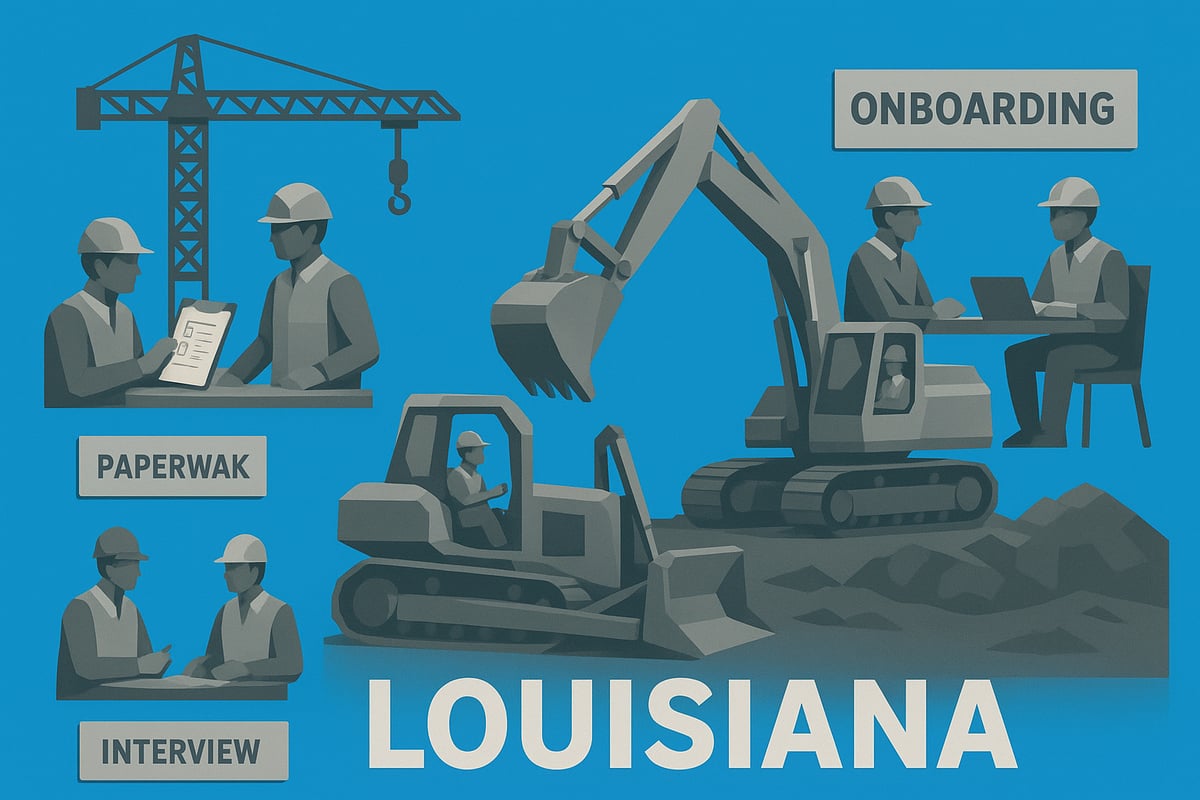
Step 1: Defining Job Requirements and Role Specifications
Start by outlining the exact needs of your project. To hire heavy equipment operators in louisiana successfully, clarity is king. Draft job descriptions that specify:
- Equipment types (excavators, bulldozers, cranes, loaders)
- Site conditions (urban, industrial, coastal, etc.)
- Shift patterns (day, night, rotating)
- Required certifications or licenses
Table: Entry-Level vs. Experienced Operator Requirements
| Requirement | Entry-Level Operator | Experienced Operator |
|---|---|---|
| Certification | Basic OSHA, NCCER intro | Advanced NCCER, specialty licenses |
| Experience | 0-2 years | 3+ years, complex projects |
| Equipment Mastery | 1-2 machine types | Multi-machine, advanced controls |
| Site Adaptability | Standard | High-risk, variable conditions |
Differentiate roles clearly so applicants know where they fit. This sets the tone for the entire process and attracts the right candidates. Remember, the more precise your requirements, the more likely you are to hire heavy equipment operators in louisiana who truly match your needs.
Step 2: Sourcing Candidates
Once you have your specs, it is time to fill the pipeline. To hire heavy equipment operators in louisiana, leverage every sourcing channel available:
- Post on online job boards (Indeed, ZipRecruiter, local classifieds)
- Partner with trade schools and vocational programs
- Tap into unions and local apprenticeship networks
- Attend Louisiana career fairs and industry expos
- Launch an employee referral program
For maximum reach and quality, consider working with construction staffing experts in Louisiana. They specialize in sourcing pre-vetted, safety-certified heavy equipment operators who understand local project demands.
Cast a wide net, but focus on quality. The right sourcing approach ensures you connect with operators who are ready to hit the ground running.
Step 3: Screening and Interviewing Applicants
Screening is where you separate contenders from pretenders. To hire heavy equipment operators in louisiana who meet your standards, use a rigorous process:
- Review certifications and verify credentials (OSHA, NCCER, local licenses)
- Assess work history and project types
- Administer practical skills tests on relevant equipment
- Conduct behavioral interviews with questions about safety, problem-solving, and reliability
- Check references and confirm employment dates
Look beyond technical skills. Seek out operators with a proven safety mindset and strong communication abilities. Red flags like frequent job changes or incomplete certifications should not be ignored. This diligence ensures you only move forward with top-tier candidates, making it easier to hire heavy equipment operators in louisiana who add real value.
Step 4: Making the Offer and Onboarding
When you find the right fit, move fast. Competitive offers are essential if you want to hire heavy equipment operators in louisiana who might be weighing multiple opportunities.
- Benchmark salaries for 2025 (typically $22–$32/hour based on experience and role)
- Offer robust benefits (health insurance, paid time off, bonuses)
- Provide a clear career path and advancement potential
Onboarding should be structured and safety-focused. Include:
- Site-specific safety orientation
- Hands-on equipment training
- Introduction to team members and mentors
A seamless onboarding process not only boosts productivity but also reinforces your company’s reputation as an employer of choice for operators looking to advance their careers in Louisiana.
Step 5: Retention Strategies for Long-Term Success
Hiring is just the start. To truly hire heavy equipment operators in louisiana and keep them, invest in retention from day one.
- Offer ongoing training and upskilling opportunities
- Recognize achievements with incentives and awards
- Foster a culture where safety and teamwork are non-negotiable
- Maintain open communication between operators and management
Retention is a marathon, not a sprint. Operators stay where they are valued, challenged, and see a future. Build a workplace that operators do not want to leave and you will minimize costly turnover.
Example: Successful Hiring Campaigns in Louisiana
Consider a recent campaign by a leading Louisiana contractor. Their goal was to hire heavy equipment operators in louisiana for a major infrastructure project with tight deadlines.
They started with detailed job specs and partnered with both local trade schools and a staffing agency. Practical skills tests weeded out underqualified applicants. The company made fast, competitive offers and launched a structured onboarding program with site-specific safety training.
The result? They filled every role on schedule, maintained a zero-incident safety record, and retained over 90 percent of new hires six months into the project. That is the power of a decisive, step-by-step approach when you need to hire heavy equipment operators in louisiana who deliver results.
[Partnering with a Specialized Staffing Agency: CDR General Services] (https://cdrgeneralservices.com/)
Finding the right talent to hire heavy equipment operators in louisiana is a serious challenge. The competition is fierce, project timelines are tight, and compliance requirements are non-negotiable. This is where a specialized staffing partner like CDR General Services steps in and tilts the odds in your favor.
![[Partnering with a Specialized Staffing Agency: CDR General Services] (https://cdrgeneralservices.com/)](https://xqvnmkjynbkcujcrtubi.supabase.co/storage/v1/object/public/article-images/36802f20-c768-4229-9303-3be3c10c500c/article-36802f20-c768-4229-930-low-poly-style-illustration-showing-a-diverse-team-3-3padvs.jpg)
Why Choose CDR General Services?
CDR General Services is the authority when you need to hire heavy equipment operators in louisiana. We do not just fill seats. We deliver operators who are safety-certified, drug-tested, and ready to hit the ground running. Our team specializes in sourcing bilingual and multicultural talent, reflecting the reality of Louisiana’s workforce. That means smoother communication, safer job sites, and higher productivity from day one.
- Bilingual (Spanish-English) operators for diverse teams
- Deep understanding of Louisiana’s industrial landscape
- Operators pre-vetted for safety, skills, and reliability
Regional Expertise, Faster Results
Our roots run deep in Louisiana, and that gives us an edge. We know the unique demands of Baton Rouge, New Orleans, and every parish in between. When you partner with CDR to hire heavy equipment operators in louisiana, you gain access to our network of local, pre-vetted professionals who know the equipment, the environment, and the culture.
We also handle all the paperwork. That includes certifications, background checks, and ongoing safety training. You get peace of mind, knowing your workforce is compliant and audit-ready.
Compliance and Retention, Handled
Staying compliant is not optional. CDR General Services manages every aspect of operator credentialing, drug testing, and insurance documentation. We keep your projects on track and out of trouble. Plus, we offer flexible staffing models, whether you need a single operator or an entire crew.
Looking to boost your team’s retention and engagement? Check out our proven employee retention strategies for 2025 to keep your operators long-term and reduce costly turnover.
Real Results: Rapid Staffing for Major Projects
Recently, a Louisiana contractor faced a critical shortage and needed to hire heavy equipment operators in louisiana on short notice for a major infrastructure project. CDR General Services mobilized a fully certified, bilingual team within days. The result? Zero downtime, full compliance, and a project delivered ahead of schedule.
Ready to get started? Contact CDR General Services for a custom consultation. We are the partner that delivers the right people, right now, every time.
Best Practices for Screening, Onboarding, and Retaining Heavy Equipment Operators
To successfully hire heavy equipment operators in louisiana, you need more than just a stack of resumes. The difference between a safe, productive crew and costly turnover comes down to your process. Here is how industry leaders approach screening, onboarding, and retention to build unbeatable teams.
Comprehensive Screening and Assessment
When you hire heavy equipment operators in louisiana, comprehensive screening is non-negotiable. Go beyond the resume. Start with practical skills tests—can your candidate operate an excavator or crane safely, efficiently, and under pressure? Use scenario-based evaluations to see how they handle real jobsite challenges.
Soft skills matter, too. Communication, teamwork, and problem solving directly impact safety and productivity. Red flags include gaps in work history, expired certifications, or evasive answers during interviews. Verify credentials against recognized training programs like the Heavy Equipment Operator Training at CLTCC to ensure candidates meet Louisiana’s standards.
Onboarding for Safety and Productivity
A structured onboarding process is essential when you hire heavy equipment operators in louisiana. Start with a mandatory safety orientation tailored to your site’s unique risks and protocols. This sets the tone for a safety-first culture from day one.
Pair new hires with experienced mentors. Peer support accelerates learning and builds loyalty. Integrate new operators into diverse teams quickly, so they feel included and engaged. Use hands-on equipment training and site walkthroughs to boost confidence and reduce accidents.
Building a Positive Work Environment
If you want to hire heavy equipment operators in louisiana and keep them, focus on your work environment. Foster inclusion and cultural competence—especially important for bilingual and multicultural crews. Simple gestures, like providing safety materials in multiple languages, go a long way.
Maintain open communication channels between operators and management. Regular team meetings and feedback sessions build trust and address issues before they escalate. A positive environment attracts top talent and encourages long-term commitment.
Retention and Engagement Strategies
Retaining skilled operators is as critical as hiring them. When you hire heavy equipment operators in louisiana, offer ongoing training and upskilling opportunities. Operators want to grow their careers, not just collect a paycheck.
Recognition and rewards matter. Celebrate safety milestones, performance, and years of service. Transparent feedback systems let employees know where they stand and how to advance. Monitor turnover rates closely and address root causes quickly to maintain a stable workforce.
Example: Retention statistics and what leading employers do differently.
Leading employers who hire heavy equipment operators in louisiana consistently outperform the competition. Retention rates above 80% are common when companies invest in continuous training, clear communication, and a culture of recognition.
For instance, some Louisiana contractors report a 20% reduction in turnover after launching mentorship programs and multilingual safety initiatives. The best in the business never settle—they analyze exit interviews, adapt strategies, and put people first. That is how you build a team that stays.
Navigating Challenges and Future Trends in Heavy Equipment Operator Hiring
Louisiana is at a crossroads: demand for skilled operators is climbing, but the landscape is shifting fast. If you want to hire heavy equipment operators in louisiana and stay ahead, you need to anticipate tomorrow’s workforce realities.
Addressing the Skilled Labor Gap
The competition to hire heavy equipment operators in louisiana is fierce. Baby boomers are retiring, and not enough young workers are entering the trades. Leading companies are solving this by partnering with trade schools and launching apprenticeship programs. For instance, the Heavy Construction Vehicle Operator Training at NLTCC prepares new operators with the skills employers need.
Employers are also:
- Offering signing bonuses and tuition reimbursement
- Hosting job fairs to attract local talent
- Collaborating with unions for steady pipelines
If you want to keep your projects staffed, investing in these partnerships is not optional—it’s essential.
Embracing Technology and Automation
Tech is transforming how you hire heavy equipment operators in louisiana. Telematics, GPS tracking, and automation are now standard on job sites. Operators must be comfortable with digital dashboards and remote controls, not just levers.
Top employers invest in:
- Regular tech upskilling workshops
- Cross-training operators on new equipment
- Incentives for tech adoption and certifications
Hiring for adaptability is as important as hiring for experience. Those who master both old-school skill and new-school tech will drive your projects forward.
Diversity, Equity, and Inclusion Initiatives
To hire heavy equipment operators in louisiana effectively, you must embrace the state’s multicultural workforce. Bilingual and multicultural teams are not just a trend—they are a competitive edge. Employers are building DEI programs that attract and retain Spanish-speaking and minority operators.
Best practices include:
- DEI training for all staff
- Clear anti-discrimination policies
- Recognition programs for inclusive teamwork
Whether your site is in Baton Rouge or New Orleans, fostering inclusion boosts safety, productivity, and loyalty.
Preparing for Regulatory and Market Changes
Staying compliant is non-negotiable when you hire heavy equipment operators in louisiana. Legislative updates for 2025 may impact certification and safety requirements. Smart employers stay ahead by monitoring policy changes and ensuring their workforce is always up to date.
Pro tips:
- Subscribe to industry alerts and state bulletins
- Conduct regular compliance audits
- Encourage ongoing certification, referencing resources like Heavy Equipment Operator Certification & License Requirements
By planning for change, you protect your bottom line and your team.
Frequently Asked Questions (FAQ)
Looking to hire heavy equipment operators in louisiana? Get answers to the most common employer questions on compliance, certifications, wages, and staffing solutions for 2025.
1. What legal requirements must employers meet when hiring operators in Louisiana?
Employers must verify state licensure, ensure operators hold up to date OSHA and NCCER certifications, and conduct drug and background checks. For water and wastewater roles, the Louisiana Operator Certification Program outlines specific mandates.
2. Which certifications are essential for heavy equipment operators?
Operators typically need OSHA 10 or 30, NCCER Heavy Equipment Operations, and site-specific safety credentials.
3. How can companies attract and retain top talent in a competitive market?
To hire heavy equipment operators in louisiana successfully, offer competitive pay, career growth, strong safety culture, and benefits. Partnering with a specialized staffing agency expands your reach.
4. What are the average wages for operators in Louisiana in 2025?
Operators in louisiana earn between $22 and $32 per hour, based on experience, location, and certifications.
5. Why use a staffing agency like CDR General Services?
CDR General Services handles screening, safety training, and delivers pre-vetted, bilingual talent, reducing your hiring risk and saving time.
6. What steps ensure ongoing safety and compliance?
Regular safety training, equipment maintenance, and strict adherence to OSHA guidelines are essential.
7. How important is hiring bilingual or Spanish-speaking operators?
Bilingual teams improve communication, safety, and productivity, especially in diverse louisiana worksites.
8. What can employers do to retain skilled operators?
Retention strategies include competitive pay, advancement paths, recognition programs, and fostering a positive work environment.
9. How do I get started with CDR General Services for my staffing needs?
Contact CDR General Services to discuss your requirements. Their team will build a tailored solution to help you hire heavy equipment operators in louisiana quickly and compliantly.