


Jobs Recruitment Agency: Your Complete 2026 Guide


Finding the right talent in 2026 demands more than posting job ads and hoping for the best. The competitive landscape requires strategic workforce solutions, specialized industry knowledge, and access to diverse talent pools that traditional hiring methods simply cannot deliver. A jobs recruitment agency serves as your strategic partner, bridging the gap between your urgent staffing needs and the skilled professionals who can drive your business forward. Whether you’re scaling operations in industrial sectors, construction sites, or maritime operations, understanding how recruitment agencies operate gives you a decisive advantage in building high-performing teams.
What Makes a Jobs Recruitment Agency Essential in 2026
The staffing landscape has transformed dramatically. Companies no longer have the luxury of time when projects demand immediate deployment of certified, safety-trained personnel.
A jobs recruitment agency operates as an extension of your HR department, maintaining ready-to-work talent pools and handling the entire recruitment lifecycle. From initial candidate sourcing through final placement, agencies manage screening, verification, certification compliance, and cultural fit assessment.
Key advantages include:
- Speed to deployment: Pre-vetted candidates ready within 24-48 hours
- Reduced hiring costs: Eliminate advertising, screening, and onboarding expenses
- Risk mitigation: Agencies handle compliance, insurance, and worker classification
- Scalability: Ramp up or down without long-term commitments
- Specialized expertise: Industry-specific knowledge and established talent networks
The staffing and recruitment industry continues experiencing significant growth, with AI automation projected to handle numerous recruitment tasks while human expertise remains irreplaceable for cultural competency and specialized placement.

The Strategic Value of Industry Specialization
Generic staffing firms cast wide nets. Elite agencies dominate specific sectors.
Industry specialization means your jobs recruitment agency understands the technical requirements, safety protocols, and certification standards unique to your field. When you need a certified welder who can pass rigorous maritime safety standards or a bilingual forklift operator for a diverse warehouse team, specialization makes the difference.
Agencies focused on industrial, construction, and maritime sectors maintain relationships with trade schools, certification bodies, and professional associations. This network access translates into higher-quality placements and reduced turnover rates.
How to Select the Right Jobs Recruitment Agency
Not all agencies deliver equal results. Your selection process determines whether you access top-tier talent or settle for mediocre placements.
Critical Evaluation Criteria
| Evaluation Factor | What to Assess | Red Flags |
|---|---|---|
| Industry Experience | Years serving your specific sector | Claims of “we do everything” |
| Safety Standards | Certification verification processes | Unclear safety protocols |
| Talent Pool Diversity | Access to bilingual and multicultural candidates | Limited demographic reach |
| Local Market Knowledge | Regional expertise and established presence | National firms with no local footprint |
| Response Time | Speed from request to qualified candidate | Vague timelines or slow communication |
Start by examining communication patterns and responsiveness. Selecting the right recruiting agency requires evaluating how agencies interact during initial consultations, revealing their operational efficiency and client commitment.
Questions Every Employer Must Ask
Before committing to any jobs recruitment agency partnership, demand clear answers to these essential questions:
- What is your average time-to-fill for positions similar to ours?
- How do you verify certifications and safety training?
- What is your candidate replacement guarantee?
- Do you provide bilingual or Spanish-speaking personnel?
- What percentage of your placements remain past 90 days?
- How do you handle worker’s compensation and liability insurance?
Agencies that hesitate or provide vague responses lack the operational rigor your business requires. Demand specifics, data, and verifiable track records.
The Gulf South region presents unique workforce challenges. An agency without established local networks cannot deliver the rapid deployment your projects demand. Understanding practical collaboration strategies ensures you maximize the partnership value.
Core Services Every Premium Jobs Recruitment Agency Provides
Understanding service offerings helps you leverage your agency partnership strategically.
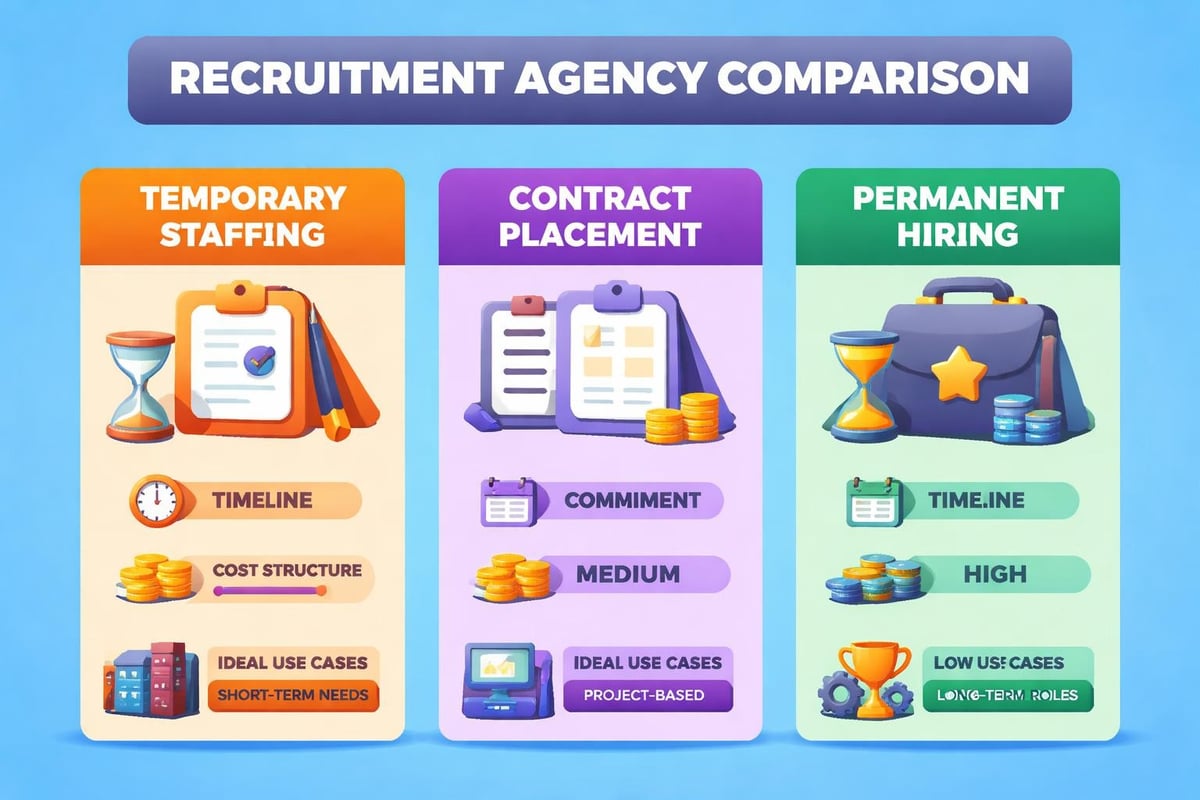
Temporary and Contract Staffing
Short-term projects, seasonal demand, and unexpected absences require flexible workforce solutions. Temporary staffing provides immediate access to skilled professionals without permanent commitments.
Contract staffing works ideally for:
- Project-based work: Construction builds, industrial maintenance shutdowns, maritime vessel repairs
- Seasonal peaks: Holiday logistics surges, summer construction season
- Trial periods: Evaluating candidates before permanent hiring decisions
- Specialized skills: Bringing in expert welders, electricians, or heavy equipment operators for specific tasks
Your jobs recruitment agency maintains benched talent ready for immediate deployment, eliminating the weeks or months traditional hiring requires.
Permanent Placement Solutions
When you need long-term team members, permanent placement services identify candidates seeking career opportunities rather than temporary assignments.
The agency handles:
- Comprehensive background checks
- Skills assessment and technical testing
- Cultural fit evaluation
- Salary negotiation
- Offer management and onboarding coordination
Most agencies provide guarantees ranging from 30 to 90 days, replacing candidates who don’t meet performance expectations at no additional cost.
Safety and Compliance Management
Industrial, construction, and maritime sectors operate under stringent safety regulations. Your jobs recruitment agency must ensure every candidate meets required certifications and training standards.
Essential safety verifications include:
- OSHA 10/30 hour certifications
- Equipment-specific operator licenses
- Industry certifications (welding, pipefitting, electrical)
- Drug screening and background checks
- Site-specific safety orientation completion
Agencies that cut corners on safety compliance expose your business to catastrophic liability. Demand documentation and verification processes before any placement.
The Competitive Advantage of Bilingual Workforce Access
The 2026 workforce demands cultural competency and communication excellence across diverse teams. This reality creates a decisive competitive advantage for employers who access bilingual talent pools.
Spanish-speaking personnel bridge communication gaps on job sites, improve safety compliance through clear instruction delivery, and enhance team cohesion across multicultural environments. Many industrial and construction projects throughout the Gulf South region require bilingual supervisors and workers who can seamlessly communicate across language barriers.
A jobs recruitment agency with specialized access to Latino talent networks provides capabilities competitors cannot match. This expertise transforms workforce challenges into strategic advantages, particularly in regions with significant Hispanic populations.
Measuring Cultural Competency in Staffing
| Capability | Standard Agency | Specialized Hispanic Staffing Agency |
|---|---|---|
| Spanish-speaking candidate pool | Limited, ad-hoc | Deep, established networks |
| Bilingual supervisor placement | Occasional | Core specialty |
| Cultural integration support | Minimal | Comprehensive |
| Communication training | Not provided | Included in placement |
| Community connections | Weak | Strong regional presence |
The difference between basic diversity hiring and authentic cultural competency staffing determines project success in increasingly diverse work environments.
Technology Integration in Modern Recruitment Services
While human expertise remains irreplaceable, AI integration in hiring processes enhances efficiency and candidate matching accuracy.
Leading agencies in 2026 leverage technology for:
- Candidate database management: Searchable skills, certifications, and availability tracking
- Automated compliance verification: Real-time certification status monitoring
- Predictive placement analytics: Matching algorithms based on historical success rates
- Mobile candidate engagement: Text-based communication and application processes
- Client portal access: Real-time visibility into candidate pipelines and placement status
Technology accelerates processes but never replaces the relationship-building and cultural assessment that experienced recruiters provide. The winning combination blends technological efficiency with human judgment.
Recent recruitment industry trends demonstrate how social media recruitment and programmatic job advertising complement traditional agency services, creating multi-channel talent acquisition strategies.
Regional Expertise and Local Market Knowledge
National staffing firms lack the boots-on-the-ground intelligence that regional specialists possess. Understanding local labor markets, wage expectations, competitor activity, and community connections directly impacts placement success.
A jobs recruitment agency serving the Gulf South region knows which trade schools produce the best welders, where certified pipefitters congregate, which communities have deep Latino talent pools, and how seasonal industries affect workforce availability.
The Gulf South Staffing Landscape
Louisiana, Mississippi, Alabama, and Kentucky present distinct workforce dynamics. Maritime operations dominate coastal regions. Industrial manufacturing anchors inland economies. Construction booms follow hurricane recovery cycles and infrastructure investment patterns.
Regional agencies maintain relationships with:
- Technical colleges and trade certification programs
- Community organizations and cultural centers
- Safety training providers and certification bodies
- Transportation networks for worker mobility
- Housing resources for temporary assignments
This local infrastructure enables rapid deployment that national firms cannot replicate. When a refinery shutdown requires 50 certified welders within 72 hours, regional expertise makes it happen.

Cost Structure and ROI Analysis
Understanding agency pricing models reveals the true value proposition versus internal recruitment costs.
Common Pricing Models
Temporary Staffing:
- Bill rate includes hourly wage plus agency markup (typically 30-50%)
- Markup covers payroll taxes, insurance, administrative costs, and profit margin
- Client pays only for hours worked
- No recruitment advertising or screening costs
Permanent Placement:
- Fee based on percentage of first-year salary (typically 15-25%)
- One-time payment upon successful placement
- Includes candidate search, screening, and guarantee period
- Eliminates internal recruiter salaries and job board fees
Contract-to-Hire:
- Temporary bill rate during trial period
- Conversion fee if hired permanently (reduced from full placement fee)
- Allows extended evaluation before commitment
Calculate true recruitment costs including:
- Internal recruiter salaries and benefits
- Job board subscriptions and advertising spend
- Applicant tracking system licenses
- Time-to-fill productivity losses
- New hire turnover and replacement costs
- Background check and drug screening fees
Most employers discover that a jobs recruitment agency delivers superior ROI, particularly for high-volume hiring or specialized skill requirements.
Maximizing Your Agency Partnership
Strategic partnerships require active engagement, not passive vendor relationships.
Best Practices for Employer Success
Provide detailed job specifications:
Don’t settle for generic job descriptions. Outline specific certifications, experience levels, equipment familiarity, and cultural requirements. The more precise your specifications, the better the candidate matches.
Communicate openly about challenges:
If placements aren’t meeting expectations, address issues immediately. Quality agencies want feedback to refine their search parameters and improve future placements.
Build relationships with your account team:
Knowing your dedicated recruiter by name, understanding their experience, and maintaining regular communication creates partnership rather than transaction.
Plan ahead when possible:
Emergency staffing requests happen, but providing advance notice for predictable needs allows deeper candidate vetting and better matches.
Offer competitive compensation:
Agencies place candidates where opportunities meet expectations. Below-market wages limit your access to top talent regardless of agency expertise.
Time-saving strategies for agency recruiters apply equally to employers, including building talent pipelines and maintaining ongoing communication even when immediate needs don’t exist.
Industry-Specific Staffing Solutions
Different sectors demand distinct expertise. Your jobs recruitment agency must demonstrate proven capability in your specific industry.
Industrial and Skilled Trades
Industrial facilities require certified professionals who understand complex equipment, safety protocols, and quality standards. Welders need specific certifications for pipe welding versus structural welding. Electricians require industrial versus residential specialization.
Key positions include:
- Certified welders (stick, MIG, TIG, pipe)
- Pipefitters and steamfitters
- Industrial electricians
- Millwrights and machinery mechanics
- Heavy equipment operators
- Instrumentation and controls technicians
Agencies must verify certifications, understand apprenticeship programs, and maintain relationships with trade unions when applicable.
Construction and General Labor
Construction staffing demands rapid scaling capabilities. Projects move from groundbreaking to completion in compressed timelines, requiring workforce flexibility.
Essential roles encompass:
- General laborers and helpers
- Carpenters and concrete finishers
- Equipment operators (excavators, loaders, cranes)
- Site supervisors and safety coordinators
- Skilled craftsmen across trades
- Cleanup and site preparation crews
Safety consciousness and reliability outweigh pure technical skills in many construction placements. A jobs recruitment agency must screen for work ethic and safety mindset, not just certifications.
Transportation and Logistics
Driver shortages continue plaguing the transportation sector in 2026. Qualified CDL drivers command premium compensation and selective job choices.
Critical positions include:
- Class A CDL drivers (long-haul, regional, local)
- Class B CDL drivers (delivery, dump trucks)
- Forklift operators (various certifications)
- Warehouse personnel and logistics coordinators
- Dispatchers and route planners
- Dock workers and material handlers
Agencies must verify CDL status, driving records, medical certifications, and equipment-specific experience. A driver with tanker experience differs fundamentally from flatbed hauling expertise.
Administrative and Clerical Support
Behind every successful industrial operation runs efficient administrative support. These positions require different screening approaches than skilled trades.
Key roles include:
- Project coordinators and schedulers
- Safety compliance administrators
- Payroll and HR support staff
- Purchasing and procurement specialists
- Customer service representatives
- Data entry and records management
Bilingual administrative support provides exceptional value, enabling seamless communication across diverse workforce populations and expanding customer service capabilities.
The Future of Jobs Recruitment Agencies
The staffing industry continues evolving rapidly. Staffing industry trends indicate increasing technology adoption while human relationships remain central to successful placements.
Emerging developments include:
- Skills-based hiring: Declining emphasis on formal degrees in favor of demonstrated competencies and certifications
- Remote staffing models: Geographic flexibility for administrative and technical positions
- Enhanced screening technology: Video interviews, skills assessments, and behavioral testing
- Gig economy integration: Blending traditional placement with flexible engagement models
- Enhanced diversity focus: Proactive multicultural recruiting beyond passive compliance
Agencies that embrace technological efficiency while maintaining cultural competency and personal relationships will dominate the next decade. Generic staffing firms will commoditize while specialized experts command premium positioning.
Building Long-Term Staffing Partnerships
Transactional vendor relationships waste opportunities. Strategic partnerships create competitive advantages.
When you identify a jobs recruitment agency that consistently delivers quality placements, understands your culture, and responds urgently to your needs, invest in that relationship. Preferred partner status often unlocks:
- Priority access to top candidates before wider market availability
- Customized screening protocols aligned with your specific requirements
- Dedicated account management and direct recruiter access
- Volume discounts and preferential pricing structures
- Proactive talent market intelligence and competitor insights
The strongest partnerships develop when agencies become embedded in your planning processes, understanding upcoming projects months before immediate needs arise. This foresight enables pipeline development and strategic candidate cultivation rather than reactive scrambling.
Regular performance reviews keep partnerships productive. Discuss placement success rates, time-to-fill metrics, retention statistics, and safety incident rates. Data-driven conversations reveal improvement opportunities and reinforce accountability.
Your agency should function as a true extension of your team, representing your employer brand with the same professionalism and standards you demand internally. When candidates experience respectful treatment, clear communication, and professional interaction with your agency, your employer reputation strengthens throughout the talent market.
The competitive landscape in 2026 demands strategic workforce solutions that combine speed, quality, and cultural competency. Finding a jobs recruitment agency with specialized industry expertise, proven safety standards, and access to diverse talent pools positions your organization for sustained success. Whether you need certified welders for industrial shutdowns, bilingual supervisors for construction sites, or reliable general labor for logistics operations, the right staffing partner transforms workforce challenges into competitive advantages. CDR General Services delivers industry-leading workforce solutions throughout the Gulf South region with unmatched expertise in Spanish-speaking personnel and bilingual staffing that bridges talent gaps competitors cannot close.