


Blog
Temporary Job Agencies: The Complete 2026 Guide


Temporary job agencies have fundamentally transformed how businesses access talent in 2026, evolving from simple placement services into strategic workforce partners. These specialized firms bridge the critical gap between employers who need flexible staffing and workers seeking immediate opportunities, particularly across industrial, construction, and administrative sectors. The staffing landscape has become increasingly sophisticated, with agencies providing not just bodies for positions but certified, safety-trained professionals ready to contribute from day one. Understanding how these agencies operate, their legal obligations, and their competitive advantages separates businesses that scale efficiently from those struggling with workforce gaps.
The Strategic Value Temporary Job Agencies Deliver
Temporary job agencies offer immediate access to pre-vetted talent pools without the overhead of traditional hiring. Companies facing seasonal demand spikes, project-based work, or unexpected absences benefit from agencies that maintain ready-to-deploy workers. The value proposition extends beyond simple placement.
Key advantages include:
- Speed to deployment: Workers available within 24-48 hours instead of weeks-long recruitment cycles
- Reduced hiring risk: Trial periods before permanent placement commitments
- Specialized expertise: Access to certified professionals like welders, electricians, and CDL drivers
- Administrative relief: Payroll, workers’ compensation, and benefits managed by the agency
- Scalability: Workforce expansion or contraction aligned with business cycles
For employers in Louisiana, Mississippi, Alabama, and Kentucky, regional temporary job agencies understand local labor markets, industry-specific safety requirements, and the talent landscape unique to the Gulf South. This geographic expertise ensures cultural fit and regulatory compliance that national agencies often miss.

How Modern Agencies Screen and Certify Workers
The screening process separates competent agencies from mediocre ones. Professional temporary job agencies implement multi-stage vetting that protects employers from liability and ensures quality. Background checks, drug screening, and skills assessments form the foundation.
| Screening Component | Purpose | Industry Application |
|---|---|---|
| Background checks | Criminal history, employment verification | All sectors, mandatory for sensitive sites |
| Drug testing | Safety compliance, liability protection | Construction, industrial, transportation |
| Skills certification | OSHA, welding certs, CDL verification | Specialized trades, equipment operation |
| Safety training | OSHA 10/30, confined space, fall protection | Construction, maritime, industrial facilities |
| Language proficiency | Communication effectiveness | Multicultural job sites, bilingual requirements |
CDR General Services demonstrates this comprehensive approach by ensuring every placed worker meets industry-specific safety certifications before assignment, eliminating the compliance burden from host employers.
Legal Responsibilities and Worker Protection Standards
Temporary job agencies operate under strict regulatory frameworks that protect both workers and employers. The U.S. Equal Employment Opportunity Commission mandates non-discrimination in all referral practices, holding agencies accountable for fair treatment across protected classes.
Safety regulations create joint employer responsibilities. OSHA guidelines for temporary workers establish clear obligations for both staffing agencies and host employers, covering:
- Worksite hazard communication
- Personal protective equipment provision
- Safety training specific to job tasks
- Incident reporting and recordkeeping
- Equal treatment with permanent employees
This dual responsibility model means temporary job agencies cannot simply place workers and walk away. The most reputable firms maintain ongoing safety oversight, conduct site visits, and ensure host employers uphold protection standards. OSHA’s recommended practices emphasize this collaborative approach.
Compliance Beyond Federal Mandates
State-level protections add additional layers. Jurisdictions establish specific requirements for temporary workers regarding payment terms, transportation, and equipment purchases. These regulations prevent exploitative practices and ensure workers receive fair treatment comparable to direct hires.
Professional agencies proactively address:
- Timely wage payment without illegal deductions
- Transparent fee structures without hidden charges
- Workers’ compensation coverage from day one
- Clear job descriptions matching actual assignments
- Anti-retaliation policies for safety complaints
Choosing temporary job agencies with demonstrated compliance records protects businesses from costly litigation and Department of Labor investigations that devastate operations and reputations.
Industrial and Construction Staffing Specialization
Generic temporary job agencies struggle in skilled trades placement because they lack industry knowledge. Specialized firms understand the difference between a 6G-certified welder and a basic MIG operator, or why a Class A CDL with hazmat endorsement commands premium rates.
The industrial sector demands workers who can step onto job sites without extensive orientation. Certified pipefitters, electricians, and heavy equipment operators require years of training and hands-on experience. Temporary job agencies serving construction and industrial clients maintain relationships with these professionals, creating talent pipelines unavailable through general staffing firms.

The Competitive Edge of Bilingual Workforce Solutions
The Gulf South’s diverse workforce creates both opportunities and communication challenges. Construction sites, manufacturing facilities, and maritime operations increasingly employ Spanish-speaking workers whose skills exceed language barriers. Temporary job agencies specializing in bilingual placement solve the productivity problems that language gaps create.
Bilingual staffing advantages include:
- Safety communication: Instructions, hazard warnings, and emergency procedures in workers’ native language
- Team cohesion: Reduced misunderstandings and faster project completion
- Supervisory efficiency: Bilingual foremen who bridge management and crew
- Cultural competence: Understanding work styles and expectations across cultures
- Expanded talent pools: Access to highly skilled workers overlooked by monolingual competitors
This specialization represents a decisive competitive advantage that generic temporary job agencies cannot replicate. Firms investing in culturally competent staffing deliver measurable productivity improvements and safety outcomes.
Transportation and Logistics Personnel Solutions
The transportation sector faces chronic driver shortages while regulatory requirements intensify. Temporary job agencies serving logistics operations must navigate CDL classifications, endorsement requirements, hours-of-service regulations, and drug testing protocols mandated by the Department of Transportation.
Quality agencies maintain pools of:
- Class A CDL drivers for tractor-trailers and combination vehicles
- Class B CDL operators for straight trucks, buses, and delivery vehicles
- Forklift certified personnel with OSHA-compliant training
- Warehouse workers experienced in inventory management and order fulfillment
- Logistics coordinators who understand supply chain operations
The temporary placement model works exceptionally well in transportation because seasonal demand, fluctuating freight volumes, and unexpected absences create unpredictable staffing needs. Companies maintain lean permanent teams while accessing surge capacity through agency relationships.
| Position Type | Typical Certification | Average Time-to-Fill | Critical Success Factor |
|---|---|---|---|
| Class A CDL Driver | CDL, Medical cert, Clean MVR | 5-7 days | Safety record verification |
| Forklift Operator | OSHA certification | 24-48 hours | Equipment-specific training |
| Warehouse Associate | Background check | 24-48 hours | Physical capability assessment |
| Logistics Coordinator | Industry experience | 7-10 days | Systems knowledge verification |
Understanding warehouse staffing dynamics helps businesses optimize their temporary workforce strategies while maintaining operational consistency.
Administrative and Professional Temporary Placements
Office environments benefit from temporary job agencies differently than industrial sites. Administrative positions require professionals who adapt quickly to systems, software, and organizational cultures. The skill sets span receptionist roles through specialized financial and managerial positions.
Common administrative placements include:
- Executive assistants supporting C-suite leadership
- Project coordinators managing cross-functional initiatives
- Accounting clerks handling accounts payable/receivable
- HR administrators processing onboarding and benefits
- Customer service representatives managing client relationships
These positions often convert to permanent employment after trial periods, making temporary placement a low-risk hiring strategy. Companies assess cultural fit, work quality, and team dynamics before committing to full-time offers. The agency absorbs initial employment costs and risks.
Evaluating Agency Performance and Partnership Value
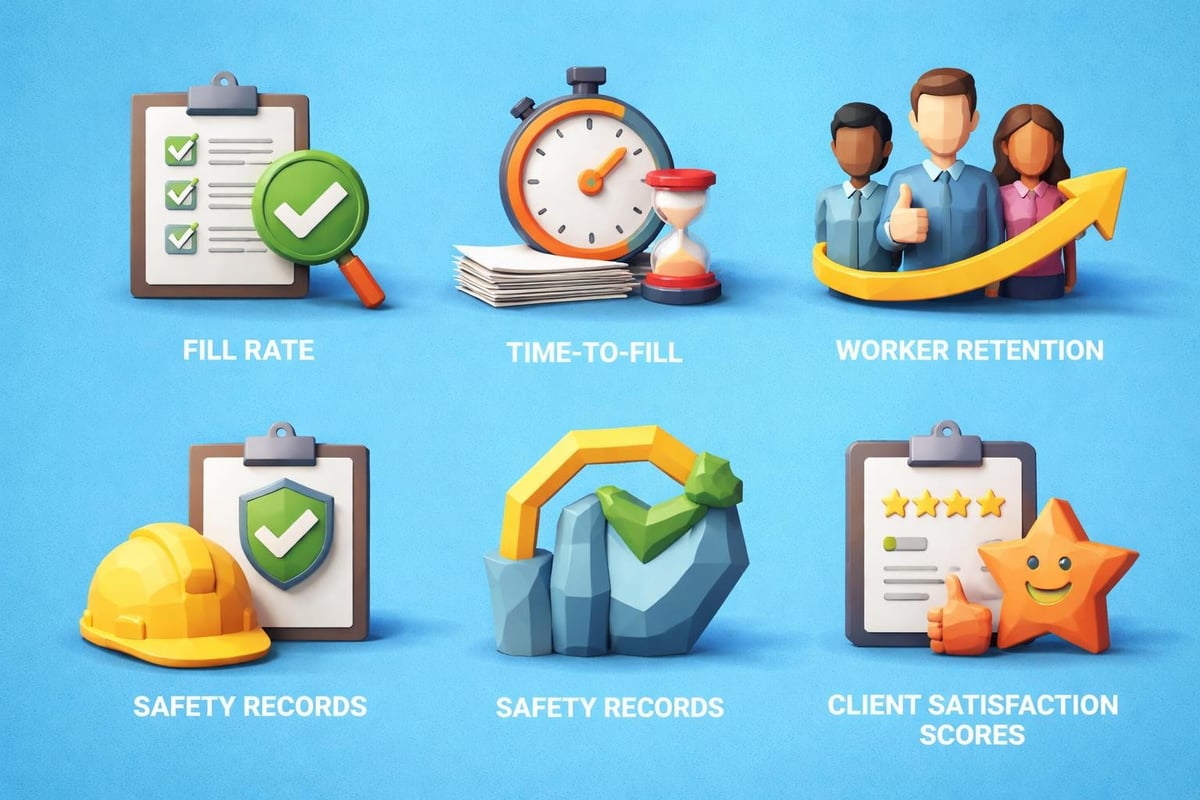
Not all temporary job agencies deliver equal value. Businesses must evaluate partners based on tangible metrics that impact operations. Response time, quality of candidates, retention rates, and safety records separate exceptional agencies from mediocre providers.
Evaluation criteria should include:
- Fill rate percentage: How many requisitions does the agency successfully complete?
- Time-to-fill average: Days from request to worker placement
- Retention beyond 90 days: Worker stability indicating good matches
- Safety incident rates: Frequency of workplace injuries among placed workers
- Client references: Testimonials from similar industry employers
- Geographic coverage: Ability to serve multiple locations consistently
Professional temporary job agencies provide transparent reporting on these metrics, demonstrating accountability and continuous improvement. Partnerships based on data-driven performance create predictable workforce solutions.
Cost Analysis and ROI of Temporary Staffing Solutions
The financial equation for temporary job agencies extends beyond hourly bill rates. Total cost of ownership includes recruitment advertising, interviewing time, background screening, onboarding, payroll administration, workers’ compensation insurance, unemployment insurance, and benefits. Agencies bundle these expenses into simplified billing.
Direct hire costs for a single industrial worker typically include:
- Job posting and advertising: $300-$800
- Recruiter time: 15-20 hours at loaded cost
- Background and drug screening: $100-$200
- Safety training and certification: $200-$500
- Onboarding administration: 8-10 hours
- Workers’ compensation insurance: 8-15% of wages
- Payroll taxes and administration: 12-15% of wages
Temporary job agencies absorb these costs, charging markup percentages that often prove more economical than internal recruitment, especially for short-term or project-based needs. The break-even point typically occurs at placements under six months duration.
Strategic Flexibility During Economic Uncertainty
The 2026 economic environment demands workforce agility. Temporary job agencies provide the flexibility to scale operations without permanent overhead commitments. When project pipelines strengthen, companies expand teams. When demand softens, they reduce temporary workers without layoffs affecting morale.
This scalability proves invaluable in cyclical industries like construction, where weather, permitting delays, and project completion create unpredictable labor demands. Maritime operations face similar variability with vessel arrivals, cargo volumes, and maintenance schedules. Personnel agencies specializing in these sectors understand the rhythm and maintain appropriate talent reserves.
Technology Integration and Workforce Management Systems
Modern temporary job agencies leverage technology that enhances placement accuracy and operational transparency. Applicant tracking systems, skills databases, and mobile credentialing platforms streamline the matching process. Employers benefit from real-time visibility into worker availability, certification status, and placement history.
Technology capabilities include:
- Mobile time-tracking: Workers clock in/out via smartphone apps
- Credential verification: Digital access to certifications and training records
- Automated compliance alerts: Expiration notifications for licenses and safety cards
- Performance dashboards: Real-time metrics on attendance, productivity, and quality
- Billing integration: Seamless invoicing connected to time-tracking data
These systems reduce administrative friction while improving accuracy. The best temporary job agencies invest continuously in technology that benefits both employers and workers, creating seamless experiences from requisition through payment.
Regional Expertise and Local Market Knowledge
National temporary job agencies offer breadth, but regional specialists provide depth. Understanding Louisiana’s petrochemical industry, Mississippi’s shipbuilding sector, Alabama’s automotive manufacturing, and Kentucky’s logistics hubs requires boots-on-the-ground presence and long-term relationships.
Local agencies know which technical schools produce quality welders, which communities have Spanish-speaking populations with construction experience, and which safety training providers meet industry standards. This intelligence creates faster placements with better cultural fit and higher retention rates.
The Gulf South region presents unique characteristics:
- Industrial density: Concentration of refineries, chemical plants, and manufacturing
- Maritime activity: Port operations, shipbuilding, and vessel maintenance
- Seasonal construction: Weather patterns affecting project timelines
- Multicultural workforce: Growing Latino populations with specialized skills
- Regulatory environment: State-specific safety and employment requirements
Temporary job agencies with deep regional roots navigate these factors instinctively, delivering superior results compared to firms parachuting in without local context. The knowledge compounds over years, creating competitive moats impossible for newcomers to replicate quickly.
Building Long-Term Strategic Partnerships
Transactional relationships with temporary job agencies yield transactional results. Strategic partnerships built on mutual accountability, transparent communication, and shared success metrics create sustainable competitive advantages. The best employer-agency relationships function as extensions of internal HR departments.
Partnership elements include:
- Dedicated account management: Single point of contact who understands your business
- Customized screening protocols: Tailored assessments matching your specific requirements
- Proactive talent pipelining: Anticipating needs before requisitions arrive
- Joint safety initiatives: Collaborative training and incident prevention programs
- Regular performance reviews: Quarterly assessments with continuous improvement focus
These relationships develop over time through consistent delivery, responsive problem-solving, and demonstrated commitment to employer success. Companies investing in agency partnerships access preferential treatment when skilled workers become scarce, gaining competitive positioning during tight labor markets.
The workforce landscape of 2026 rewards businesses that treat temporary job agencies as strategic partners rather than vendors. This mindset shift unlocks value beyond simple labor arbitrage, creating operational flexibility, risk mitigation, and access to specialized talent unavailable through traditional recruitment.
Navigating the complexities of temporary staffing requires partners who understand your industry, prioritize safety, and deliver certified professionals ready to contribute immediately. Whether you need bilingual construction crews, certified industrial tradespeople, or reliable warehouse personnel across the Gulf South, strategic staffing relationships create the workforce agility that drives competitive advantage. CDR General Services specializes in culturally competent, safety-certified staffing solutions that transform temporary placements into strategic workforce advantages for Louisiana, Mississippi, Alabama, and Kentucky employers.