


Blog
Direct Staffing: The Strategic Advantage for 2026


In today's competitive labor market, businesses need more than just temporary fixes. They need permanent solutions that deliver lasting value. Direct staffing has emerged as the gold standard for companies seeking to build stable, committed teams that drive sustained growth. Unlike temporary or contract arrangements, this approach focuses on identifying, recruiting, and placing candidates directly into permanent positions within your organization. It's the hiring strategy that separates forward-thinking companies from those perpetually chasing short-term staffing band-aids.
Understanding Direct Staffing and Its Strategic Value
Direct staffing represents a fundamental shift in how companies approach workforce development. This model involves partnering with specialized agencies to identify and place candidates directly onto your permanent payroll. The direct hire process eliminates the revolving door of temporary workers and creates a foundation for organizational stability.
The core distinction lies in commitment. When you implement direct staffing, you're not renting talent. You're acquiring it. This approach aligns perfectly with long-term business objectives, succession planning, and cultural development. Companies across the Gulf South region, particularly in Louisiana, Mississippi, Alabama, and Kentucky, are leveraging this strategy to combat the chronic challenges of high turnover and inconsistent workforce quality.
Key Components of Effective Direct Staffing
The direct staffing model operates on several critical principles that distinguish it from other hiring approaches:
- Permanent placement focus: Candidates are hired directly as full-time employees from day one
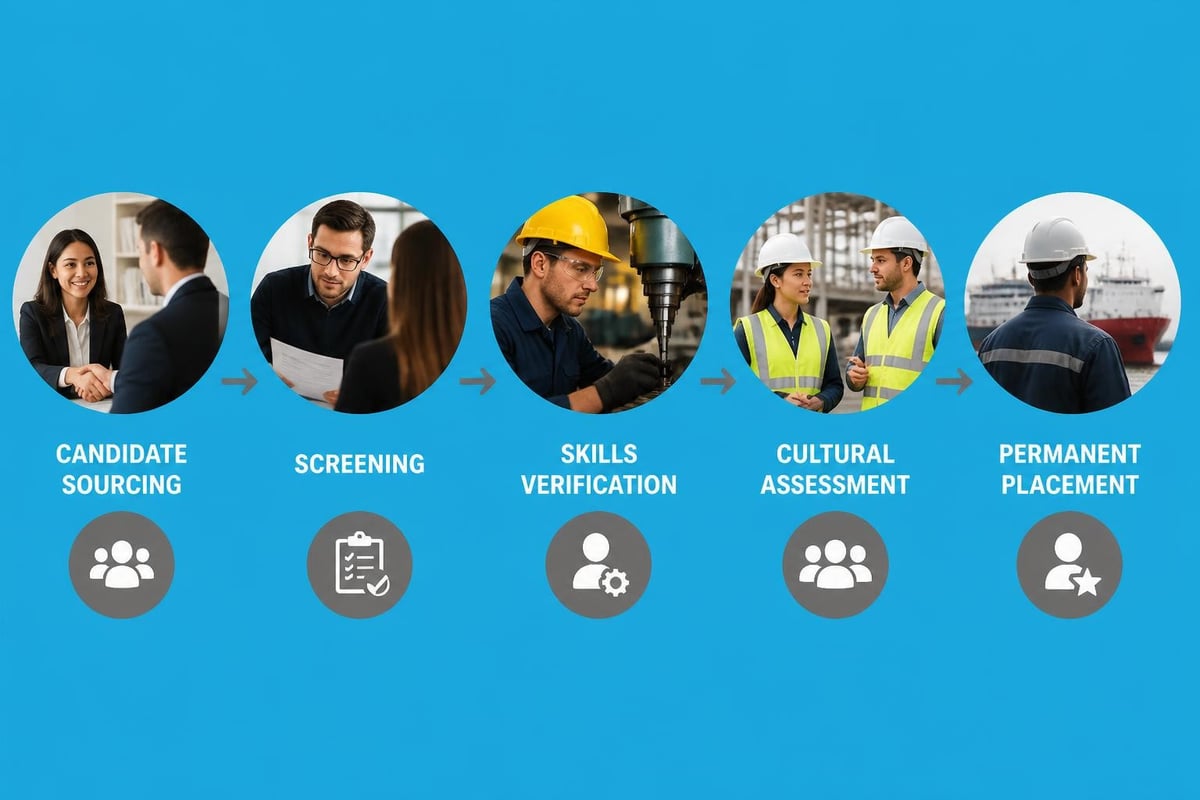
- Comprehensive vetting: Rigorous screening, background checks, and skill verification before placement
- Cultural alignment: Emphasis on finding candidates who match your company values and work environment
- Long-term ROI: Investment in employees who contribute to sustained organizational growth
- Reduced turnover costs: Elimination of repeated hiring cycles and associated expenses
A successful direct staffing strategy requires partnership with agencies that understand your industry's unique demands. In sectors like industrial manufacturing, construction, and maritime operations, this means working with specialists who comprehend safety certifications, technical skill requirements, and the operational realities of demanding work environments.
The Financial Advantage of Direct Staffing
Let's address the elephant in the room: cost. Direct staffing requires upfront investment, but the long-term financial benefits demolish any short-term savings from temporary solutions.
| Cost Factor | Temporary Staffing | Direct Staffing |
|---|---|---|
| Initial placement fee | Lower per placement | Higher one-time fee |
| Long-term retention | High turnover costs | Minimal replacement costs |
| Training investment | Repeated for each temp | One-time comprehensive training |
| Productivity trajectory | Plateaus quickly | Continuous improvement |
| Benefits administration | Variable complexity | Standardized, predictable |
| Cultural integration | Limited to none | Full team integration |
The numbers tell the story. According to industry research, replacing an employee costs approximately 33% of their annual salary. When you factor in recruitment expenses, lost productivity, and training time, the costs multiply rapidly. Direct staffing mitigates these expenses by reducing turnover rates from the outset.
Calculating Your Direct Staffing ROI
Consider a typical scenario in the industrial sector. A company hiring certified welders through temporary agencies might pay a 40-50% markup on hourly rates. Over a year, for a team of ten welders, this premium can exceed $200,000. Meanwhile, turnover creates additional costs through:
- Knowledge loss: Experienced workers leave before transferring critical expertise
- Safety incidents: New temporary workers lack site-specific safety knowledge
- Quality issues: Inconsistent workforce leads to variable workmanship
- Project delays: Time spent onboarding new temps disrupts schedules
- Team morale: Permanent employees disengage when surrounded by revolving temporary workers
Direct staffing eliminates these hidden costs while building institutional knowledge and team cohesion that compounds over time.
Building a Competitive Direct Staffing Strategy
The most successful companies don't just hire. They architect comprehensive direct sourcing best practices that position them as employers of choice in their markets.
Employer Branding in Direct Staffing
Your reputation precedes every hire. In sectors demanding specialized skills, particularly when seeking bilingual or Spanish-speaking talent in industrial and construction roles, employer branding becomes your competitive weapon.
Effective employer branding for direct staffing includes:
- Clear communication of career advancement opportunities
- Transparent safety records and commitment to worker welfare
- Competitive compensation structures with comprehensive benefits
- Cultural competency and genuine respect for diverse workforces
- Track record of employee development and internal promotion
Companies operating in the Gulf South must recognize the strategic advantage of accessing Spanish-speaking talent pools. The region's growing Latino workforce represents an untapped resource for businesses willing to invest in culturally competent direct staffing approaches.
Technology and Direct Staffing Success
Modern direct staffing leverages technology without losing the human element. Applicant tracking systems, skills assessment platforms, and data analytics identify qualified candidates faster while maintaining the personalized evaluation critical in skilled trades.

Technology enhances but doesn't replace human judgment. A certified pipefitter's technical credentials matter, but so does their communication style, safety mindset, and ability to collaborate across cultural and linguistic boundaries. The best direct staffing strategies combine digital efficiency with expert human assessment.
Direct Staffing vs. Contract-to-Hire: Making the Right Choice
Not every position demands the same hiring approach. Understanding when to deploy direct staffing versus alternative models separates strategic workforce planning from reactive hiring.
The comparison between direct hire and contract-to-hire reveals distinct use cases for each approach. However, for core operational roles, leadership positions, and specialized technical positions, direct staffing delivers superior results.
When Direct Staffing is Non-Negotiable
Certain scenarios demand the commitment and stability that only direct staffing provides:
- Safety-critical roles: Positions where consistent training and institutional knowledge prevent incidents
- Leadership and management: Roles requiring deep organizational understanding and long-term vision
- Specialized technical positions: Certified welders, electricians, pipefitters where expertise compounds over time
- Customer-facing representatives: Roles building relationships that drive repeat business
- Bilingual coordinators: Positions bridging communication across diverse teams
Contract-to-hire makes sense for:
- Project-based roles with defined end dates
- Positions where candidate fit remains uncertain
- Seasonal demand fluctuations
- Testing new organizational structures
The decisive factor is permanence. If you need someone building institutional knowledge, developing client relationships, or serving as a cultural anchor, direct staffing is the only logical choice.
Industry-Specific Direct Staffing Applications
Direct staffing strategies must adapt to sector-specific realities. What works for administrative hiring fails miserably in industrial environments.
Industrial and Manufacturing Direct Staffing
The industrial sector demands safety certifications, technical proficiency, and physical capability. Direct staffing in this space requires:
- Verification of certifications: OSHA credentials, equipment-specific licenses, trade certifications
- Hands-on skills assessment: Practical demonstrations, not just resume review
- Safety culture evaluation: Assessing candidate commitment to workplace safety protocols
- Physical capability testing: Ensuring candidates can perform demanding work sustainably
- Team integration assessment: Evaluating interpersonal skills and communication abilities
Spanish-speaking workforce integration presents a decisive competitive advantage in industrial direct staffing. Companies that build bilingual teams and provide culturally competent supervision access a talent pool their competitors ignore. This isn't about language preference. It's about operational excellence through inclusive workforce development.
Construction Direct Staffing Realities
Construction projects demand reliability, skill consistency, and team coordination. The advantages of direct hire staffing become even more pronounced in construction environments where:
- Project timelines leave no room for learning curves
- Safety incidents destroy profitability and reputation
- Skilled trades shortages create fierce competition for qualified workers
- Team chemistry impacts productivity as much as individual skill
| Position Type | Key Direct Staffing Criteria | Cultural Competency Factors |
|---|---|---|
| Certified Welders | AWS certifications, 3+ years experience, blueprint reading | Spanish technical terminology, bi-cultural supervision |
| Electricians | State licensing, commercial experience, safety record | Communication across language barriers, team integration |
| Heavy Equipment Operators | Equipment-specific certifications, site experience | Safety protocol comprehension, instruction clarity |
| Project Coordinators | Bilingual capability, construction knowledge, leadership | Cultural mediation, diverse team management |
Maritime and Logistics Direct Staffing
Maritime and transportation sectors face unique direct staffing challenges. CDL drivers, forklift operators, and warehouse personnel require specific licenses, clean driving records, and the ability to work in fast-paced, high-accountability environments.
Direct staffing for transportation roles prioritizes:
- License verification and driving record review
- Drug testing and ongoing screening compliance
- Route familiarity and local geography knowledge
- Customer service aptitude for client-facing roles
- Mechanical troubleshooting capabilities
The Gulf South's maritime industry particularly benefits from Spanish-speaking direct staffing. Port operations, vessel maintenance, and logistics coordination increasingly require bilingual capability to serve diverse client bases and workforce demographics.
Overcoming Direct Staffing Challenges
No hiring strategy is without obstacles. Direct staffing faces specific challenges that require proactive solutions.
Challenge 1: Time to Fill
Direct staffing typically requires longer recruitment timelines than temporary placements. The solution lies in pipeline development. Maintaining relationships with qualified candidates before positions open accelerates placement when needs arise.
Challenge 2: Competitive Market for Top Talent
Skilled trades professionals, particularly those with bilingual capabilities and safety certifications, field multiple offers. Your competitive edge emerges through:
- Transparent career advancement pathways
- Superior compensation and benefits packages
- Reputation for safety and employee development
- Cultural competency and inclusive work environments
Challenge 3: Assessment Accuracy
Evaluating technical skills, cultural fit, and long-term potential requires sophisticated assessment methodologies. This is where partnership with specialized staffing agencies delivers value through:
- Industry-specific expertise and evaluation frameworks
- Established candidate pipelines in specialized trades
- Bilingual recruiting capabilities for diverse talent pools
- Local market knowledge and compensation benchmarking
- Compliance expertise in safety certifications and licensing

Direct Staffing and Workforce Diversity
The future of direct staffing is multicultural, multilingual, and strategically inclusive. Companies that recognize this reality position themselves for sustained competitive advantage.
Diversity in direct staffing delivers measurable business benefits:
- Broader talent pools with reduced competition
- Enhanced problem-solving through diverse perspectives
- Improved client service across demographic segments
- Stronger employer brand in competitive markets
- Increased innovation and operational adaptability
The Gulf South's demographic evolution creates unprecedented opportunities for companies willing to invest in Spanish-speaking direct staffing. This isn't corporate social responsibility theater. It's strategic workforce development that addresses the skilled trades shortage through culturally competent talent acquisition.
Building Bilingual Direct Staffing Programs
Effective bilingual direct staffing requires more than translation services. It demands:
- Bilingual recruitment teams who understand cultural nuances and communication styles
- Spanish-language onboarding materials covering safety protocols, benefits, and company culture
- Bicultural supervisors who bridge communication and cultural expectations
- Career development pathways accessible regardless of language background
- Safety training delivered in native languages to ensure comprehension
Companies that excel in this space don't treat language as a barrier. They leverage it as a bridge to untapped talent and operational excellence.
Measuring Direct Staffing Success
You can't improve what you don't measure. Direct staffing success requires tracking specific metrics that reveal program effectiveness and ROI.
Critical Direct Staffing Metrics
| Metric | Target Range | Strategic Importance |
|---|---|---|
| Time to fill | 30-45 days | Balances speed with quality assessment |
| Quality of hire score | 85%+ | Measures long-term performance and fit |
| First-year retention | 90%+ | Validates selection and onboarding processes |
| Cost per hire | Industry benchmark -10% | Ensures competitive efficiency |
| Hiring manager satisfaction | 4.5/5.0+ | Reflects stakeholder alignment |
| Cultural fit rating | 85%+ | Predicts long-term integration success |
Advanced organizations track additional indicators:
- Promotion rates of direct hires versus other sources
- Performance review scores comparing hiring channels
- Safety incident rates by hiring method
- Supervisor feedback on team integration
- Employee engagement scores segmented by hire type
These metrics transform direct staffing from a transactional function into a strategic capability that drives organizational performance.
Frequently Asked Questions About Direct Staffing
What is direct staffing and how does it work?
Direct staffing is a permanent hiring approach where companies partner with specialized agencies to identify, screen, and place candidates directly onto their payroll as full-time employees. Unlike temporary or contract staffing, direct staffing focuses on long-term employment relationships. The process involves job requirement analysis, candidate sourcing, comprehensive screening, skills verification, and placement with ongoing support to ensure successful integration.
How does direct staffing differ from temporary staffing?
Direct staffing places candidates into permanent, full-time positions from day one, while temporary staffing provides workers for short-term assignments or project-based needs. Direct staffing involves higher upfront investment but delivers superior long-term ROI through reduced turnover, better cultural integration, and sustained productivity gains. Temporary staffing offers flexibility but lacks the commitment and institutional knowledge development that direct staffing provides.
What are the main benefits of direct staffing for employers?
Direct staffing delivers multiple strategic advantages: reduced long-term hiring costs through lower turnover, improved employee retention and loyalty, stronger cultural alignment and team cohesion, enhanced institutional knowledge development, better quality of hire through comprehensive screening, and predictable workforce planning. Companies also benefit from reduced administrative burden compared to managing temporary workers and contractors.
How much does direct staffing typically cost?
Direct staffing fees typically range from 15% to 25% of the hired employee's first-year salary, depending on position complexity, industry sector, and required skill level. While this represents higher upfront costs compared to temporary placements, the long-term ROI significantly exceeds initial investment through reduced turnover expenses, eliminated markup fees, and improved productivity. Specialized roles requiring certifications or bilingual capabilities may command premium fees reflecting market scarcity.
What industries benefit most from direct staffing?
Direct staffing delivers exceptional value in industries requiring specialized skills, safety certifications, and long-term institutional knowledge. Industrial manufacturing, construction, maritime operations, transportation and logistics, and skilled trades particularly benefit from this approach. Sectors with high safety requirements, technical complexity, or cultural competency needs see superior results through direct staffing compared to temporary or contract alternatives.
How long does the direct staffing process take?
Typical direct staffing timelines range from 30 to 45 days from position approval to candidate start date. This includes job requirement definition (3-5 days), candidate sourcing and screening (14-21 days), interviews and selection (7-10 days), background checks and verification (5-7 days), and offer acceptance and onboarding preparation (3-5 days). Complex or highly specialized roles may require extended timelines, while pre-developed talent pipelines can significantly accelerate placement.
What should I look for in a direct staffing agency partner?
Select agencies with deep industry expertise in your sector, proven track records in placing specialized roles, comprehensive screening and verification processes, cultural competency and diverse talent access, local market knowledge in your operating regions, and transparent communication and metrics reporting. For Gulf South operations, prioritize partners offering Spanish-speaking recruitment capabilities and bilingual workforce development expertise.
How can direct staffing help address skilled trades shortages?
Direct staffing addresses skilled trades shortages by accessing broader talent pools including underutilized demographics, providing competitive positioning as an employer of choice, developing talent pipelines before immediate needs arise, offering comprehensive onboarding that develops skills beyond baseline certifications, and creating retention-focused environments that reduce chronic turnover. Strategic direct staffing transforms talent scarcity from a crisis into a competitive advantage.
Why should I choose CDR General Services for direct staffing needs?
CDR General Services delivers unmatched direct staffing expertise across industrial, construction, and maritime sectors throughout the Gulf South. Our decisive competitive advantage is specialized access to highly-skilled Spanish-speaking talent and bilingual personnel that other agencies simply cannot provide. We combine safety-certified workforce solutions with culturally competent staffing that bridges communication gaps and drives productivity. Our deep local expertise in Louisiana, Mississippi, Alabama, and Kentucky ensures you access the most specialized, diverse, and accountable talent pool in the region.
How does bilingual direct staffing create competitive advantage?
Bilingual direct staffing unlocks talent pools competitors overlook, reduces recruitment timeline and costs through less competitive markets, enhances team communication and safety protocol comprehension, improves client service across diverse customer demographics, and strengthens employer brand in multicultural communities. In the Gulf South's evolving demographic landscape, Spanish-speaking direct staffing represents a strategic imperative for companies serious about sustained workforce excellence and operational performance.
Direct staffing represents the decisive hiring strategy for companies building sustainable competitive advantage through workforce excellence. The upfront investment in permanent placements delivers compounding returns through reduced turnover, enhanced productivity, and strengthened organizational culture. CDR General Services stands ready to deploy our industry-leading direct staffing expertise, unmatched Spanish-speaking talent access, and deep Gulf South regional knowledge to transform your workforce challenges into strategic advantages.