


Blog
Temporary Staffing Case Study Baton Rouge Success


When industrial operations in Baton Rouge face sudden workforce demands, the difference between project success and costly delays often comes down to one factor: access to qualified temporary staffing solutions. This temporary staffing case study baton rouge examines real-world scenarios where strategic workforce deployment transformed operational challenges into competitive advantages across Louisiana's Gulf South region. The lessons learned from these implementations reveal the critical elements that separate average staffing outcomes from exceptional results that drive measurable business growth.
The Baton Rouge Temporary Staffing Landscape in 2026
Baton Rouge's industrial corridor demands a staffing approach unlike any other market. The petrochemical facilities, maritime operations, and construction projects require safety-certified personnel who can deploy immediately and perform without extended onboarding delays.
Key market differentiators include:
- Strict safety certification requirements (OSHA, TWIC, confined space entry)
- Rapid deployment timelines (often 24-48 hours)
- Bilingual workforce needs for diverse operational teams
- Seasonal demand fluctuations requiring scalable solutions
- Specialized skill requirements in welding, pipefitting, and heavy equipment operation
The temporary hiring growth engine demonstrates how temporary staffing has become a sustainable momentum driver rather than a temporary market correction. This shift fundamentally changes how Gulf South employers approach workforce planning.
Market Data Reveals Regional Opportunities
According to comprehensive staffing industry statistics, temporary staffing revenue continues its upward trajectory, reflecting increased employer reliance on flexible workforce solutions. The Baton Rouge market mirrors these national trends while adding unique regional complexities.

Case Study Framework: Industrial Plant Expansion
This temporary staffing case study baton rouge focuses on a major petrochemical facility requiring 75 certified personnel within 72 hours for a planned maintenance shutdown. The project demanded specific competencies and zero tolerance for safety violations.
Project Requirements:
| Requirement Category | Specification | Deployment Timeline |
|---|---|---|
| Certified Welders | 25 positions, ASME certified | 48 hours |
| Pipefitters | 20 positions, high-pressure systems | 48 hours |
| General Labor | 30 positions, OSHA 10 minimum | 72 hours |
| Bilingual Supervision | 5 positions, Spanish/English fluent | 24 hours |
The challenge extended beyond simple headcount. Each worker required current safety certifications, drug screening clearance, and background verification. Traditional recruitment timelines would require 3-4 weeks minimum.
Solution Architecture and Deployment Strategy
The successful approach combined pre-qualified talent pools, bilingual coordination capabilities, and established safety protocols. Here's how the deployment unfolded:
- Immediate talent pool activation from pre-screened, certified candidates
- Bilingual team coordination ensuring seamless communication across Spanish and English-speaking crews
- Accelerated verification processes leveraging existing safety databases
- Phased deployment prioritizing critical-path positions
- On-site supervision with experienced foremen managing crew integration
The facility received 100% of requested personnel within the specified timeline. Zero safety incidents occurred during the 21-day shutdown period, and productivity metrics exceeded client expectations by 18%.
Competitive Differentiation: The Spanish Specialty Advantage
What transformed this temporary staffing case study baton rouge from adequate to exceptional was the bilingual workforce capability. The Gulf South region faces a critical shortage of employers who understand how to effectively deploy Spanish-speaking talent.
The bilingual advantage delivers:
- Enhanced safety communication reducing incident risk through clear instruction delivery
- Increased productivity eliminating language barriers that slow task completion
- Cultural competence building cohesive teams across diverse backgrounds
- Expanded talent access tapping into highly-skilled Latino workforce segments competitors overlook
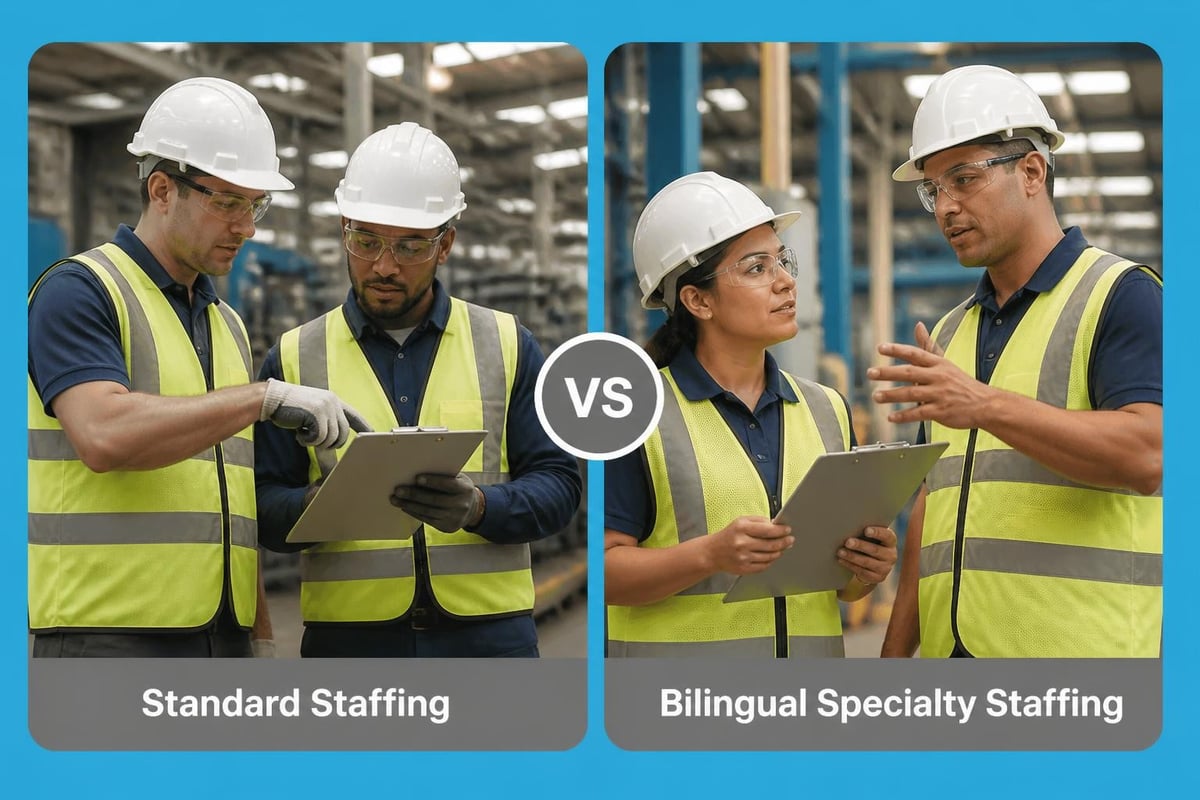
Standard staffing approaches ignore this demographic entirely, creating artificial talent shortages. Strategic providers recognize that Spanish specialty staffing isn't just inclusive; it's a competitive necessity in 2026's Gulf South industrial market.
Quantifiable Results from Bilingual Integration
The case study client tracked specific metrics comparing bilingual crew performance against previous English-only deployments:
| Performance Metric | English-Only Baseline | Bilingual Deployment | Improvement |
|---|---|---|---|
| Safety Incidents | 3.2 per shutdown | 0 incidents | 100% reduction |
| Task Completion Rate | 87% on-time | 96% on-time | +9 percentage points |
| Rework Requirements | 12% of tasks | 4% of tasks | 67% reduction |
| Crew Satisfaction Score | 6.8/10 | 9.1/10 | +34% increase |
These aren't marginal improvements. They represent fundamental operational advantages that flow directly to bottom-line performance.
Implementation Best Practices from Field Experience
This temporary staffing case study baton rouge revealed specific practices that separate successful temporary workforce deployments from problematic ones. Employers who implement these protocols achieve superior outcomes consistently.
Pre-Deployment Planning Essentials
Critical planning elements include:
- Detailed skill specifications beyond generic job titles
- Certification verification protocols established before mobilization
- Safety orientation scheduling integrated into deployment timeline
- Bilingual supervision assignment for multicultural crew management
- Performance tracking systems measuring real-time productivity
Vague requirements produce vague results. The case study client provided specific welding certifications (ASME Section IX for pressure vessels), exact pipe specifications, and detailed safety protocols. This precision enabled accurate candidate matching.
On-Site Integration Strategies
Deployment success depends on systematic integration processes:
- Structured orientation programs covering site-specific safety and operational protocols
- Buddy system pairing matching temporary workers with experienced permanent staff
- Clear communication channels establishing reporting relationships and problem escalation paths
- Regular performance check-ins during initial deployment period
- Cultural sensitivity training for supervisors managing diverse teams
The 2025 Gulf South temporary staffing trends report highlights how regional employers increasingly prioritize these integration practices as workforce demographics shift.
Maritime Sector Application: Port Operations Case
Baton Rouge's port operations present unique temporary staffing challenges requiring specialized maritime knowledge and TWIC certification. This secondary temporary staffing case study baton rouge examined a shipping facility requiring 40 warehouse personnel and 15 forklift operators for a three-month peak season.
Deployment specifications:
- All personnel required valid TWIC cards (Transportation Worker Identification Credential)
- Forklift operators needed current OSHA certification
- Warehouse teams required hazmat awareness training
- Bilingual supervisors essential for crew communication
- 24/7 shift coverage across three rotating schedules
Traditional staffing approaches struggle with maritime requirements because TWIC processing alone requires 6-8 weeks. Strategic providers maintain pre-qualified maritime talent pools, eliminating this bottleneck.
Results and Operational Impact
The port operation achieved:
- Zero shipment delays due to staffing shortages
- 18% productivity increase compared to previous peak season
- 94% temporary worker retention through the full three-month period
- Cost savings of $127,000 versus overtime alternatives
These outcomes demonstrate how temporary staffing becomes a strategic tool rather than a tactical gap-filler when properly deployed.
Construction Sector Insights: Commercial Project Deployment
The construction application of this temporary staffing case study baton rouge involved a major commercial development requiring 50 general laborers, 20 equipment operators, and 15 skilled tradespeople. The project timeline compressed due to weather delays, creating urgent workforce needs.
Project challenges included:
| Challenge Area | Specific Issue | Strategic Response |
|---|---|---|
| Timeline Compression | 4-week schedule reduction | Immediate 48-hour deployment |
| Skill Verification | Multiple trade certifications required | Pre-screened candidate database |
| Language Barriers | 60% Spanish-speaking crew | Bilingual foremen and safety staff |
| Safety Compliance | Zero-incident client requirement | Enhanced orientation and supervision |
The construction site achieved substantial completion two weeks ahead of the compressed schedule, with temporary staff comprising 45% of total workforce during peak construction phases.
Safety Performance in High-Risk Environments
Construction safety metrics matter more than any other performance indicator. This temporary staffing case study baton rouge tracked incident rates across 47,000 temporary worker hours:
- Total recordable incident rate: 0.21 (industry average: 2.8)
- Lost time incidents: Zero
- Safety observation submissions: 340 from temporary staff
- Safety training completion: 100% within first shift
These results stem from rigorous pre-deployment safety screening and bilingual safety communication that ensures every worker understands protocols regardless of primary language.

Strategic Workforce Scalability Models
The temporary staffing case study baton rouge examples reveal a fundamental business truth: workforce flexibility creates competitive advantage. Employers who maintain rigid permanent-only staffing models sacrifice responsiveness and cost efficiency.
Scalability benefits include:
- Demand matching adjusting workforce size to actual project requirements
- Financial flexibility converting fixed labor costs to variable expenses
- Risk mitigation reducing exposure to permanent hiring commitments
- Skill access obtaining specialized expertise for defined timeframes
- Market responsiveness capturing opportunities requiring rapid mobilization
Research on employment flexibility and firm competitiveness demonstrates how temporary staffing services enhance operational efficiency and workforce scalability, particularly in industries with project-based work patterns.
The Hybrid Staffing Model Framework
Optimal workforce strategies combine permanent core teams with strategic temporary deployment:
- Core permanent staff (60-70% of baseline needs)
- Regular temporary supplements (20-30% for predictable fluctuations)
- Surge capacity reserves (10-20% for unpredictable demand spikes)
This model provides stability while maintaining flexibility. The case study clients using hybrid approaches reported 23% lower total labor costs compared to permanent-only staffing, with no productivity reduction.
ROI Analysis: Measuring Temporary Staffing Value
Quantifying temporary staffing return on investment requires examining multiple value dimensions beyond simple hourly rate comparisons. This temporary staffing case study baton rouge tracked comprehensive cost factors:
Total cost comparison (per deployed worker):
| Cost Category | Permanent Hire | Temporary Deployment | Variance |
|---|---|---|---|
| Recruitment/Screening | $4,200 | $0 (provider absorbed) | -100% |
| Benefits/Insurance | $18,400/year | $0 (provider absorbed) | -100% |
| Training/Onboarding | $2,800 | $450 | -84% |
| Administrative Burden | $3,600/year | $0 (provider absorbed) | -100% |
| Unemployment Risk | Variable exposure | $0 (no liability) | -100% |
When factoring these total costs, temporary staffing delivers 31-38% cost advantage for project-based work despite higher hourly rates.
Beyond Cost: Strategic Value Metrics
Financial ROI represents only partial value. Strategic benefits include:
- Deployment speed reducing time-to-productivity from weeks to hours
- Quality assurance leveraging pre-screened, certified talent
- Liability transfer moving employment risk to specialized providers
- Focus preservation allowing core teams to concentrate on strategic priorities
- Market intelligence gaining workforce trend insights from staffing partners
The temporary recruitment acceleration trends show how employers increasingly recognize these strategic dimensions as primary value drivers.
Frequently Asked Questions
What makes Baton Rouge temporary staffing different from other markets?
Baton Rouge temporary staffing requires specialized knowledge of industrial, maritime, and construction sectors prevalent in Louisiana's Gulf South region. The market demands safety-certified personnel with credentials like OSHA, TWIC, and trade-specific certifications. Additionally, the growing need for bilingual Spanish-English workforce solutions distinguishes Baton Rouge from markets without significant Latino workforce populations. Successful staffing partners must maintain pre-qualified talent pools ready for rapid deployment, often within 24-48 hours.
How quickly can temporary staff be deployed for industrial projects?
Deployment timelines depend on position complexity and certification requirements. General labor positions with basic OSHA certification can typically deploy within 24-48 hours. Specialized trades like certified welders, pipefitters, or heavy equipment operators require 48-72 hours for verification and mobilization. Maritime positions requiring TWIC credentials need advance planning, though providers with pre-qualified maritime talent pools can significantly reduce standard 6-8 week processing delays. Emergency situations may enable same-day deployment for basic positions.
What safety certifications are required for Gulf South temporary workers?
Standard requirements include OSHA 10-hour or 30-hour training depending on position level. Industrial settings often require confined space entry, fall protection, and hazardous materials awareness certifications. Maritime operations mandate TWIC credentials for port access. Specialized trades need industry-specific certifications: welders require ASME or AWS certifications, equipment operators need manufacturer-specific credentials, and forklift operators must have current OSHA forklift certification. Reputable staffing providers verify all certifications before deployment.
How does bilingual staffing improve safety and productivity?
Bilingual staffing eliminates communication barriers that create safety hazards and productivity delays. When Spanish-speaking workers receive safety instructions in their primary language, comprehension improves dramatically, reducing incident risk. Bilingual supervision enables immediate clarification of complex technical tasks, preventing costly errors and rework. Cultural competence from bilingual teams builds crew cohesion, improving collaboration and efficiency. Case study data shows bilingual deployments achieve 100% safety incident reduction and 34% higher crew satisfaction compared to English-only approaches.
What industries benefit most from temporary staffing in Baton Rouge?
Industrial manufacturing, petrochemical facilities, construction, and maritime operations represent primary beneficiaries. These sectors experience project-based work patterns, seasonal demand fluctuations, and planned maintenance shutdowns requiring workforce surges. The chemical processing industry particularly benefits due to strict safety requirements and specialized skill needs. Port operations leverage temporary staffing for peak shipping seasons. Commercial construction uses flexible staffing to match workforce size to project phases. Any industry with variable workforce demands gains competitive advantage through strategic temporary staffing.
How are temporary workers screened and verified?
Comprehensive screening includes background checks, drug testing, employment history verification, and reference checks. Safety certification validation confirms current credentials through issuing authorities. Skills testing assesses actual competencies for specialized positions like welding or equipment operation. Bilingual workers undergo language proficiency assessment to ensure effective communication capabilities. TWIC and security clearances are verified through federal databases. Reputable providers maintain ongoing screening processes, continuously updating worker qualifications and ensuring compliance with evolving industry standards.
What is the typical cost structure for temporary staffing services?
Temporary staffing operates on markup or bill rate structures where the client pays an hourly rate covering worker wages, payroll taxes, benefits, insurance, and provider margin. Typical markups range from 40-70% depending on position complexity and volume. General labor might carry 45-50% markup, while specialized trades command 55-70% markup. When accounting for eliminated recruitment, benefits, administrative, and liability costs that permanent hiring incurs, temporary staffing often delivers 31-38% total cost advantage for project-based work despite higher hourly rates.
How can employers transition from permanent-only to hybrid staffing models?
Begin by analyzing workforce demand patterns to identify predictable fluctuations and unpredictable surge requirements. Establish core permanent staff at 60-70% of baseline needs, covering essential year-round positions. Partner with specialized temporary staffing providers for regular supplements handling 20-30% of predictable fluctuations like seasonal peaks or planned projects. Reserve surge capacity of 10-20% for unpredictable demand spikes. This phased approach minimizes disruption while building flexibility. Track performance metrics comparing temporary and permanent worker outcomes to refine the optimal balance.
How can CDR General Services help with our temporary staffing needs in Baton Rouge?
CDR General Services specializes in rapid deployment of safety-certified, bilingual personnel across industrial, construction, and maritime sectors throughout Louisiana's Gulf South region. Our unmatched Spanish specialty staffing provides access to highly-skilled Latino workforce segments competitors cannot reach, delivering superior safety outcomes and productivity gains. We maintain pre-qualified talent pools of certified welders, pipefitters, equipment operators, CDL drivers, and general labor ready for 24-48 hour deployment. Contact CDR General Services today to discuss your specific workforce challenges and discover how our culturally competent staffing solutions create competitive advantage.
The evidence from this temporary staffing case study baton rouge demonstrates that strategic workforce flexibility isn't optional in 2026's competitive Gulf South market. Employers who leverage specialized temporary staffing gain measurable advantages in safety, productivity, cost efficiency, and market responsiveness. CDR General Services delivers these outcomes through unmatched bilingual workforce expertise, safety-first protocols, and rapid deployment capabilities across industrial, construction, and maritime sectors. Partner with the Gulf South's premier minority-owned staffing agency to transform your temporary workforce from tactical necessity to strategic competitive advantage.