


Job Employment Agency: Your Complete 2026 Guide


The modern workforce landscape demands speed, specialization, and cultural competency. Employers face mounting pressure to fill critical roles with qualified, safety-certified personnel while maintaining compliance and controlling costs. A job employment agency serves as the strategic bridge between these workforce demands and business reality, delivering scalable talent solutions that internal HR teams simply cannot match. For industries like construction, industrial manufacturing, and maritime operations, the right agency partnership transforms hiring from a bottleneck into a competitive advantage.
What Makes a Job Employment Agency Essential in 2026
A job employment agency operates as a specialized intermediary that connects qualified candidates with employers who need their skills. Unlike internal recruitment, these agencies maintain vast talent networks, pre-vetted candidate pools, and industry-specific expertise that accelerates hiring timelines from months to days.
The value proposition is straightforward: speed, expertise, and risk mitigation. When a Gulf Coast refinery needs certified welders within 48 hours or a construction project requires a bilingual crew for seamless on-site communication, a specialized job employment agency delivers what generalist recruiting cannot.
Core Functions and Services
Modern agencies provide far more than simple resume matching. The comprehensive service model includes:
- Talent sourcing and pre-screening across multiple channels and communities
- Compliance verification including safety certifications, licenses, and work authorization
- Skills assessment and technical qualifications validation
- Payroll and benefits administration for temporary and contract workers
- Onboarding coordination and workplace integration support
- Ongoing performance management and candidate relationship maintenance

This end-to-end approach removes administrative burden from employers while ensuring every placement meets rigorous safety and competency standards. According to Bullhorn’s 2024 Talent Trends report, staffing firms are increasingly leveraging technology and specialized networks to meet evolving workforce expectations.
The Industrial Staffing Landscape: Specialized Expertise Required
Industrial, construction, and maritime sectors present unique staffing challenges that generic agencies cannot address. These industries demand technical certifications, safety compliance, physical capability assessments, and often bilingual communication skills.
A specialized job employment agency understands these requirements intimately. They know that a pipefitter position requires specific welding certifications, that construction sites need OSHA-trained personnel, and that maritime operations demand documented safety protocols.
Technical Skill Verification
| Role Category | Required Certifications | Typical Verification Timeline |
|---|---|---|
| Welders | AWS D1.1, 6G pipe certification, visual acuity test | 3-5 business days |
| CDL Drivers | Class A/B license, clean MVR, DOT physical | 2-4 business days |
| Electricians | Journeyman/Master license, NEC knowledge, safety training | 4-7 business days |
| Heavy Equipment Operators | Equipment-specific certifications, safety clearance | 3-5 business days |
This verification process protects employers from liability while ensuring project teams possess the competencies they claim. The EEOC provides comprehensive guidance on how anti-discrimination laws apply to employment agencies, establishing the legal framework these verifications must follow.
Safety-First Commitment
Industrial environments tolerate zero compromise on safety. Every placement carries potential liability, making safety certification non-negotiable. A qualified job employment agency maintains rigorous safety standards:
- Pre-placement safety screening including drug testing and background checks
- OSHA 10/30 certification verification for all construction and industrial placements
- Site-specific safety orientation coordination with client requirements
- Ongoing safety performance tracking and incident documentation
- Workers' compensation administration and claims management
This safety infrastructure transforms staffing from a transactional service into a strategic risk management partnership.
The Competitive Advantage of Cultural Competency
The Gulf South workforce is increasingly diverse, with Spanish-speaking talent representing a critical and growing segment. Yet most employers lack the infrastructure to effectively recruit, communicate with, and retain bilingual workers.
A job employment agency with specialized bilingual capabilities delivers immediate competitive advantage. This cultural competency encompasses:
Recruitment access to Latino talent networks that traditional channels never reach. These communities rely on trusted relationships and cultural understanding that generic job boards cannot provide.
Bilingual communication throughout the employment lifecycle, from initial interviews through daily job site coordination. This eliminates misunderstandings, improves safety compliance, and enhances productivity.
Cultural integration support that helps diverse teams collaborate effectively. When English and Spanish speakers work side-by-side with proper communication protocols, project outcomes improve measurably.
The practical impact is substantial. A construction project requiring 50 laborers can access a ready-to-work, safety-certified, Spanish-speaking crew within days rather than weeks. The right agency partnership doesn't just fill positions; it unlocks talent pools competitors cannot reach.
Compliance and Legal Framework: Non-Negotiable Standards
Employment agencies operate within a complex regulatory environment that demands expertise and vigilance. Compliance failures expose both the agency and client employers to significant legal and financial risk.
Regulatory Requirements
The legal obligations span multiple domains:
- Anti-discrimination compliance under Title VII, ADA, and ADEA requirements
- Wage and hour regulations including FLSA overtime, minimum wage, and record-keeping
- Work authorization verification through I-9 and E-Verify processes
- Workers' compensation insurance and proper employee classification
- Occupational safety standards under OSHA and industry-specific regulations
- Data privacy and security for candidate and employee information

Research from GOV.UK on employer awareness of right-to-work checks demonstrates the critical importance of proper eligibility verification processes, even though this study focuses on UK practices.
Joint Employer Liability Considerations
Recent regulatory developments have expanded joint employer liability, meaning client companies can be held responsible for agency workers' employment conditions. This makes agency selection a critical risk management decision.
A reputable job employment agency assumes primary employment responsibilities while ensuring clients maintain appropriate oversight without triggering joint employer status. This delicate balance requires legal expertise and operational discipline.
Temporary vs. Direct Placement: Matching Model to Need
Different workforce needs demand different engagement models. Understanding these distinctions enables strategic agency utilization.
Temporary Staffing Model
| Advantage | Business Application |
|---|---|
| Immediate scalability | Seasonal demand, project-based work, production surges |
| No long-term commitment | Testing candidates before permanent hire, uncertain project duration |
| Reduced administrative burden | Agency handles payroll, benefits, workers' comp |
| Flexibility in workforce size | Quick ramp-up and ramp-down based on business conditions |
Temporary placements work perfectly for construction projects with defined timelines, seasonal production increases, or filling gaps during employee leave.
Direct Placement Model
Direct hire placements suit permanent positions requiring long-term investment. The job employment agency conducts the entire search, screens candidates, and presents only qualified finalists. The employer makes the final decision and brings the candidate directly onto their payroll.
This model delivers:
- Access to passive candidates not actively job searching
- Reduced internal recruiting costs and time-to-fill metrics
- Professional screening and assessment expertise
- Market intelligence on compensation and availability
The financial structure typically involves a percentage of first-year salary, making it cost-effective for hard-to-fill professional and technical roles.
Temp-to-Hire: The Best of Both Models
Many employers leverage temp-to-hire arrangements that begin as temporary assignments with the option to convert to permanent employment. This "try before you buy" approach reduces hiring risk while giving candidates opportunity to demonstrate their fit.
For skilled trades positions like electricians or heavy equipment operators, temp-to-hire arrangements let employers evaluate technical competency and cultural fit under actual working conditions before making permanent commitments.
Industry-Specific Expertise: Gulf South Regional Knowledge
The Gulf South presents unique workforce dynamics that national staffing chains cannot navigate effectively. Regional expertise makes the difference between adequate service and strategic partnership.
A job employment agency focused on Louisiana, Mississippi, Alabama, and Kentucky understands:
- Local labor market conditions including wage expectations, skills availability, and competitive dynamics
- Regional safety requirements specific to Gulf Coast industrial operations
- Cultural composition of the workforce and community-specific recruitment channels
- Transportation and logistics challenges affecting worker availability and retention
- Industry concentrations in petrochemical, maritime, construction, and manufacturing sectors
This regional depth enables faster placements, better candidate quality, and lower turnover rates. When a maritime facility in Mobile needs certified welders or a construction project in Baton Rouge requires bilingual general laborers, local expertise delivers superior results.
The Recruitment Process Outsourcing (RPO) Alternative
Some organizations consider Recruitment Process Outsourcing (RPO) as an alternative to traditional staffing agencies. Understanding the distinction helps align workforce strategy with business needs.
RPO providers embed within the organization and manage the entire recruiting function, typically for permanent employees. They become an extension of HR, using the client's brand and systems.
Traditional staffing agencies maintain their own candidate pools, employment relationship, and infrastructure. They operate as external partners providing workers as needed.
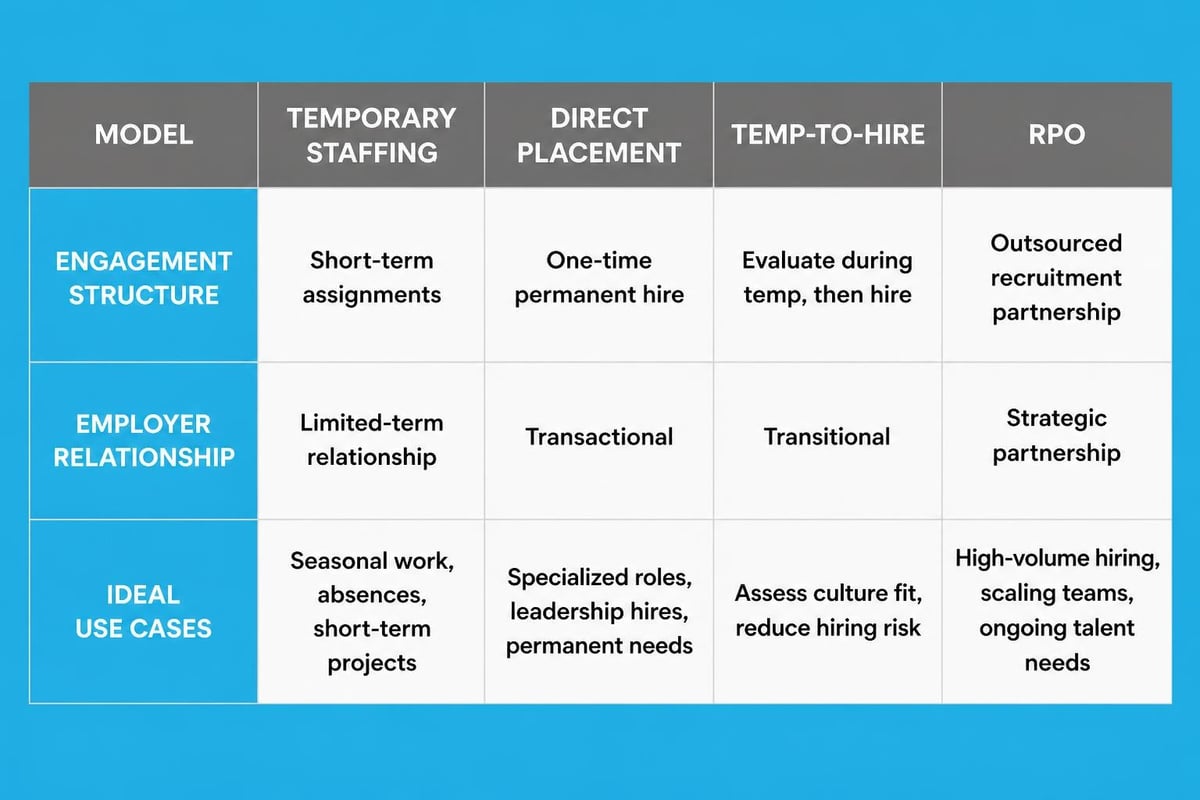
For industrial and construction operations requiring flexible, scalable workforce solutions with specialized skills, the traditional agency model delivers superior value. RPO makes sense for large corporations with high-volume permanent hiring needs and infrastructure to support embedded recruiting teams.
Evaluating Job Employment Agency Partners: Critical Selection Criteria
Selecting the right agency partnership requires rigorous evaluation across multiple dimensions. Not all agencies deliver equivalent value, and poor selection carries significant operational and legal risk.
Essential Evaluation Criteria
Industry specialization and technical expertise: Does the agency understand your sector's unique requirements, certifications, and safety standards? Generic agencies cannot deliver specialized industrial talent effectively.
Candidate pool quality and diversity: What talent networks does the agency access? Can they reach bilingual workers, specialized trades, and hard-to-find skill sets?
Compliance infrastructure and risk management: How does the agency ensure regulatory compliance, safety verification, and proper worker classification?
Speed and scalability: What are typical time-to-fill metrics for your role types? Can they scale quickly when project demands surge?
Technology and communication systems: Do they provide real-time reporting, digital onboarding, and mobile-friendly worker engagement?
Financial stability and insurance coverage: Is the agency properly capitalized with adequate liability and workers' compensation insurance?
References and reputation: What do current clients say about quality, reliability, and partnership approach?
Red Flags to Avoid
- Impossibly low pricing that suggests corner-cutting on compliance or candidate quality
- Lack of industry-specific expertise in your sector's technical requirements
- Poor communication responsiveness indicating operational deficiencies
- Inability to provide verifiable references from similar client engagements
- Vague compliance procedures or reluctance to discuss verification processes
- High candidate turnover rates suggesting poor screening or worker relations
The right agency becomes a strategic extension of your workforce management capability, not just a vendor filling requisitions.
Technology Integration and Modern Staffing Operations
Leading staffing agencies leverage technology to enhance service delivery, improve candidate experience, and provide clients with real-time visibility into workforce management.
Modern systems include:
- Applicant tracking systems (ATS) managing candidate pipelines and screening workflows
- Mobile onboarding platforms enabling digital document completion and verification
- Skills assessment tools providing objective evaluation of technical competencies
- Real-time reporting dashboards giving clients visibility into placements, hours, and performance
- Communication platforms facilitating multilingual engagement with diverse candidate populations
- Predictive analytics forecasting workforce needs and availability trends
This technology infrastructure transforms staffing from a manual, paper-intensive process into a data-driven strategic function. For bilingual workforce management, technology enables Spanish-language interfaces, translation services, and culturally appropriate communication workflows.
Frequently Asked Questions
What is a job employment agency and how does it work?
A job employment agency connects qualified workers with employers who need their skills. The agency recruits, screens, and verifies candidates, then places them in temporary, temp-to-hire, or permanent positions. The agency typically handles payroll, benefits, and compliance for temporary workers, while employers manage day-to-day work assignments.
How much does it cost to use a job employment agency?
Costs vary by engagement model. For temporary staffing, clients pay an hourly bill rate that includes the worker's wage plus the agency's markup covering payroll taxes, insurance, and service fees. Direct placement typically costs 15-25% of the candidate's first-year salary. Temp-to-hire combines both models with a conversion fee if the temporary worker becomes permanent.
What industries benefit most from job employment agencies?
Industries with fluctuating workforce needs, specialized skill requirements, or seasonal demand benefit most. Construction, industrial manufacturing, maritime operations, logistics, and warehousing rely heavily on staffing agencies. Any sector needing rapid scaling, safety-certified personnel, or bilingual workers gains significant advantage from specialized agency partnerships.
How quickly can a job employment agency fill open positions?
Specialized agencies with established talent pools can fill many positions within 24-48 hours for common roles like general laborers or forklift operators. Technical positions requiring specific certifications (welders, electricians, CDL drivers) typically fill within 3-7 business days. Timeline depends on role complexity, certification requirements, and current market availability.
What's the difference between a staffing agency and a recruitment agency?
The terms are often used interchangeably, but staffing agencies typically focus on temporary and contract workers who remain on the agency's payroll. Recruitment agencies traditionally specialize in permanent placements where candidates join the client's payroll directly. Many modern job employment agencies offer both services as comprehensive workforce solutions.
How do job employment agencies ensure worker safety and compliance?
Reputable agencies maintain rigorous verification processes including background checks, drug screening, safety certification validation, and license verification. They ensure OSHA compliance, provide safety training, maintain workers' compensation coverage, and implement ongoing performance monitoring. Compliance with EEOC anti-discrimination requirements is mandatory throughout the placement process.
Can a job employment agency provide bilingual or Spanish-speaking workers?
Specialized agencies with cultural competency and Latino talent networks can provide bilingual workers effectively. This requires recruitment infrastructure within Spanish-speaking communities, bilingual staff for communication, and culturally appropriate engagement practices. Not all agencies possess these capabilities, making specialization a critical selection criterion for diverse workforce needs.
What should I look for when selecting a job employment agency partner?
Prioritize industry-specific expertise, proven talent networks in your required skill sets, robust compliance infrastructure, and strong safety protocols. Evaluate their technology platforms, communication responsiveness, financial stability, and verifiable client references. For industrial sectors, ensure they understand technical certifications and can provide safety-certified, ready-to-work personnel.
How can CDR General Services help with my staffing needs?
CDR General Services specializes in industrial, construction, and maritime staffing throughout the Gulf South, with unmatched expertise in bilingual Spanish-speaking workforce solutions. We provide safety-certified welders, pipefitters, electricians, CDL drivers, and construction crews with the cultural competency and technical skills your projects demand. Contact CDR General Services to discuss your specific workforce requirements.
What are the benefits of using a local Gulf South job employment agency?
Local agencies understand regional labor markets, wage expectations, cultural dynamics, and industry concentrations. They maintain established relationships within communities, enabling faster recruitment of specialized talent. Regional expertise delivers better candidate quality, lower turnover, and deeper understanding of Gulf Coast industrial operations compared to national chains lacking local presence.
Do job employment agencies handle workers' compensation and payroll taxes?
For temporary and contract placements, yes. The agency serves as the employer of record, handling all payroll processing, tax withholding, unemployment insurance, and workers' compensation coverage. This removes significant administrative burden from client companies and ensures compliance with employment regulations. For direct placements, the client company assumes these responsibilities once the candidate joins their payroll.
Strategic workforce solutions demand specialized expertise, cultural competency, and unwavering commitment to safety and compliance. The right job employment agency partnership transforms hiring from a persistent challenge into a decisive competitive advantage. CDR General Services delivers industry-leading staffing solutions across industrial, construction, and maritime sectors throughout the Gulf South, with unmatched bilingual workforce expertise that bridges the talent gap for demanding projects. When you need safety-certified, ready-to-work personnel who communicate effectively and perform reliably, partner with CDR General Services for workforce solutions that simply work.