


Blog
Logistics Temp Agency: The Competitive Advantage for 2026


The logistics industry in 2026 faces unprecedented challenges: labor shortages, fluctuating demand cycles, and the relentless pressure to maintain operational efficiency while controlling costs. Businesses operating warehouses, distribution centers, and transportation networks need workforce solutions that adapt instantly to market conditions. That’s where a logistics temp agency becomes your decisive competitive advantage. The right staffing partner doesn’t just fill positions. It transforms how you scale operations, manage seasonal surges, and maintain the safety-certified, reliable workforce your business demands without the overhead that crushes your margins.
Why Businesses Partner with a Logistics Temp Agency
Traditional hiring models break down when demand shifts faster than your recruitment cycle. A logistics temp agency eliminates the lag time between identifying a staffing need and deploying qualified workers. This speed-to-deployment advantage keeps operations running while competitors scramble to post job ads and schedule interviews.
Cost control drives the partnership decision. When you hire permanent staff for temporary demand, you’re locking in long-term compensation, benefits, and overhead for short-term needs. Logistics staffing companies can help reduce recruitment costs by eliminating advertising expenses, background check fees, and the administrative burden of processing dozens of applications for positions that may only last weeks or months.
The True Cost of Understaffing
Consider what happens when your warehouse runs short-handed during peak season:
- Order fulfillment delays that damage customer relationships
- Mandatory overtime that inflates labor costs by 50% or more
- Safety incidents that increase when exhausted workers cut corners
- Employee burnout leading to permanent staff turnover
- Lost revenue from orders you simply cannot process
The financial impact compounds daily. A logistics temp agency prevents these cascading failures by maintaining a ready-to-deploy talent pool that scales with your actual demand, not your budget projections from six months ago.

Core Services a Logistics Temp Agency Provides
The warehouse floor, the loading dock, the transportation network. Each function requires specialized skills and certifications. A professional logistics temp agency maintains personnel across every operational category your business needs.
| Staffing Category | Typical Roles | Key Certifications |
|---|---|---|
| Warehouse Operations | Forklift operators, pickers, packers, inventory specialists | OSHA safety training, forklift certification |
| Transportation | CDL Class A & B drivers, delivery drivers, route coordinators | Valid CDL, DOT physical, clean driving record |
| Material Handling | Load specialists, shipping/receiving clerks, dock workers | Material handling equipment certification |
| Quality Control | Inspectors, compliance specialists, inventory auditors | Industry-specific quality certifications |
| Administrative | Dispatchers, warehouse supervisors, logistics coordinators | Management experience, software proficiency |
Forklift Operators and Material Handling Specialists
Your distribution center runs on material handling equipment. Every forklift operator must hold valid certifications and demonstrate operational competency. A logistics temp agency pre-screens candidates, verifies certifications, and ensures every worker meets OSHA standards before stepping onto your warehouse floor.
The alternative? You conduct your own certification verification, schedule equipment testing, and assume liability for unqualified operators. The agency handles this entire process, delivering only workers who can start productive work immediately.
CDL Drivers and Transportation Personnel
Transportation staffing demands even stricter compliance. How temp staffing helps solve supply chain bottlenecks becomes evident when you need qualified CDL drivers without the 3-6 week hiring timeline. Licensed Class A and Class B drivers with clean driving records, current DOT physicals, and documented safety histories become available within days, not months.
The Gulf South region, spanning Louisiana, Mississippi, Alabama, and Kentucky, presents unique logistical challenges. Regional expertise matters. A logistics temp agency with deep local market knowledge understands the specific requirements, traffic patterns, and regulatory environment of your operating territory.
The Competitive Advantage of Bilingual Logistics Staffing
Here’s the reality nobody else wants to discuss: workforce diversity isn’t just about compliance or optics. It’s about accessing the largest possible talent pool and matching your workforce demographics to the communities you serve and the projects you execute.
The Spanish-speaking workforce represents a massive, underutilized talent reservoir in the logistics industry. When your logistics temp agency can provide bilingual forklift operators, warehouse supervisors, and transportation personnel, you unlock operational advantages competitors cannot match:
- Expanded talent access during critical labor shortages
- Enhanced team communication in multicultural work environments
- Improved safety outcomes when training and procedures reach every worker in their native language
- Faster problem resolution when supervisors and workers communicate without language barriers
- Cultural competency that increases retention and team cohesion
This isn’t theoretical. In 2026, businesses operating in the Gulf South region face documented labor shortages across skilled trades and logistics positions. The company that can field bilingual teams, provide culturally competent supervision, and communicate safety protocols in both English and Spanish gains an insurmountable competitive edge.
Peak Season Management and Demand Surge Response
The fourth quarter crushes logistics operations. E-commerce peak season, holiday retail demand, and end-of-year inventory pushes create staffing requirements that can triple normal headcount. Your options: scramble to hire temporary workers yourself, force existing staff into unsustainable overtime, or partner with a logistics temp agency that planned for this surge months ago.
Strategic Workforce Planning
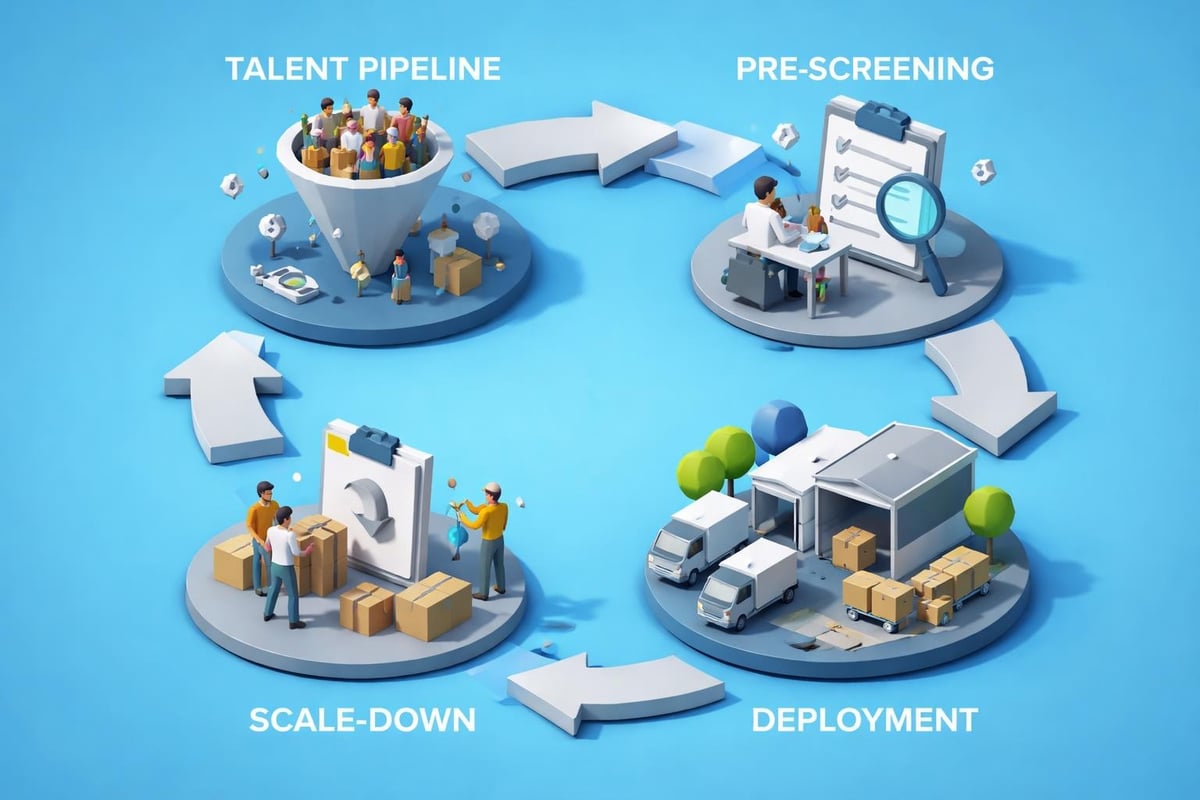
Smart operators don’t wait until November to address December demand. A logistics temp agency builds relationships throughout the year, maintaining contact with qualified workers who want seasonal opportunities. When you activate your peak season staffing plan, the agency deploys teams already vetted, trained, and ready.
Pre-season preparation separates average agencies from industry leaders:
- Talent pipeline development starting in Q2
- Pre-screening and certification verification before peak demand
- On-site safety orientation scheduled in advance
- Flexible staffing agreements that scale with actual order volume
- Backup personnel identified for immediate deployment if initial teams underperform
The logistics company that treats temporary staffing as a strategic planning component, not an emergency response, maintains service levels while competitors fail.
Safety Compliance and Risk Management
Every worker on your site represents potential liability. One safety incident can trigger OSHA investigations, workers’ compensation claims, and lawsuits that dwarf any staffing cost savings. A professional logistics temp agency assumes significant portions of this risk through comprehensive safety programs and insurance coverage.
The Agency Safety Responsibility
When temporary workers operate under agency employment, the agency typically maintains:
- Workers’ compensation insurance covering on-the-job injuries
- General liability coverage for property damage and third-party claims
- Employment practices liability protecting against discrimination claims
- Background screening identifying candidates with concerning safety histories
- Drug testing programs ensuring only sober workers access your facility
This risk transfer matters. You maintain safety control over your operations while the agency handles the administrative burden and legal exposure of being the employer of record. Best practices in logistics emphasize flexible staffing arrangements that maintain safety standards while adapting to demand fluctuations.
| Risk Category | Your Direct Hire | Agency Temporary Staff |
|---|---|---|
| Workers’ Comp Claims | Your policy, your rates | Agency policy and rates |
| Unemployment Claims | Your account charged | Agency account charged |
| Payroll Tax Admin | Your responsibility | Agency responsibility |
| Background Checks | Your cost and liability | Agency cost and liability |
| Safety Training | Your program and cost | Often included in agency service |
Quality and Performance Management Systems
Sending bodies to fill positions isn’t staffing. It’s desperation. A legitimate logistics temp agency implements performance management systems that ensure temporary workers meet the same productivity and quality standards as your permanent staff.
Performance Metrics and Accountability
Establish clear expectations before the first worker arrives:
- Productivity benchmarks measured against your permanent staff baselines
- Quality standards with acceptable error rates defined upfront
- Attendance requirements with consequences for no-shows or tardiness
- Safety compliance with immediate removal for violations
- Supervisor feedback systems allowing real-time performance reporting
The agency relationship must include accountability mechanisms. When a temporary worker underperforms, the agency provides immediate replacement at no additional cost. This performance guarantee separates professional staffing partners from labor brokers who vanish after collecting placement fees.
Long-Term Partnership Benefits and Strategic Value
The smartest logistics operators view temporary staffing as a permanent strategic capability, not an emergency option. This mindset shift creates compounding advantages over time.
Try-before-you-hire talent evaluation eliminates bad hiring decisions. When you identify exceptional temporary workers, you can offer permanent positions knowing exactly what you’re getting. This extended interview period reduces turnover among permanent hires by 40% or more compared to traditional hiring processes.
The agency becomes an extension of your HR department. They understand your culture, your quality standards, your equipment, and your expectations. This institutional knowledge means better candidate matching and faster onboarding with each engagement.
Building the Strategic Staffing Relationship
Year one with a logistics temp agency focuses on establishing processes and proving the concept. Year two and beyond deliver the real competitive advantage:
- Priority access to the agency’s best workers during tight labor markets
- Customized safety training specific to your facility and equipment
- Dedicated account management with a single point of contact who knows your business
- Predictive staffing models based on your historical demand patterns
- Cost optimization through volume discounts and streamlined processes
Companies that treat their staffing agency as a strategic partner, not a vendor, gain preferential treatment when labor markets tighten. The agency deploys their best workers to clients who demonstrate loyalty and provide consistent business throughout the year, not just during peak seasons.

Gulf South Regional Expertise and Local Market Knowledge
Logistics operations in Louisiana, Mississippi, Alabama, and Kentucky face unique challenges that generic national staffing firms cannot address. Port operations in New Orleans demand different expertise than distribution centers in Birmingham. The regulatory environment varies by state. Local market knowledge matters.
A logistics temp agency with deep Gulf South roots understands:
- Regional labor market dynamics including wage expectations and talent availability
- Industry-specific requirements for maritime logistics versus inland distribution
- Cultural factors affecting workforce recruitment and retention
- Seasonal patterns unique to Gulf South industries and weather events
- Transportation infrastructure and its impact on staffing locations
When hurricanes threaten Gulf operations, local staffing partners maintain relationships with workers who understand evacuation procedures and return protocols. When port activity surges due to offshore energy projects, agencies with maritime industry connections can source dock workers, forklift operators, and logistics coordinators who’ve worked those environments before.
Technology Integration and Workforce Management Systems
Manual timekeeping, paper-based communication, and phone-call scheduling belong in 2015, not 2026. Modern logistics temp agencies deploy technology platforms that integrate with your existing workforce management systems.
Digital Staffing Capabilities
Expect these technological capabilities from any serious staffing partner:
- Mobile apps allowing workers to clock in/out, receive shift notifications, and communicate with supervisors
- Real-time reporting providing hourly updates on attendance, productivity, and costs
- Automated billing with detailed breakdowns of hours, rates, and job classifications
- Candidate databases searchable by skills, certifications, and past performance ratings
- Electronic onboarding completing I-9 verification, tax forms, and safety training digitally
Technology doesn’t replace human expertise. It amplifies it. The account manager who knows your business uses data analytics to predict your staffing needs before you call. The system that tracks worker performance across multiple client sites identifies your best candidates automatically.
Specialized Logistics Roles and Niche Expertise
Commodity warehouse work requires one skill set. Specialized logistics operations demand entirely different expertise. Hiring effective temp workers for warehouses requires partnering with agencies that understand the specific skills your operation demands.
Cold storage facilities need workers who can function productively in subzero temperatures for extended periods. Not everyone can. The right logistics temp agency pre-screens for cold tolerance and provides workers with documented experience in temperature-controlled environments.
Hazmat operations require specific certifications and safety training. Chemical distribution, pharmaceutical logistics, and industrial materials handling fall under strict regulatory oversight. Your temporary workers must hold the same credentials as permanent staff, or you assume catastrophic liability exposure.
Cross-docking operations demand speed and precision unlike traditional warehousing. Workers must process incoming shipments and redirect them to outbound carriers within hours, not days. This requires higher productivity rates and more sophisticated logistics knowledge than basic picking and packing roles.
The logistics temp agency that provides generic labor cannot serve these specialized functions. Demand proof of industry-specific experience and access to certified personnel before committing to any staffing partnership.
Cost Analysis and ROI Calculation
Temporary staffing costs more per hour than permanent employees. This fact causes some managers to reject the entire concept without conducting actual financial analysis. Smart operators calculate total cost of employment, not just hourly wages.
True Cost Comparison
| Cost Category | Permanent Employee | Temporary Worker |
|---|---|---|
| Base Hourly Wage | $18.00 | $0.00 (included in bill rate) |
| Payroll Taxes (7.65%) | $1.38 | $0.00 (agency pays) |
| Workers’ Comp (varies) | $1.80 | $0.00 (agency insures) |
| Health Benefits | $4.50 | $0.00 (agency responsibility) |
| Paid Time Off | $1.40 | $0.00 (not applicable) |
| Recruitment Cost | $0.85 | $0.00 (agency handles) |
| Training Time | $1.20 | $0.40 (reduced onboarding) |
| Total Hourly Cost | $29.13 | $25.00 bill rate |
These numbers reflect 2026 market conditions in the Gulf South region. Your specific costs vary based on benefits packages, workers’ compensation experience ratings, and recruiting efficiency. The principle remains: temporary staffing delivers cost savings when you account for all employment expenses and the flexibility to scale headcount with actual demand.
Calculate ROI properly. The cost isn’t the hourly bill rate. It’s the total operational impact of having the right number of qualified workers exactly when you need them, compared to maintaining excess permanent headcount or operating short-staffed during demand surges.
Industry Trends and Market Evolution
The staffing and temp agencies industry continues evolving rapidly in 2026. Understanding these trends helps you select the right logistics temp agency and structure agreements that position your business for future success.
Gig economy integration blurs traditional employment boundaries. Workers increasingly prefer project-based opportunities over permanent positions. The logistics temp agency that can attract and retain quality workers in this new employment landscape becomes exponentially more valuable as a business partner.
Automation anxiety drives some companies to reduce headcount prematurely. The reality: automation creates different staffing needs, not elimination of human workers. Robotics require monitoring, maintenance, and exception handling. The warehouse of 2026 needs fewer pickers but more technicians. Smart staffing partners evolve their talent pools to match technological advancement.
Talent shortages intensify across skilled logistics roles. The logistics industry faces challenges including workforce gaps that won’t resolve through traditional recruitment. Companies that secure priority access to quality temporary labor gain positioning advantages that compound throughout the decade.
The logistics temp agency you select in 2026 determines whether you control costs and scale efficiently or struggle with labor shortages and operational disruptions throughout the year. Strategic workforce planning demands a staffing partner with proven logistics expertise, comprehensive safety programs, and access to diverse talent pools including Spanish-speaking workers who expand your competitive positioning. CDR General Services delivers industry-leading logistics staffing solutions throughout the Gulf South region with safety-certified personnel, bilingual teams, and the local market knowledge that transforms temporary staffing from tactical necessity into strategic advantage. Discover how CDR General Services can eliminate your logistics workforce challenges and position your operations for sustained success.