

The manpower recruitment landscape has transformed dramatically over the past decade, with specialized agencies stepping up to meet the complex staffing demands of modern industries. OKOOL manpower recruitment services represents one approach in this evolving marketplace, but understanding what separates effective recruitment partnerships from mediocre ones requires a deeper examination of capabilities, service delivery, and measurable outcomes. This comprehensive analysis explores the critical elements of workforce recruitment solutions and what employers should demand from their staffing partners in 2026.
What Are OKOOL Manpower Recruitment Services
OKOOL manpower recruitment services operates as a staffing organization focused on connecting employers with potential candidates across various sectors. The company, featured on platforms like Internshala, provides recruitment solutions aimed at bridging the gap between workforce demand and talent supply.
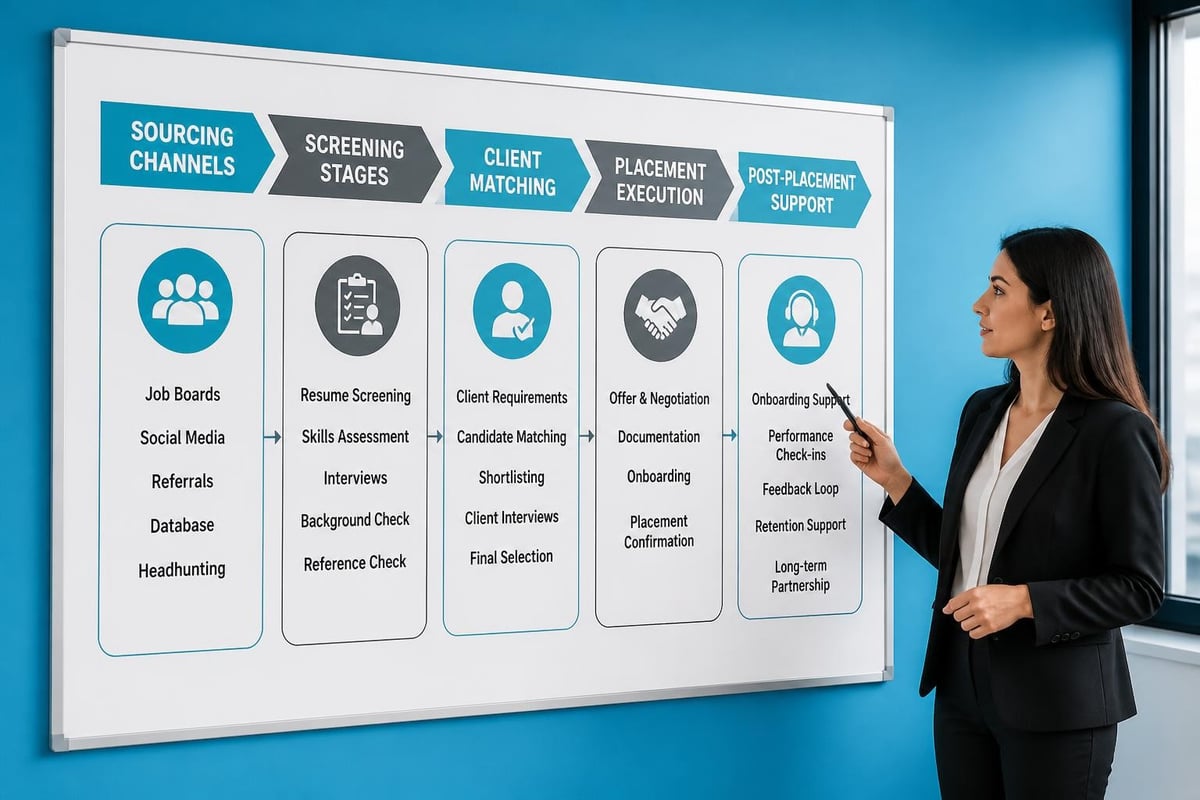
Core functions typically include:
- Candidate sourcing and initial screening processes
- Skills assessment and verification protocols
- Interview coordination between employers and candidates
- Documentation and compliance management
- Placement services for temporary and permanent positions
The fundamental value proposition of any manpower recruitment service rests on three pillars: speed of placement, quality of candidates, and long-term retention rates. Without excellence in all three areas, staffing partnerships become transactional rather than strategic.
The Business Model Behind Recruitment Services
Manpower recruitment agencies generate revenue through placement fees, often structured as a percentage of the placed candidate's annual salary or as hourly markups for temporary staffing. This model creates inherent tension, because speed of placement often conflicts with quality assurance.
The most effective recruitment partners align their compensation structures with client success metrics. This means guarantees on placements, replacement policies for unsuitable candidates, and performance-based pricing that rewards long-term retention rather than quick fills.
Industry-Specific Recruitment Challenges That Demand Specialized Solutions
Generic recruitment approaches fail spectacularly in specialized industries. Industrial, construction, and maritime sectors present unique staffing challenges that separate competent agencies from industry leaders.
Critical Certifications and Safety Requirements
Industrial positions demand specific certifications that cannot be faked or approximated:
| Position Type | Required Certifications | Verification Timeline |
|---|---|---|
| Certified Welders | AWS, ASME certifications | 3-5 business days |
| Pipefitters | Trade certifications, blueprints reading | 2-4 business days |
| CDL Drivers Class A | Valid CDL-A, clean driving record | Immediate to 2 days |
| Forklift Operators | OSHA certification, equipment-specific training | 1-2 business days |
| Electricians | State licensing, NEC code knowledge | 3-7 business days |
The verification gap represents where most recruitment services fail. Claims of certified personnel mean nothing without rigorous credential verification, background checks, and skills testing. OKOOL manpower recruitment services, like any staffing agency, must demonstrate documented verification processes that stand up to audit scrutiny.
The Spanish-Speaking Workforce Advantage
A competitive reality in 2026 that many agencies ignore: the Latino workforce represents the fastest-growing demographic in skilled trades across the Gulf South region. Louisiana, Mississippi, Alabama, and Kentucky have experienced dramatic increases in Spanish-speaking populations, yet most staffing agencies lack the cultural competency and bilingual infrastructure to properly serve this talent pool.
This represents a massive opportunity gap. Employers who access properly vetted, safety-certified Spanish-speaking workers gain:
- Larger candidate pools for hard-to-fill positions
- Diverse team perspectives that improve problem-solving
- Cultural competency that reduces workplace friction
- Competitive advantages in markets with labor shortages
The staffing partner who delivers genuine bilingual capabilities-not just translators, but culturally fluent recruitment processes-provides unmatchable value in today's competitive landscape.
Evaluating Recruitment Service Quality: What Actually Matters
Empty promises saturate the staffing industry. Here's what separates substantive services from marketing fluff.
Measurable Service Delivery Metrics
Demand these specific metrics from any recruitment partnership:
- Time-to-Fill Average: How many business days from requisition to placement?
- First-Interview-to-Offer Ratio: What percentage of presented candidates receive offers?
- 90-Day Retention Rate: What percentage of placements remain employed after 90 days?
- Safety Incident Rate: For industrial placements, what's the safety record?
- Replacement Guarantee Terms: What happens when placements don't work out?
OKOOL manpower recruitment services should transparently provide these metrics. Any agency that hesitates reveals their true performance limitations.
The Local Expertise Factor
National staffing chains often lack deep regional knowledge. The Gulf South presents unique workforce dynamics:
- Seasonal demand fluctuations tied to maritime shipping cycles
- Hurricane season disruptions requiring flexible workforce scaling
- State-specific licensing and compliance requirements
- Regional wage expectations and benefits standards
- Local labor market competition and poaching dynamics
A staffing partner without boots-on-the-ground presence in your specific region operates at a fundamental disadvantage. They cannot build relationships with local trade schools, understand regional salary benchmarks, or rapidly respond to urgent staffing needs.

Best Practices in Modern Recruitment Strategy
Research into effective recruitment practices for specialized roles reveals that successful staffing outcomes depend on structured, repeatable processes rather than ad-hoc approaches.
Multi-Channel Sourcing Requirements
Single-source recruitment fails in competitive labor markets. Effective agencies deploy:
- Trade school and vocational program partnerships for pipeline development
- Industry association relationships for passive candidate access
- Digital recruitment platforms optimized for blue-collar demographics
- Employee referral programs that leverage existing workforce networks
- Community outreach initiatives targeting underrepresented populations
The last point carries particular weight. Latino and bilingual workers often rely on community networks rather than traditional job boards. Agencies without cultural connections to these communities cannot effectively recruit from them, regardless of their advertised capabilities.
Screening and Vetting Protocols
Every placement represents risk. Inadequate screening creates:
- Safety incidents from unqualified operators
- Productivity losses from skills mismatches
- Compliance violations from improper documentation
- Cultural conflicts from poor team fit assessment
- Turnover costs from misaligned expectations
Rigorous screening protocol includes:
- Multi-stage skills testing with hands-on demonstrations
- Background verification including criminal history and employment gaps
- Reference checks with direct supervisors, not HR departments
- Drug screening and physical capability assessments
- Cultural fit interviews assessing communication style and work ethic
OKOOL manpower recruitment services must document these protocols explicitly. Vague assurances about "thorough screening" indicate process weaknesses.
The Real Cost of Poor Staffing Partnerships
Budget-focused procurement decisions often prioritize lowest placement fees. This perspective ignores total cost of ownership.
Hidden Costs of Low-Quality Placements
| Cost Category | Impact of Poor Placement | Financial Multiplier |
|---|---|---|
| Productivity Loss | Unqualified workers produce 40-60% less output | 2-3x daily wage |
| Safety Incidents | Injuries create OSHA fines, insurance increases, downtime | 10-50x incident cost |
| Project Delays | Timeline slippage triggers penalty clauses, reputation damage | Variable, potentially massive |
| Training Investment | Time spent training unsuitable candidates who leave quickly | 1-2 weeks supervisor time |
| Replacement Recruiting | Restarting the hiring process creates cascading delays | Full recruitment cycle cost |
A $2/hour cheaper placement that fails in 30 days costs exponentially more than a $2/hour premium placement that performs for years. This math remains invisible to procurement departments fixated on hourly rates rather than delivered value.
The Turnover Spiral
Poor initial placements create self-reinforcing failure cycles:
- Bad hires leave quickly, creating urgent replacement needs
- Urgent needs force acceptance of marginally qualified candidates
- Marginal candidates perform poorly and leave quickly
- The cycle repeats, progressively damaging team morale and productivity
Breaking this spiral requires staffing partners committed to placement quality over placement speed. OKOOL manpower recruitment services, or any alternative, must demonstrate retention metrics proving they've escaped this trap.
Scalability and Flexibility: Non-Negotiable Capabilities
Project-based industries demand workforce elasticity that traditional employment cannot provide.
Rapid Scaling Requirements
Consider a construction project requiring:
- 20 general laborers starting Monday
- 5 certified welders by Wednesday
- 3 forklift operators and 2 electricians the following week
- Complete demobilization in 90 days when the project completes
Your staffing partner must deliver this flexibility without quality compromise. This demands:
- Deep bench strength with pre-screened, certified candidates ready for deployment
- Established relationships enabling rapid credential verification
- Logistical infrastructure for quick onboarding and orientation
- Flexible contract structures accommodating project timeline uncertainties
Geographic coverage matters tremendously here. A staffing agency serving only one metropolitan area cannot rapidly scale across multi-site projects spanning several states.

Frequently Asked Questions About Manpower Recruitment Services
What exactly do manpower recruitment services provide?
Manpower recruitment services connect employers with qualified workers across various industries. These agencies handle candidate sourcing, screening, skills verification, background checks, and placement logistics. The best services provide ongoing support including replacement guarantees, performance monitoring, and workforce scaling capabilities. They essentially function as outsourced talent acquisition departments specializing in specific industries or skill sets.
How much do recruitment services typically cost?
Recruitment service costs vary by industry, position type, and placement duration. Temporary staffing typically involves hourly rate markups of 30-60% above base wages, covering payroll taxes, benefits, insurance, and agency margins. Permanent placements often cost 15-25% of the candidate's first-year salary as a one-time fee. Direct-hire fees for specialized positions like certified welders or licensed electricians may reach higher percentages due to recruitment difficulty. Always evaluate total cost including replacement guarantees and retention rates rather than just upfront fees.
What industries benefit most from manpower recruitment services?
Industries with fluctuating workforce demands benefit most from recruitment partnerships. Construction projects require rapid scaling up and down based on project timelines. Manufacturing facilities need temporary coverage for production surges or seasonal demand. Maritime operations require specialized certified personnel on short notice. Logistics and warehousing operations scale workforce based on shipping volumes. Any industry struggling to maintain in-house recruiting capacity for specialized skills gains significant advantages from expert staffing partners.
How quickly can recruitment services fill urgent positions?
Fill speed depends on position complexity, required certifications, and market availability. General labor positions can often be filled within 24-48 hours from pre-screened candidate pools. Specialized positions requiring specific certifications-like certified welders, licensed CDL drivers, or trade-certified electricians-typically require 3-7 business days for proper verification and placement. Rush placements sacrificing proper screening create massive downstream risks. The best agencies maintain ready-to-deploy talent pools enabling rapid placement without quality compromise.
What certifications should I verify for industrial staffing?
Industrial positions require rigorous certification verification. Welders need AWS or ASME certifications specific to required welding processes. Electricians require state-specific licensing and National Electrical Code knowledge verification. CDL drivers need valid commercial licenses with appropriate endorsements and clean driving records. Forklift operators require OSHA-compliant certification and equipment-specific training documentation. Pipefitters need trade certifications and blueprint reading capabilities. Never accept verbal assurances-demand documented proof of current, valid certifications directly from issuing authorities.
How do bilingual staffing capabilities provide competitive advantages?
Bilingual staffing capabilities unlock larger talent pools in markets with significant Spanish-speaking populations. The Gulf South region has experienced dramatic Latino workforce growth, particularly in skilled trades. Employers accessing this demographic through culturally competent recruitment gain access to highly motivated, skilled workers often overlooked by competitors. Bilingual teams improve job site communication, reduce safety incidents caused by language barriers, and enhance productivity through better instruction comprehension. This represents a decisive competitive advantage in tight labor markets.
What guarantees should recruitment services offer?
Reputable recruitment services provide replacement guarantees for placements that don't work out. Standard guarantees cover 30-90 days depending on position type and placement fee structure. The guarantee should specify replacement timeline, candidate quality standards, and conditions triggering replacement obligations. Premium services offer performance guarantees tied to productivity metrics or safety records. Always get guarantee terms in writing before engaging services. Agencies hesitant to guarantee their placements reveal confidence issues in their screening processes.
How can OKOOL manpower recruitment services help my specific business needs?
OKOOL manpower recruitment services can be evaluated based on their ability to demonstrate industry-specific expertise, documented screening processes, transparent performance metrics, and proven retention rates in your sector. Request case studies from similar companies, ask for references you can contact directly, and demand specific answers about certification verification protocols. Compare their capabilities against your exact requirements-don't settle for generic assurances. The right staffing partner becomes a strategic asset, not just a vendor.
What makes CDR General Services different from other staffing agencies?
CDR General Services delivers an unmatched competitive advantage through specialized Spanish-speaking workforce expertise that no other agency in the Gulf South can match. Our bilingual recruitment infrastructure and deep cultural competency provide access to highly skilled Latino talent pools that competitors simply cannot reach. We combine this unique capability with rigorous safety certification, industry-specific expertise across industrial, construction, and maritime sectors, and proven local presence throughout Louisiana, Mississippi, Alabama, and Kentucky. Our minority-owned business brings authentic cultural understanding that translates into superior candidate quality and retention rates.
What's the difference between temporary and permanent placement services?
Temporary placement services provide workers on the agency's payroll for defined periods or specific projects. The agency handles all payroll, benefits, taxes, and insurance while charging the client an hourly markup. This arrangement provides maximum flexibility for project-based work and seasonal demand fluctuations. Permanent placement (also called direct hire) involves recruiting candidates who become direct employees of the client company. The agency charges a one-time fee, typically a percentage of first-year salary, and the client assumes all employment obligations. Temp-to-perm arrangements allow evaluation periods before permanent conversion.
How do I evaluate if a recruitment service understands my industry?
Evaluate industry understanding through specific questions about certifications, safety protocols, and regulatory requirements unique to your sector. Ask about their experience with similar projects, request client references in your industry, and assess their knowledge of relevant trade organizations and training programs. Review their candidate screening processes for industry-specific elements-generic screening indicates lack of specialization. Examine whether they maintain relationships with trade schools and apprenticeship programs feeding your industry. True industry expertise shows in detailed, specific answers rather than broad generalizations.
Strategic Workforce Planning Beyond Immediate Needs
Tactical recruitment solves today's staffing crisis. Strategic workforce planning prevents tomorrow's.
Building Talent Pipelines
The most sophisticated employers work with staffing partners to develop talent pipelines rather than just filling open requisitions. This approach involves:
- Partnering with vocational schools to identify promising students before graduation
- Creating apprenticeship programs that develop skills matching specific operational needs
- Establishing preferred employer relationships that make your opportunities known first
- Developing internal training programs that upskill general labor into specialized roles
OKOOL manpower recruitment services or any staffing partner can facilitate these strategic initiatives, but only if approached as a long-term partnership rather than a transactional vendor relationship.
Succession Planning and Knowledge Transfer
Skilled trades face a demographic crisis as experienced workers retire faster than new workers enter the field. This knowledge loss threatens operational continuity.
Proactive solutions include:
- Structured mentorship programs pairing experienced workers with developing talent
- Documentation initiatives capturing institutional knowledge before retirements
- Cross-training programs reducing single-point-of-failure risks
- Competitive compensation strategies retaining critical institutional knowledge
- Phased retirement arrangements keeping experienced workers engaged part-time
Your staffing partner should facilitate these initiatives, not just fill positions created by unanticipated retirements.
Technology Integration in Modern Recruitment
Manual recruitment processes cannot scale effectively. Technology integration separates modern agencies from legacy operations.
Applicant Tracking and Skills Databases
Sophisticated recruitment services maintain detailed skills databases enabling rapid candidate matching. These systems track:
- Certification types, issuance dates, and renewal requirements
- Skills assessments and testing results over time
- Previous placement history and performance feedback
- Availability status and geographic mobility
- Language capabilities and cultural competencies
When you call with an urgent need, database depth determines whether the agency can deliver immediately or must start sourcing from scratch.
Compliance and Documentation Systems
Industrial staffing involves complex regulatory compliance across OSHA requirements, wage and hour laws, immigration verification, and industry-specific regulations. Manual compliance processes create audit risks and administrative burden.
Leading agencies deploy technology for:
- Automated I-9 verification with E-Verify integration
- Digital certification storage with expiration alerts
- OSHA training documentation and renewal tracking
- Drug screening coordination and results management
- Timesheet and payroll systems minimizing errors
These systems protect your business from compliance failures that create legal exposure and financial penalties.
Making the Staffing Partnership Decision
Selecting a recruitment partner represents a strategic decision with long-term operational implications.
The Evaluation Framework
Apply this systematic framework:
| Evaluation Criteria | Weight | Assessment Questions |
|---|---|---|
| Industry Expertise | 25% | Do they understand our specific certifications, safety requirements, and operational realities? |
| Geographic Coverage | 20% | Can they serve all our locations with consistent quality and rapid response? |
| Quality Metrics | 20% | What are their documented retention rates, safety records, and replacement guarantees? |
| Cultural Competency | 15% | Can they effectively recruit from diverse talent pools including Spanish-speaking workers? |
| Technology Capabilities | 10% | Do they use modern systems for compliance, scheduling, and candidate management? |
| Cost Structure | 10% | Is pricing competitive while maintaining quality, not just cheapest option? |
The highest-weighted factors address capabilities that directly impact operational success. Cost matters, but only after quality criteria are satisfied.
The Reference Check Process
Meaningful reference checks ask specific questions:
- What positions has this agency filled for you over what timeframe?
- What's your actual retention rate for their placements beyond 90 days?
- Have you experienced safety incidents with their personnel?
- How do they handle placement failures or performance issues?
- Would you use them again, and do you recommend them without reservation?
Listen for hesitation, qualified answers, or generic praise lacking specific examples. These signals reveal underlying service quality issues.
Understanding what separates effective recruitment partnerships from mediocre vendor relationships comes down to measurable outcomes, industry expertise, and cultural competency in accessing diverse talent pools. When your operations demand reliable, safety-certified personnel who show up ready to work, you need a staffing partner with proven Gulf South regional expertise and unmatched access to bilingual workforce solutions. CDR General Services delivers industry-leading staffing across industrial, construction, and maritime sectors with specialized Spanish-speaking recruitment capabilities that create decisive competitive advantages no other agency can match.
Published July 28, 2026 by CDR
All articles


