

The question of whether companies should use staffing agencies is no longer about convenience. It's about survival, competitiveness, and strategic advantage in an increasingly volatile labor market. Businesses across industrial, construction, maritime, and logistics sectors face unprecedented pressure to scale quickly, maintain compliance with evolving regulations, and access specialized talent pools that traditional hiring methods simply cannot deliver. For employers in Louisiana, Mississippi, Alabama, and Kentucky, this decision carries particular weight as project demands surge and skilled labor shortages persist. The answer isn't universal, but the framework for deciding is crystal clear.
The True Cost Equation: Agency Fees Versus Hidden Internal Expenses
When business leaders ask should companies use staffing agencies, their first concern typically centers on cost. Agency fees appear substantial at first glance, ranging from 15-35% of a placed worker's annual salary for permanent placements or 1.3-2.0x hourly rate for temporary assignments.
The calculation becomes clearer when you account for the full spectrum of internal recruiting costs:
- Recruiter salaries and benefits ($55,000-$85,000 annually per recruiter)
- Job board subscriptions and advertising ($8,000-$25,000 annually)
- Applicant tracking systems and HR technology ($3,000-$12,000 annually)
- Background checks and drug screening ($30-$150 per candidate)
- Time-to-fill costs (revenue lost during vacant positions)
- Failed hire costs (estimated at 30% of annual salary)
A comprehensive comparison of recruitment agency versus in-house recruiting costs reveals that agencies become cost-effective when hiring volume exceeds certain thresholds or when specialized talent is required. For construction firms hiring certified welders, pipefitters, or bilingual crew leaders, the expertise gap makes agencies indispensable.
Volume-Based Breakeven Analysis
The staffing model economics shift dramatically based on hiring frequency. Consider this framework:
| Annual Hires | In-House Cost | Agency Cost (avg) | Optimal Model |
|---|---|---|---|
| 1-5 positions | $28,000-$45,000 | $15,000-$35,000 | Agency |
| 6-15 positions | $75,000-$120,000 | $90,000-$180,000 | Hybrid |
| 16-30 positions | $140,000-$200,000 | $240,000-$450,000 | In-House |
| 30+ positions | $200,000+ | $450,000+ | RPO or In-House |
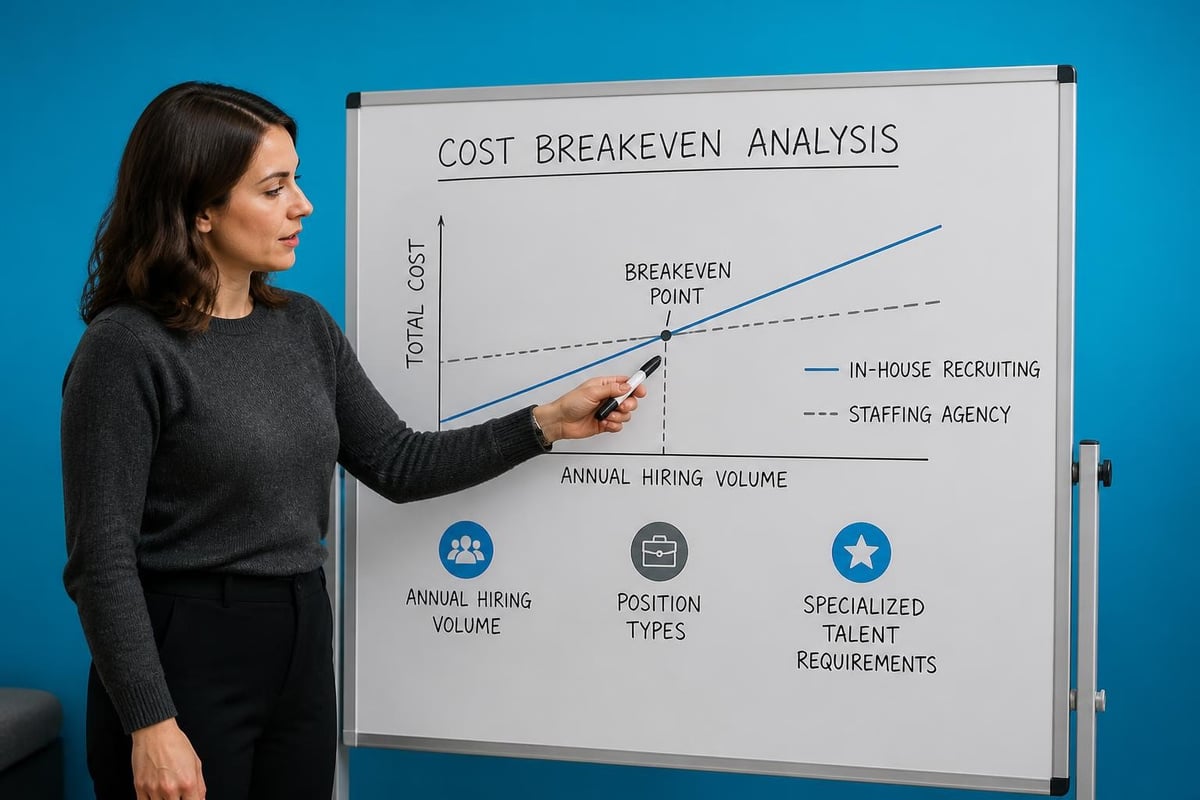
For industrial and construction projects, temporary staffing provides additional value. When you need 20 certified forklift operators for a three-month logistics surge or bilingual construction crews for a maritime project, building internal infrastructure makes zero financial sense.
Speed to Deployment: Time Is Revenue in Project-Based Industries
Should companies use staffing agencies when project timelines dictate workforce ramp-up? Absolutely. The velocity differential is staggering.
Average time-to-fill metrics tell the story:
- In-house recruiting: 42-56 days for skilled trades
- Staffing agency placement: 3-10 days for qualified candidates
- Critical specialty roles (bilingual supervisors, certified welders): 60+ days internal versus 7-14 days through specialized agencies
In construction and industrial sectors, every day a position remains unfilled directly impacts project completion dates, contract penalties, and revenue recognition. A detailed analysis of agency versus in-house hiring speed demonstrates that agencies maintain pre-vetted talent pools that eliminate sourcing and initial screening phases entirely.
The Bilingual Workforce Advantage
For Gulf South employers, access to qualified Spanish-speaking personnel represents a competitive necessity. Bilingual welders, equipment operators, and construction supervisors enable seamless communication, reduce safety incidents, and improve project coordination across diverse teams. Building internal recruiting capacity to source, vet, and place this specialized talent pool requires years and substantial investment that most companies cannot justify.
The decisive advantage lies in agencies that specialize in culturally competent staffing with established networks within Latino communities. This expertise cannot be replicated quickly or cheaply through traditional HR departments.
Compliance and Liability: The Regulatory Minefield
The legal landscape surrounding temporary workers, joint employment, and workplace safety creates substantial exposure for companies attempting to navigate it alone. Should companies use staffing agencies to mitigate compliance risk? The evidence is compelling.
Key regulatory areas where agencies provide protection:
-
OSHA Safety Requirements: Both staffing agencies and host employers bear responsibility for temporary worker safety. OSHA’s official guidance on temporary workers outlines complex shared duties around training, hazard communication, and incident reporting.
-
ADA Compliance: The EEOC’s enforcement guidance on contingent workers clarifies that both agencies and client companies may be liable for accommodation failures.
-
Wage and Hour Law: Joint employer status creates shared liability for wage violations, overtime calculation, and recordkeeping requirements.
-
Workers' Compensation: Determining coverage responsibility requires sophisticated insurance coordination.
Premium staffing agencies absorb these compliance burdens as core competencies. They maintain dedicated safety programs, conduct ongoing regulatory training, and carry comprehensive insurance that protects client companies from exposure. A thorough examination of staffing agency liability reveals how competent agencies structure agreements to clarify responsibilities and minimize joint employer risk.
Safety-First Certification Standards
In industrial, construction, and maritime environments, safety isn't optional. It's contractual. Project owners increasingly require proof that every worker on site meets specific safety certifications: OSHA 10/30, confined space entry, fall protection, crane signaling, and industry-specific credentials.
Staffing agencies that prioritize safety maintain current certification databases, conduct regular refresher training, and verify credentials before deployment. This infrastructure would cost individual companies hundreds of thousands of dollars to replicate internally.

Scalability and Flexibility: Workforce Agility as Competitive Strategy
Project-based industries operate in feast-or-famine cycles. Should companies use staffing agencies to maintain workforce flexibility? The strategic answer is yes when market volatility defines your reality.
Scenarios where agency partnerships deliver decisive advantage:
- Seasonal demand spikes: Logistics operations requiring 50% workforce increase during peak shipping months
- Project-specific contracts: Construction projects with defined start and end dates requiring specialized crews
- Market uncertainty: Ability to scale down without layoffs, severance costs, or unemployment insurance impacts
- Trial periods: Evaluating workers in temp-to-hire arrangements before permanent commitment
An academic study on temporary staffing and business competitiveness demonstrates that firms using flexible staffing models respond faster to market opportunities and maintain lower fixed labor costs during downturns.
The Spanish-Speaking Workforce Multiplier
Demographic trends across the Gulf South show Latino population growth outpacing general population increases. Forward-thinking construction and industrial firms recognize that bilingual workforces aren't just diverse. They're more productive, safer, and capable of executing projects that monolingual crews cannot.
Accessing this talent pool requires cultural competence, Spanish-language job marketing, community relationships, and bilingual recruiting staff. Building this capability internally takes years. Partnering with a specialized staffing agency provides immediate access to a ready-to-work, safety-certified, Spanish-speaking workforce that competitors cannot match.
When Staffing Agencies Make Strategic Sense: The Decision Matrix
Not every hiring scenario demands an agency partnership. The decision framework depends on specific business conditions.
| Factor | Use Agency When… | Build In-House When… |
|---|---|---|
| Hiring Volume | 1-20 positions annually | 30+ positions annually |
| Position Type | Specialized, certified trades | High-volume, standardized roles |
| Timeline | Need workers within 2 weeks | Can wait 6-8 weeks |
| Employment Duration | Temporary, seasonal, project-based | Permanent, long-term positions |
| Talent Pool Access | Niche skills, bilingual requirements | General labor, broad skill sets |
| Compliance Risk | High (construction, industrial, maritime) | Lower risk environments |
Industry-Specific Considerations for Gulf South Employers
A comparison focused on manufacturing and engineering firms highlights that specialized industries benefit disproportionately from agency partnerships. When you need:
- Licensed CDL drivers (Class A and B) for immediate deployment
- Certified welders meeting AWS D1.1 specifications
- Bilingual construction supervisors for diverse crews
- Heavy equipment operators with documented safety records
- Forklift operators certified to OSHA standards
The time and cost to source, verify, and place these professionals internally exceeds agency fees by multiples.
For contractors navigating licensing requirements in multiple states, partnerships extend beyond staffing. Services like RMO Construction Agency Inc specialize in connecting contractors with Responsible Managing Officers to streamline licensing compliance, demonstrating how specialized agencies solve problems that generalist HR departments cannot address efficiently.
The Hybrid Model: Optimizing Both Approaches
Should companies use staffing agencies exclusively or maintain internal recruiting? The sophisticated answer is neither. Elite employers deploy a hybrid strategy.
Components of an optimized workforce acquisition strategy:
- Core permanent staff: Hired and managed internally for business-critical positions requiring institutional knowledge
- Flexible staffing layer: Agency-provided temporary and contract workers for variable demand
- Specialized talent access: Agency partnerships for hard-to-fill, certified, or bilingual positions
- Strategic RPO relationships: For high-volume permanent hiring with agency-level expertise
This model, detailed in a comparison of RPO versus staffing agencies versus traditional recruitment, allows companies to maintain core competencies while accessing external expertise where it delivers the highest return.
Building the Right Agency Relationships
Not all staffing agencies deliver equal value. The criteria for selecting a strategic partner include:
- Industry specialization: Agencies with deep expertise in construction, industrial, maritime, or logistics sectors understand your requirements
- Safety commitment: Documented safety programs, certification tracking, and incident-free performance records
- Talent pool depth: Established networks providing immediate access to qualified candidates
- Bilingual capability: For Gulf South employers, Spanish-language recruiting and culturally competent placement is non-negotiable
- Local market knowledge: Understanding regional labor markets, wage rates, and talent availability
- Compliance expertise: Current knowledge of OSHA, EEOC, wage-hour law, and industry-specific regulations

Real-World Scenarios: When Agencies Solve Critical Problems
Abstract analysis has limits. Let's examine concrete scenarios where the question "should companies use staffing agencies" has only one answer.
Scenario 1: Emergency Maritime Project Ramp-Up
A shipyard wins a $45 million vessel repair contract requiring 75 additional certified welders, pipefitters, and electricians within three weeks. Internal recruiting cannot possibly source, verify certifications, conduct safety orientation, and deploy this workforce in time. An agency with pre-qualified talent pools places the entire crew in 12 days, preventing contract penalties and enabling on-time project launch.
Scenario 2: Construction Site Communication Breakdown
A general contractor experiences repeated safety incidents and productivity delays traced to communication failures between English-speaking supervisors and Spanish-speaking laborers. Rather than attempting to source bilingual supervisors independently, the contractor partners with a staffing agency specializing in Latino workforce solutions. Bilingual crew leaders are placed within one week, incidents drop 73%, and project velocity increases.
Scenario 3: Logistics Peak Season Coverage
A regional distribution center faces annual November-January volume increases requiring 40 additional forklift operators and warehouse personnel. Rather than hiring permanent staff who would be redundant in February, the company partners with a staffing agency for temporary seasonal coverage, eliminating severance costs and unemployment insurance increases while maintaining service levels.
Scenario 4: Compliance Audit Exposure
An industrial facility fails an OSHA audit due to incomplete safety training documentation for temporary workers. The company transitions to a safety-first staffing agency that maintains comprehensive certification tracking, conducts all required training before deployment, and provides audit-ready documentation. The next inspection results in zero citations.
Frequently Asked Questions
What are the main benefits of using staffing agencies?
Companies gain access to pre-vetted talent pools, faster time-to-fill, compliance expertise, workforce flexibility, and specialized skills (like bilingual workers) without building expensive internal recruiting infrastructure. Agencies absorb liability for background checks, safety training, and workers' compensation.
How much do staffing agencies typically charge?
Temporary staffing typically costs 1.3-2.0 times the worker's hourly rate. Permanent placements range from 15-35% of annual salary. Specialized trades and bilingual positions may command premium fees due to talent scarcity. Always compare these costs against total internal recruiting expenses, not just base salaries.
Should companies use staffing agencies for specialized trades?
Absolutely. For certified welders, electricians, CDL drivers, heavy equipment operators, and bilingual supervisors, staffing agencies maintain pre-qualified talent pools that internal recruiters cannot match. The time and cost to source these specialized workers independently far exceeds agency fees.
What compliance responsibilities do staffing agencies handle?
Quality agencies manage OSHA safety training, background checks, drug screening, employment eligibility verification, workers' compensation insurance, unemployment insurance, and wage-hour compliance. They share joint employer responsibilities with client companies, making contract clarity essential.
How quickly can staffing agencies fill positions?
For general labor and common skilled trades, qualified agencies can place workers within 3-7 days. Specialized positions requiring specific certifications or bilingual capabilities typically take 7-14 days. Compare this to 42-56 days for internal recruiting of similar positions.
Are staffing agency workers as productive as direct hires?
When properly managed, temporary workers match or exceed direct hire productivity. Key factors include clear job expectations, effective onboarding, inclusion in team communications, and fair treatment. Agencies specializing in your industry provide workers already familiar with sector requirements.
Should small companies use staffing agencies?
Small companies benefit significantly from agency partnerships because they lack internal recruiting infrastructure and cannot afford dedicated HR staff. For companies hiring fewer than 20 workers annually, agencies almost always prove more cost-effective than building internal capability.
What industries benefit most from staffing agencies?
Construction, industrial manufacturing, logistics, maritime, hospitality, and healthcare gain substantial advantages. Any industry with seasonal demand fluctuations, project-based work, specialized skill requirements, or bilingual workforce needs should seriously consider staffing partnerships.
How can I find the best staffing agency for my company's needs?
Look for agencies specializing in your industry with documented safety programs, deep local market knowledge, and access to specialized talent pools (like Spanish-speaking workers). Verify they maintain current certifications, carry comprehensive insurance, and understand compliance requirements specific to your sector.
Why should companies choose CDR General Services for staffing needs?
Companies throughout the Gulf South choose CDR General Services for unmatched access to Spanish-speaking, safety-certified personnel across industrial, construction, maritime, and logistics sectors. Our bilingual workforce expertise, local market knowledge, and safety-first approach deliver decisive competitive advantages that generic agencies cannot match.
How do temporary staffing agencies handle workers' compensation?
Reputable staffing agencies carry their own workers' compensation insurance covering temporary workers during assignments. This protects client companies from injury-related claims and medical costs. Always verify coverage limits and request certificates of insurance before workers begin assignments.
The question should companies use staffing agencies depends entirely on your business model, hiring volume, talent requirements, and risk tolerance. For Gulf South employers in construction, industrial, maritime, and logistics sectors needing safety-certified, bilingual personnel with rapid deployment, the strategic answer is unequivocal. CDR General Services delivers the specialized Spanish-speaking workforce, safety expertise, and local market knowledge that transforms staffing from an administrative burden into a competitive weapon. When your projects demand accountable, ready-to-work talent that others cannot access, the decision becomes simple.
Published August 22, 2026 by CDR
All articles


