


Blog
Temporary Placement Agencies Near Me: 2026 Guide


Finding the right temporary placement agencies near me has become a strategic imperative for businesses navigating the competitive landscape of 2026. Whether you're managing a construction project in Louisiana, scaling industrial operations in Alabama, or staffing maritime facilities along the Gulf Coast, the quality of your temporary workforce directly impacts productivity, safety compliance, and bottom-line results. The temporary staffing industry generated over 171 billion dollars in 2025, according to comprehensive temporary work statistics, and the demand continues to surge as businesses seek flexible, skilled labor solutions. This guide delivers the authoritative framework for identifying, vetting, and partnering with temporary placement agencies that deliver measurable results.
Understanding the Temporary Placement Agency Landscape in 2026
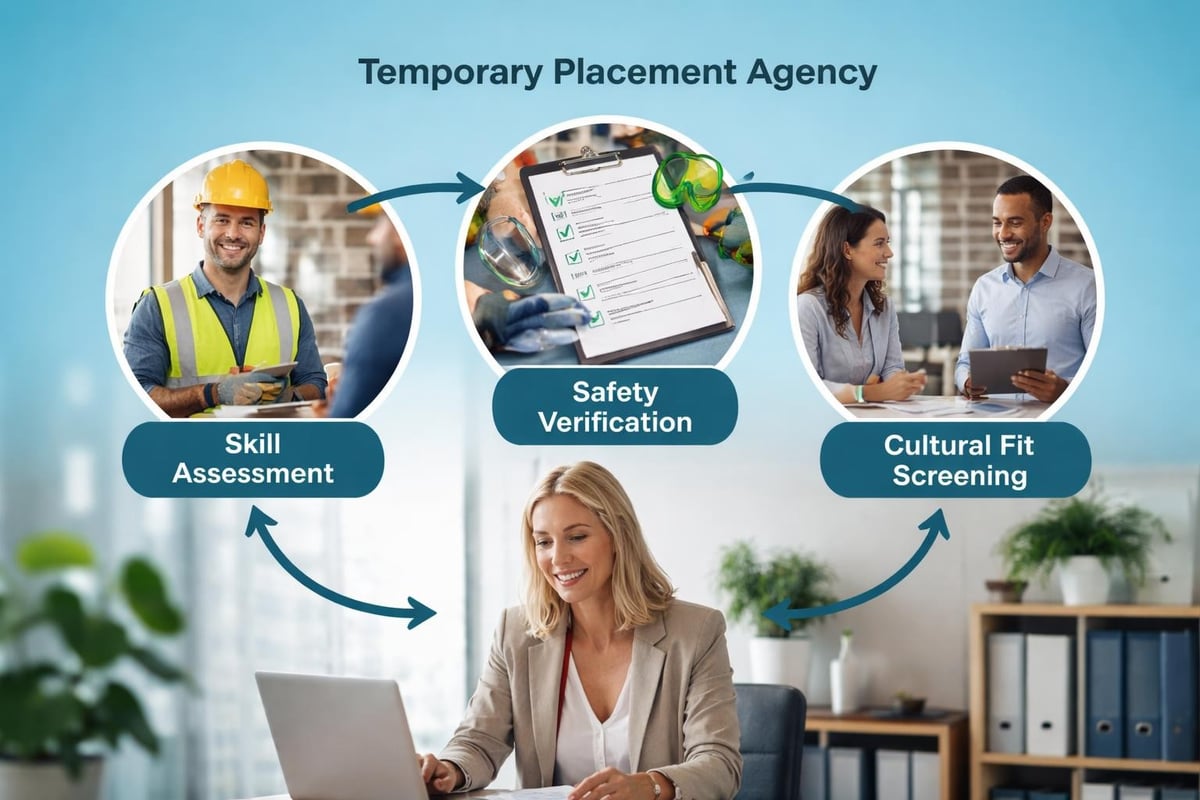
The temporary staffing sector has transformed dramatically, evolving from simple labor placement to sophisticated workforce management solutions. Today's temporary placement agencies near me function as strategic partners, providing not just bodies but certified, safety-trained, and culturally competent professionals ready to contribute from day one.
The current market dynamics reveal several critical trends:
- Increased specialization in niche industries like construction, maritime, and industrial sectors
- Growing demand for bilingual and Spanish-speaking workforce solutions
- Heightened emphasis on safety certification and compliance documentation
- Technology-driven matching systems connecting talent with opportunities faster than ever
The staffing industry statistics demonstrate that over 16 million temporary and contract employees work through staffing agencies annually across the United States. This massive talent pool represents both opportunity and challenge for employers seeking quality personnel.
The Strategic Value of Local Temporary Placement Expertise
Geographic proximity matters when searching for temporary placement agencies near me. Local agencies possess intimate knowledge of regional labor markets, understand specific state compliance requirements, and maintain established relationships with qualified workers in your area. A staffing partner operating in Louisiana understands the unique demands of refineries along the Gulf Coast, while agencies serving Kentucky comprehend the logistics and transportation needs of that market.
Regional expertise translates into tangible advantages:
- Faster placement cycles because local agencies maintain active candidate pools
- Better cultural fit through understanding of regional workforce dynamics
- Compliance confidence with state-specific labor laws and safety regulations
- Reduced recruitment costs by leveraging existing local talent networks
The temporary staffing industry trends indicate that businesses partnering with geographically aligned agencies experience 40% faster time-to-fill rates compared to national-only providers.
Evaluating Quality in Temporary Placement Agencies
Not all temporary placement agencies near me deliver equal value. The difference between an average agency and an exceptional one lies in their commitment to quality, safety, and specialized expertise. Here's the framework for separating the contenders from the pretenders.
Core Evaluation Criteria
| Evaluation Factor | What to Look For | Why It Matters |
|---|---|---|
| Industry Specialization | Deep expertise in your specific sector (industrial, construction, maritime) | Ensures candidates understand job requirements and safety protocols |
| Safety Certification Programs | OSHA compliance, equipment operation certifications, site-specific training | Reduces workplace incidents and liability exposure |
| Bilingual Capabilities | Spanish-speaking workforce availability and bilingual coordinators | Critical for diverse teams and cross-cultural communication |
| Vetting Processes | Background checks, skills verification, drug screening protocols | Guarantees workforce reliability and quality |
| Response Time | How quickly they fill requisitions and handle urgent needs | Impacts project timelines and operational continuity |
| Local Market Knowledge | Understanding of regional labor dynamics and compensation benchmarks | Ensures competitive positioning and successful placements |
The vetting process separates professional agencies from placement mills. Premium temporary placement agencies near me invest heavily in comprehensive candidate screening, including trade skills testing for welders, pipefitters, and electricians, commercial driver's license verification for CDL operators, and rigorous safety orientation programs.
The Spanish-Speaking Workforce Advantage
In 2026, the ability to provide qualified Spanish-speaking workers represents a decisive competitive advantage that most agencies simply cannot match. The construction and industrial sectors increasingly rely on Latino talent, and agencies offering bilingual staffing solutions bridge critical communication gaps that impact safety, productivity, and team cohesion.
Benefits of bilingual workforce access include:
- Enhanced safety communication on job sites with diverse teams
- Increased productivity through clear instruction and feedback
- Reduced workplace conflicts stemming from language barriers
- Expanded talent pool accessing highly skilled trades professionals
This specialty staffing capability transforms temporary placement from commodity service to strategic advantage, particularly across the Gulf South region where major industrial and construction projects demand multicultural workforce coordination.
Industry-Specific Temporary Placement Solutions
The most effective temporary placement agencies near me organize their services around industry verticals, delivering specialized expertise rather than generic labor placement. This vertical focus ensures that placed workers possess both the technical skills and industry knowledge required for immediate contribution.
Industrial and Skilled Trades Staffing
Industrial operations demand precision, safety consciousness, and specialized certifications. When searching for temporary placement agencies near me to staff refineries, manufacturing facilities, or processing plants, verify their ability to provide:
- Certified welders with current AWS certifications and pipe welding experience
- Pipefitters knowledgeable in industrial piping systems and pressure testing
- Electricians holding journeyman licenses and industrial electrical experience
- Heavy equipment operators certified on cranes, forklifts, and specialized machinery
These positions require more than basic labor skills. They demand trade expertise, safety awareness, and the ability to integrate into complex industrial environments where mistakes cost money and risk lives.

Construction and General Labor Deployment
Construction projects operate on compressed timelines with fluctuating workforce needs. The right temporary placement agencies near me understand construction cycles and maintain ready-to-deploy teams capable of ramping up quickly.
Critical construction staffing capabilities:
- Scalable general labor teams for site preparation, materials handling, and cleanup operations
- Skilled trades professionals including framers, concrete finishers, and equipment operators
- Safety-trained personnel with OSHA 10 or OSHA 30 certifications
- Bilingual supervisors and workers facilitating diverse team communication
- Rapid deployment capabilities meeting urgent project demands
The staffing industry indicator data shows construction staffing hours increasing 23% year-over-year through early 2026, reflecting robust demand across residential, commercial, and infrastructure projects.
Transportation and Logistics Expertise
Supply chain operations and transportation networks require specialized licensing and compliance knowledge. When evaluating temporary placement agencies near me for logistics support, prioritize those offering:
| Position Type | Key Requirements | Typical Applications |
|---|---|---|
| Class A CDL Drivers | Current CDL-A, clean driving record, DOT compliance | Long-haul freight, regional distribution, specialized hauling |
| Class B CDL Drivers | CDL-B license, passenger or hazmat endorsements | Local delivery, shuttle services, materials transport |
| Forklift Operators | Certified operation, warehouse experience, safety training | Distribution centers, manufacturing facilities, dock operations |
| Warehouse Personnel | Inventory management, order fulfillment, safety protocols | E-commerce fulfillment, general warehousing, cross-dock operations |
Transportation staffing demands rigorous compliance with Department of Transportation regulations, drug testing protocols, and ongoing driver qualification files. Agencies lacking this specialized compliance infrastructure create significant liability exposure.
Administrative and Clerical Support
Professional office environments require temporary placement agencies near me that understand corporate culture, professional standards, and the soft skills distinguishing adequate from exceptional administrative talent.
Administrative placement considerations include:
- Professional communication skills and business etiquette
- Technology proficiency including Microsoft Office, industry-specific software, and collaboration platforms
- Reliability and discretion handling sensitive information
- Adaptability integrating into existing team structures
- Bilingual capabilities supporting diverse customer bases and internal teams
Administrative placements often transition to permanent hires, making the initial vetting and cultural fit assessment even more critical.
Maximizing Value from Temporary Staffing Partnerships
Strategic use of temporary placement agencies near me extends beyond filling immediate gaps. Sophisticated businesses leverage staffing partnerships for workforce optimization, seasonal scaling, and talent evaluation before permanent hiring commitments.
Strategic Applications of Temporary Staffing
Project-based scaling allows businesses to ramp workforce up or down based on project pipelines without permanent headcount commitments. Construction firms staff major builds with temporary crews, then scale back during slower periods, maintaining financial flexibility while accessing top talent.
Seasonal demand management addresses cyclical business patterns. Maritime operations intensify during certain shipping seasons, industrial plants schedule major maintenance turnarounds requiring temporary workforce surges, and logistics operations peak during holiday seasons.
Trial periods for permanent hiring reduce hiring risk by evaluating workers in actual job conditions before extending permanent offers. This temp-to-hire approach minimizes bad hiring decisions and improves cultural fit.
Specialized skills for specific projects enables access to expertise not requiring permanent employment. A six-month construction project might need specialized welding capabilities that don't justify a permanent hire but are critical for project success.

Cost Analysis and ROI Considerations
Understanding the true cost of temporary placement agencies near me requires looking beyond hourly bill rates to total cost of ownership, including:
- Bill rate versus permanent employee cost including benefits, payroll taxes, workers' compensation, and administrative overhead
- Recruitment cost avoidance by eliminating job posting, candidate sourcing, screening, and interviewing expenses
- Time-to-productivity calculations measuring how quickly temporary workers contribute versus permanent hires
- Flexibility value quantifying the financial benefit of scaling workforce without severance or unemployment exposure
| Cost Factor | Permanent Employee | Temporary Placement | Advantage |
|---|---|---|---|
| Base Compensation | Direct salary cost | Bill rate | Varies by position |
| Benefits Package | 25-40% of salary | Included in bill rate | Temporary placement |
| Payroll Taxes | Employer responsibility | Agency responsibility | Temporary placement |
| Workers' Comp Insurance | Company policy | Agency coverage | Temporary placement |
| Recruitment Costs | $3,000-$5,000 per hire | Zero | Temporary placement |
| Termination Risk | Unemployment, severance, legal exposure | None | Temporary placement |
The U.S. staffing industry strategy analysis confirms that temporary staffing delivers superior ROI for positions with defined end dates, seasonal requirements, or uncertain long-term needs.
Safety and Compliance in Temporary Workforce Management
Safety represents the non-negotiable foundation of professional temporary placement agencies near me. In high-risk industries like construction, maritime, and industrial operations, safety failures carry catastrophic consequences including worker injuries, regulatory penalties, and project shutdowns.
Essential safety program components:
- Comprehensive pre-employment safety orientation covering general safety principles and site-specific hazards
- Equipment operation certifications verified through practical testing and credential validation
- Drug screening programs meeting DOT and industry-specific requirements
- Ongoing safety training refreshers maintaining awareness and skill currency
- Incident reporting protocols ensuring transparency and continuous improvement
- Personal protective equipment provision and proper use training
Premium agencies maintain safety records and provide clients with placement safety histories, demonstrating their commitment to workforce protection. According to temporary staffing industry statistics, agencies with formal safety programs reduce workplace incidents by up to 60% compared to those with minimal safety infrastructure.
Compliance and Regulatory Considerations
Temporary staffing involves complex regulatory requirements spanning employment law, immigration compliance, tax obligations, and industry-specific regulations. The right temporary placement agencies near me handle this compliance burden, protecting clients from costly violations.
Critical compliance areas include:
- Employment classification properly distinguishing between W-2 employees and independent contractors
- Immigration documentation verifying work authorization through I-9 compliance
- Wage and hour regulations ensuring proper classification, overtime calculation, and minimum wage compliance
- Workers' compensation coverage maintaining appropriate insurance and claims management
- OSHA compliance meeting occupational safety standards and recordkeeping requirements
- Industry-specific regulations adhering to DOT rules for transportation, MSHA standards for mining operations, or Coast Guard requirements for maritime work
Agencies operating across the Gulf South region must navigate varying state regulations in Louisiana, Mississippi, Alabama, and Kentucky, each with distinct labor laws and compliance requirements.
Finding and Vetting Temporary Placement Agencies Near Me
The search for temporary placement agencies near me begins with understanding your specific workforce needs, then identifying agencies with demonstrated expertise in those areas. This systematic approach ensures you partner with agencies capable of delivering results rather than empty promises.
The Search and Selection Process
Step 1: Define Your Requirements
Clearly articulate the positions you need to fill, required qualifications, expected duration, and any special requirements like bilingual capabilities or specific certifications. Vague requirements generate mediocre placements.
Step 2: Identify Specialized Agencies
Focus on agencies specializing in your industry rather than generalist providers. A construction-focused agency understands site safety requirements, trade certifications, and construction workforce dynamics that general agencies miss.
Step 3: Verify Credentials and References
Request client references from similar companies in your industry and geography. Ask specific questions about fill rates, worker quality, safety records, and responsiveness to urgent needs.
Step 4: Assess Cultural Competency
If your workforce or customer base includes significant Spanish-speaking populations, verify the agency's bilingual capabilities. Can they provide bilingual coordinators? Do they maintain Spanish-speaking talent pools? Can they facilitate cross-cultural communication?
Step 5: Review Safety and Compliance Programs
Request documentation of safety training programs, certification processes, and compliance procedures. Professional agencies provide this information readily; reluctant agencies raise red flags.
Step 6: Negotiate Terms and Service Level Agreements
Establish clear expectations around response times, replacement policies, billing procedures, and performance metrics. Document these agreements to ensure accountability.
Red Flags and Warning Signs
Certain indicators signal problematic temporary placement agencies near me that will create headaches rather than solutions:
- Unrealistic promises about fill times or candidate availability
- Lack of industry-specific knowledge revealed through generic responses to technical questions
- Minimal safety program infrastructure or vague answers about safety protocols
- No verifiable references or reluctance to provide client contacts
- Unclear billing practices or hidden fees beyond stated bill rates
- High worker turnover indicating quality or cultural issues
- Poor communication responsiveness during the sales process (it won't improve post-contract)
Trust your instincts. If an agency feels unprofessional during the courtship phase, the relationship will deteriorate once you're a paying client.
Technology and Innovation in Temporary Placement
Modern temporary placement agencies near me leverage technology to improve matching accuracy, accelerate placement cycles, and enhance communication between agencies, clients, and workers. The technology and automation trends shaping temporary staffing include applicant tracking systems, skills assessment platforms, mobile workforce management apps, and AI-driven candidate matching.
Technology-enabled advantages:
- Faster candidate matching through automated skills-to-job requirement alignment
- Digital onboarding reducing paperwork and accelerating time-to-work
- Real-time communication via mobile apps connecting workers, clients, and coordinators
- Automated compliance tracking ensuring certifications, licenses, and training remain current
- Performance analytics measuring productivity, safety incidents, and placement success rates
However, technology complements rather than replaces the human judgment, industry expertise, and relationship management that distinguish exceptional temporary placement agencies near me from algorithm-driven commodity services.
Mobile Workforce Management
Today's temporary workers expect mobile-first experiences including digital job applications, instant shift notifications, mobile time tracking, and direct deposit payment access. Agencies providing these capabilities attract higher-quality talent and improve worker satisfaction, which translates into better client service and placement stability.
The market research on temporary help services projects continued investment in mobile technologies throughout 2026 as agencies compete for top temporary talent in tight labor markets.
Regional Considerations for Gulf South Businesses
Businesses operating across Louisiana, Mississippi, Alabama, and Kentucky face unique workforce challenges and opportunities when partnering with temporary placement agencies near me. The Gulf South region combines robust industrial activity, major construction projects, critical maritime operations, and diverse demographic composition creating specific staffing requirements.
Gulf South Workforce Dynamics
Louisiana maintains significant refinery, petrochemical, and maritime operations requiring specialized industrial and marine trades. The state's bilingual population (particularly in southern parishes) creates both workforce availability and cultural communication needs.
Mississippi focuses on manufacturing, logistics, and construction with growing demand for certified tradespeople and transportation professionals. The state's right-to-work status influences labor relations and workforce deployment strategies.
Alabama combines automotive manufacturing, steel production, maritime commerce, and construction creating diverse temporary staffing needs across skilled trades and general labor categories.
Kentucky emphasizes logistics (proximity to major distribution hubs), manufacturing, and construction with particular demand for CDL drivers and warehouse personnel supporting supply chain operations.
Bilingual Staffing as Competitive Advantage
The Gulf South's growing Latino population represents both a demographic reality and a strategic staffing opportunity. Temporary placement agencies near me offering Spanish-language recruitment, bilingual coordination, and culturally competent workforce management deliver measurable advantages including:
- Access to qualified tradespeople often overlooked by monolingual agencies
- Improved safety outcomes through clear communication in workers' native language
- Enhanced productivity by eliminating language barriers affecting instruction and feedback
- Reduced turnover because culturally competent management improves worker satisfaction
- Expanded talent pools in tight labor markets where every qualified worker matters
This bilingual capability isn't a nice-to-have feature but a decisive competitive differentiator separating commodity staffing from strategic workforce partnership.
Frequently Asked Questions About Temporary Placement Agencies
What should I expect to pay for temporary staffing services?
Temporary placement bill rates vary significantly based on position type, required qualifications, and geographic market. General laborers might bill at 15 to 20 dollars per hour, while certified welders, electricians, or CDL drivers command 30 to 50 dollars per hour or more. This bill rate includes the worker's wage plus agency markup covering payroll taxes, workers' compensation insurance, benefits, recruitment costs, and agency profit margin. Always request detailed bill rate breakdowns understanding exactly what you're paying for.
How quickly can temporary placement agencies fill my staffing needs?
Fill time depends on position complexity, required certifications, and current labor market conditions. General labor positions often fill within 24 to 48 hours, while specialized trades like certified welders or Class A CDL drivers might require one to two weeks for proper vetting and availability coordination. Agencies maintaining active talent pools of pre-screened, safety-certified candidates dramatically accelerate placement cycles. Establishing relationships before urgent needs arise ensures faster response when critical staffing gaps emerge.
What's the difference between temporary, temp-to-hire, and contract placements?
Temporary placements fill defined-duration needs with workers remaining agency employees throughout the assignment. Temp-to-hire arrangements function as trial periods where workers start as agency employees but transition to permanent company employment after a predetermined evaluation period (typically 90 days), with the client paying a conversion fee. Contract placements involve longer-term assignments (often three to twelve months) for specialized projects or coverage needs, with workers remaining agency employees but functioning in extended roles. Each structure serves different business needs and involves distinct cost models.
How do temporary placement agencies handle worker injuries or performance issues?
Reputable agencies maintain workers' compensation insurance covering workplace injuries, handle claims administration, and manage return-to-work coordination. For performance issues, professional agencies respond immediately to client concerns, investigating problems, providing coaching or retraining if appropriate, or replacing workers who fail to meet standards. Service level agreements should specify replacement timelines (typically 24 hours) and performance guarantee provisions ensuring client satisfaction.
Can I hire temporary workers as permanent employees?
Most temporary placement agencies permit temp-to-hire conversions, though terms vary. Some require workers to complete a minimum temporary period (often 90 days) before conversion eligibility, while others allow earlier transitions for a higher fee. Conversion fees (sometimes called buyout fees) typically equal a percentage of the worker's annual salary or a flat fee based on assignment duration. These fees compensate agencies for recruitment costs and lost ongoing billing revenue. Always clarify conversion policies and fees before engaging temporary placements you might want to hire permanently.
What safety certifications should temporary workers possess?
Required certifications depend on job duties and industry sector. Common safety requirements include OSHA 10 or OSHA 30 training for construction and general industry, forklift operator certification for warehouse and materials handling positions, first aid and CPR certification for certain roles, confined space entry training for industrial maintenance, fall protection certification for work at heights, and lockout/tagout training for equipment maintenance. Trade-specific positions require additional credentials like AWS welding certifications, journeyman electrician licenses, or commercial driver's licenses with appropriate endorsements. Premium temporary placement agencies verify all certifications and maintain documentation for client review.
Why should I choose a staffing agency with Spanish-speaking capabilities?
Spanish-language capabilities transform temporary staffing from commodity service to strategic advantage. Agencies offering bilingual recruitment access highly-skilled Latino trades professionals often overlooked by monolingual competitors, expanding your available talent pool significantly. Bilingual coordinators facilitate clear communication between management and Spanish-speaking workers, improving safety outcomes, productivity, and team cohesion. In industries like construction and industrial operations where Latino talent represents a substantial workforce segment, culturally competent staffing isn't optional but essential for accessing the best available workers and maintaining competitive advantage in tight labor markets.
How do I verify a temporary placement agency's safety record?
Request the agency's Experience Modification Rate (EMR), a workers' compensation metric where 1.0 represents average industry performance, below 1.0 indicates better-than-average safety, and above 1.0 signals higher incident rates. Ask for Total Recordable Incident Rate (TRIR) and Days Away, Restricted, or Transferred (DART) rate data comparing their safety performance to industry benchmarks. Request client references specifically addressing safety performance and incident response. Professional agencies track these metrics, provide transparent reporting, and demonstrate continuous safety improvement initiatives. Agencies reluctant to discuss safety statistics raise immediate red flags about their operational standards.
What should I ask when speaking with a temporary placement agency for the first time?
Start with questions establishing their industry specialization and experience in your specific sector. Ask about their candidate vetting processes including background checks, skills verification, drug screening, and safety training protocols. Inquire about their average fill times for positions similar to your needs and their current availability of qualified workers. Discuss their billing structure and any fees beyond hourly bill rates. Request information about replacement policies if placed workers don't meet expectations. Ask about bilingual capabilities if your workforce or customer base includes Spanish speakers. Finally, request client references from similar companies in your industry and geography who can speak to their actual performance versus promises. These questions reveal whether you're speaking with a professional staffing partner or a placement mill pushing bodies without quality focus.
How can CDR General Services help with my temporary staffing needs?
CDR General Services delivers industry-leading temporary staffing solutions across industrial, construction, and maritime sectors throughout the Gulf South region. Our unmatched competitive advantage lies in our specialized Spanish-speaking workforce and bilingual personnel expertise, providing culturally competent staffing that bridges communication gaps and expands your available talent pool beyond what generic agencies offer. We maintain ready-to-deploy teams of safety-certified welders, pipefitters, electricians, heavy equipment operators, CDL drivers, warehouse personnel, and administrative professionals. Our safety-first commitment, deep local market knowledge across Louisiana, Mississippi, Alabama, and Kentucky, and minority-owned business status make us the strategic staffing partner businesses trust for reliable, quality temporary placements. Whether you need to scale for a major project, manage seasonal demand, or fill urgent gaps, CDR General Services delivers the specialized, diverse, and accountable workforce you need when you need it.
Choosing the right temporary placement agencies near me determines whether you access commodity labor or strategic workforce advantage. The distinction between average and exceptional staffing partners lies in specialized industry expertise, comprehensive safety programs, and unique capabilities like bilingual workforce access that most agencies simply cannot provide. CDR General Services delivers all three across the Gulf South region, combining deep industrial, construction, and maritime sector knowledge with safety-first operations and unmatched Spanish-speaking workforce expertise. When your projects demand reliable, certified, culturally competent temporary staffing, CDR General Services provides the decisive competitive advantage that transforms workforce challenges into operational success.