


Blog
Private Staffing Agency: The Definitive 2026 Guide


A private staffing agency operates as the strategic bridge between employers demanding specialized talent and skilled professionals seeking meaningful opportunities. In 2026, these agencies have evolved beyond simple placement services into comprehensive workforce partners that deliver safety-certified personnel, manage compliance complexities, and provide scalable labor solutions across demanding industries. The right private staffing agency doesn't just fill positions-it transforms operational capacity through strategic talent deployment and unmatched industry expertise.
Understanding the Private Staffing Agency Model
The core value proposition of a private staffing agency centers on eliminating the resource drain of traditional hiring. While internal HR departments often struggle with high-volume recruitment, compliance management, and industry-specific certifications, specialized staffing partners bring established talent pipelines and proven vetting processes.
Direct Hire vs. Temporary Placement Models
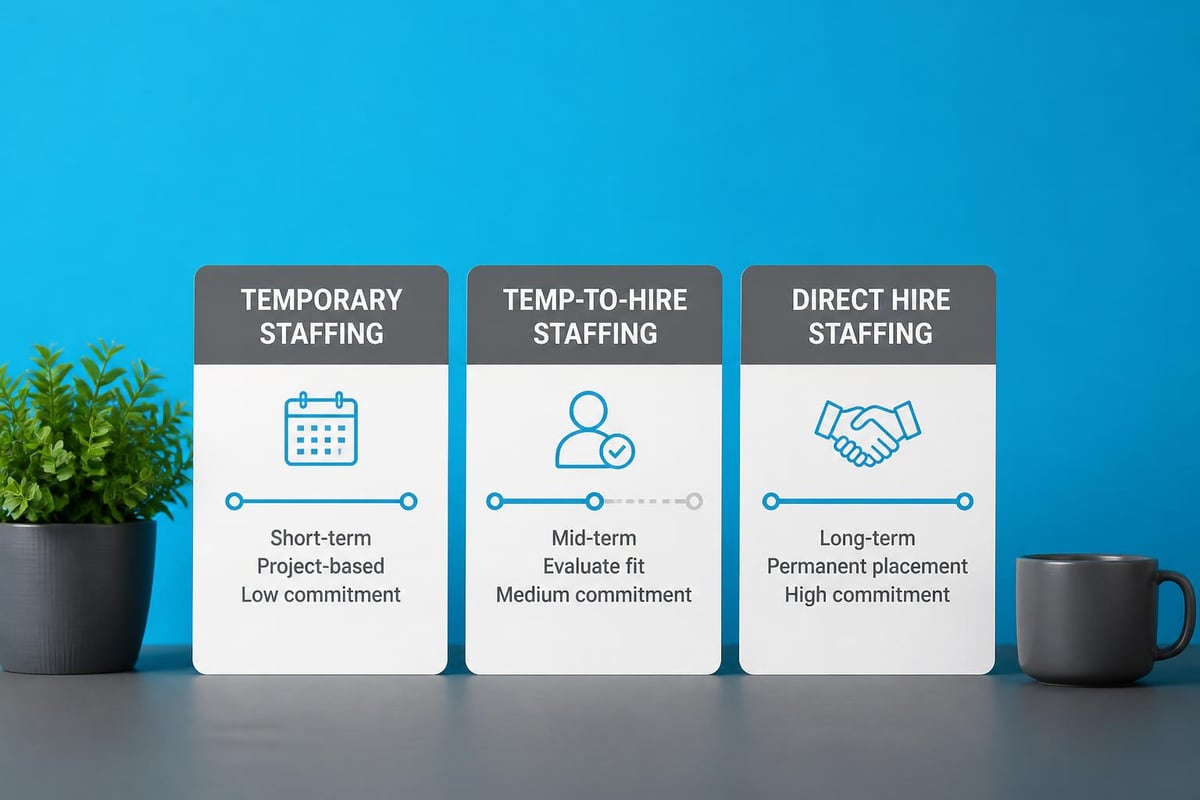
Private staffing agencies typically operate through three distinct engagement models:
Temporary staffing addresses short-term needs, seasonal peaks, or project-based work. This model provides immediate workforce access without long-term employment commitments, making it ideal for construction projects, industrial maintenance shutdowns, or maritime operations with variable labor demands.
Temp-to-hire arrangements allow employers to evaluate candidates in actual working conditions before making permanent employment decisions. This reduces hiring risk while giving workers the opportunity to assess company culture and job fit before committing.
Direct hire placements function as traditional recruitment services where the private staffing agency identifies, vets, and presents qualified candidates for permanent positions. The agency handles the entire recruitment process, delivering pre-screened talent ready for immediate contribution.
According to comprehensive staffing industry statistics, temporary and contract staffing employed an average of 3.1 million workers per day in the U.S. during 2024, demonstrating the massive scale and employer reliance on this workforce model.
Competitive Advantages of Specialized Private Staffing
Not all private staffing agencies deliver equal value. The differentiator lies in specialized expertise and unique talent access that generalist recruiters cannot match.
Industry-Specific Knowledge
A private staffing agency focused on industrial, construction, and maritime sectors understands the exact certifications, safety training, and technical competencies required for each role. This specialized knowledge accelerates placement timelines and dramatically improves candidate quality.
Certified welders require specific AWS certifications. Pipefitters need documented experience with various pipe materials and joining methods. CDL drivers must maintain current DOT medical certifications and clean driving records. A specialized private staffing agency maintains current knowledge of these requirements and pre-screens candidates accordingly.
The Bilingual Workforce Advantage
The most decisive competitive edge in 2026 belongs to agencies offering bilingual staffing capabilities, particularly Spanish-speaking skilled labor. This specialized talent pool addresses critical workforce shortages while delivering superior communication across diverse teams.
Manufacturing facilities, construction sites, and maritime operations increasingly require bilingual supervisors and skilled tradespeople who can bridge language gaps and ensure safety protocol comprehension across multicultural crews. The workforce solutions offered by CDR General Services exemplify this strategic advantage through specialized Latino talent recruitment and culturally competent staffing that competitors simply cannot replicate.
| Capability | Generalist Agency | Specialized Private Staffing Agency |
|---|---|---|
| Industry Certifications | Basic verification | Deep expertise and pre-certification |
| Safety Compliance | Standard background checks | Industry-specific safety training verification |
| Bilingual Talent | Limited availability | Dedicated Spanish-speaking workforce pipeline |
| Gulf South Coverage | Regional limitations | Comprehensive Louisiana, Mississippi, Alabama, Kentucky networks |
| Technical Skills Validation | Resume review | Hands-on skills assessment and certification verification |
Operational Excellence Through Strategic Partnership
The relationship between employers and a private staffing agency should function as a true strategic partnership, not a transactional vendor arrangement. This partnership delivers measurable operational advantages that impact your bottom line.
Rapid Workforce Scaling
Industrial projects demand the ability to scale labor up or down based on project phases, contract awards, or seasonal demand. A private staffing agency with established talent pipelines can deploy teams of 10, 50, or 100+ workers within days rather than the weeks or months required for traditional hiring.
This scalability proves especially critical for:
- Construction project mobilization requiring immediate crew deployment
- Plant maintenance shutdowns needing specialized tradespeople for concentrated timeframes
- Maritime operations with fluctuating labor needs based on shipping schedules
- Warehouse operations experiencing seasonal volume spikes
Risk Transfer and Compliance Management
Employment law complexity continues escalating in 2026. A competent private staffing agency assumes substantial liability and compliance burdens that would otherwise fall on your organization.
Payroll administration, workers' compensation insurance, unemployment claims, and tax withholding all transfer to the staffing agency for temporary and contract workers. This administrative relief allows your team to focus on core operations rather than HR complexity.
When evaluating potential partners, the qualities to look for in a staffing agency include demonstrated compliance expertise, robust risk management protocols, and transparent communication practices that support informed decision-making.
Safety-First Approach as Non-Negotiable Standard
In industrial, construction, and maritime environments, safety isn't a competitive differentiator-it's the baseline requirement. A private staffing agency operating in these sectors must demonstrate an unwavering commitment to worker safety and regulatory compliance.
Pre-Deployment Safety Protocols
Every placed worker should complete comprehensive safety orientation before site deployment:
- Industry-specific safety training relevant to the work environment
- PPE requirements verification and proper usage instruction
- Site-specific hazard awareness briefings
- Emergency response procedures familiarization
- OSHA compliance documentation and recordkeeping
The best practices for employee safety established by industry associations emphasize the staffing agency's responsibility to foster safe work environments through proactive safety culture, continuous training, and rigorous incident prevention protocols.

Ongoing Safety Management
Safety responsibility doesn't end at placement. Elite private staffing agencies maintain continuous oversight through regular site visits, safety performance monitoring, and immediate incident response protocols. This ongoing engagement protects workers, minimizes client liability, and demonstrates the agency's commitment to long-term partnership rather than transactional placement.
High-Volume Onboarding Efficiency
The ability to rapidly onboard large workforce deployments separates competent agencies from industry leaders. High-volume onboarding requires systematic processes, technology integration, and meticulous attention to compliance details.
Streamlined Documentation and Credentialing
Modern private staffing agencies leverage technology platforms to accelerate the traditionally cumbersome onboarding process:
- Digital I-9 verification with remote identity authentication
- Electronic background check integration delivering results within 24-48 hours
- Automated skills certification verification against industry databases
- Mobile-first candidate experience allowing documentation completion from any device
- Compliance tracking dashboards providing real-time visibility into onboarding status
The best practices for high-volume onboarding emphasize the importance of efficient processes that move candidates from offer acceptance to work-ready status as quickly as possible while maintaining thorough compliance verification.
Financial Considerations and Payroll Excellence
The financial relationship with a private staffing agency involves more complexity than simple hourly rates. Understanding the complete cost structure enables accurate budgeting and ROI calculation.
Transparent Pricing Models
Professional staffing agencies operate on clearly defined markup or fee structures:
Markup percentage on hourly wages covers the agency's operational costs, insurance, compliance administration, and profit margin. Typical markups range from 40% to 75% depending on skill level, volume, and assignment duration.
Direct hire fees typically equal 15% to 25% of the placed candidate's first-year salary, paid upon successful placement and completion of any guarantee period.
Payroll Accuracy and Compliance
Staffing agencies must maintain impeccable payroll accuracy while managing the cash flow challenges of weekly pay cycles. The best payroll practices for staffing firms focus on payment accuracy, regulatory compliance, and robust cash flow management to support consistent weekly payroll delivery.
Accurate time tracking, proper wage classification, overtime calculation, and multi-state compliance all require sophisticated payroll systems and experienced administration. Your private staffing agency partner should demonstrate mastery of these operational fundamentals.
Technology Integration and Data-Driven Performance
In 2026, leading private staffing agencies leverage technology not just for operational efficiency but for strategic workforce intelligence that drives better business decisions.
Applicant Tracking and Talent Pipeline Management
Robust applicant tracking systems (ATS) enable agencies to maintain searchable databases of pre-vetted candidates, track certification expiration dates, manage re-engagement campaigns for previous workers, and quickly identify qualified talent when urgent needs arise.
This technology foundation allows rapid response to client requests. When you need five certified welders tomorrow morning, the agency's ATS immediately identifies available candidates matching your exact requirements.
Performance Analytics and Workforce Intelligence
Data-driven staffing partners provide regular performance reporting that quantifies the partnership value:
- Time-to-fill metrics measuring how quickly positions are filled
- Retention rates tracking assignment completion and worker tenure
- Safety incident rates comparing your staffed workers against industry benchmarks
- Quality metrics measuring supervisor satisfaction and worker performance
- Cost per hire analysis demonstrating ROI compared to direct hiring
Advanced agencies also leverage AI and automation tools to enhance operational efficiency. Platforms like RankPill demonstrate how AI technology transforms content creation and marketing effectiveness, while similar AI applications in staffing streamline candidate matching and improve placement quality.
Industry-Specific Expertise Across Key Sectors
A private staffing agency's value directly correlates to its depth of knowledge within your specific industry. Surface-level understanding produces mediocre results. Deep expertise delivers transformational workforce capability.
Industrial and Manufacturing Staffing
Industrial environments demand workers who understand production processes, quality standards, and safety protocols specific to manufacturing operations. A specialized private staffing agency maintains relationships with certified welders, CNC operators, quality control technicians, maintenance mechanics, and production supervisors who bring immediate productivity without extended training periods.
Construction and Skilled Trades
Construction staffing requires understanding various trades, certification requirements, union relationships, and project-based labor dynamics. The agency must quickly deploy electricians, HVAC technicians, heavy equipment operators, general laborers, and project coordinators who integrate seamlessly into existing crews and maintain safety standards across diverse job sites.
Transportation and Logistics
The transportation sector presents unique challenges including DOT compliance, driver qualification files, hours of service regulations, and vehicle-specific licensing. A competent private staffing agency maintains pre-qualified pools of Class A CDL drivers, Class B CDL drivers, forklift operators, warehouse personnel, and logistics coordinators who meet all regulatory requirements and deliver reliable service.

Maritime and Port Operations
Maritime staffing demands knowledge of TWIC requirements, maritime certifications, port security protocols, and specialized equipment operation. Agencies serving this sector must understand longshoreman requirements, vessel maintenance crew qualifications, port equipment operators, and the unique regulatory environment governing maritime employment.
Regional Expertise and Local Market Knowledge
National staffing agencies offer broad coverage but often lack the deep local relationships and market intelligence that drive superior results. Regional specialists understand local labor market dynamics, prevailing wage rates, competitor hiring patterns, and community talent pools.
Gulf South Market Specialization
The Louisiana, Mississippi, Alabama, and Kentucky corridor presents unique workforce characteristics, industry concentrations, and regulatory environments. A private staffing agency with dedicated Gulf South expertise understands:
- Petrochemical industry staffing patterns and shutdown scheduling
- Port and maritime labor dynamics across Gulf Coast facilities
- Construction seasonality and project pipeline visibility
- Local certification requirements and training provider relationships
- Regional wage expectations and competitive compensation benchmarks
This local intelligence enables more accurate candidate sourcing, realistic timeline projections, and competitive advantage through established community relationships that national competitors cannot replicate.
Avoiding Common Partnership Mistakes
Even experienced employers make critical errors when engaging a private staffing agency. Understanding these pitfalls enables proactive mitigation and stronger partnership outcomes.
Inadequate Communication and Expectation Setting
The most common failure point involves unclear communication about role requirements, performance expectations, work environment realities, and success criteria. Comprehensive job descriptions, detailed safety requirements, and honest cultural assessment create alignment that prevents placement failures.
Healthcare facilities frequently encounter similar challenges, with the most common mistakes healthcare facilities make including inadequate onboarding, unrealistic expectations, and poor communication-lessons equally applicable across industrial staffing.
Focusing Solely on Price
The lowest bill rate rarely delivers the best value. When a private staffing agency undercuts market rates significantly, they're cutting corners somewhere-reduced screening, minimal safety training, inadequate insurance coverage, or compromised candidate quality. These hidden costs manifest through higher turnover, safety incidents, or performance issues that far exceed any initial savings.
Neglecting the Partnership Aspect
Transactional relationships produce transactional results. Strategic partnerships require investment from both parties: regular communication, performance feedback, workforce planning collaboration, and mutual commitment to continuous improvement. The best outcomes emerge when employers treat their private staffing agency as an extension of their internal team rather than an outside vendor.
The Cultural Competency Imperative
Workforce diversity isn't just a compliance checkbox in 2026-it's a competitive necessity that drives innovation, expands talent access, and enhances organizational resilience. A private staffing agency that truly understands cultural competency delivers advantages competitors cannot match.
Bilingual Staffing as Strategic Advantage
The ability to deploy bilingual supervisors, skilled tradespeople, and support staff eliminates communication barriers that compromise safety, reduce productivity, and create cultural friction. Spanish-speaking workers represent an enormous talent pool often overlooked by competitors lacking the cultural competency and recruitment networks to access this workforce effectively.
Manufacturing operations benefit from bilingual quality control technicians who can train and supervise diverse teams. Construction sites gain safety advantages through bilingual safety coordinators who ensure universal protocol comprehension. Logistics operations improve efficiency through bilingual warehouse supervisors who optimize multicultural team performance.
Supply chain operations increasingly require sophisticated intelligence capabilities to navigate global complexity. While platforms like The Sov Sentinel help companies master strategic dependencies and map supplier risks across geopolitical landscapes, similar strategic thinking applies to workforce management-understanding labor market dynamics, talent dependencies, and cultural factors that impact workforce availability and performance.
Measuring ROI and Partnership Value
Quantifying the return on investment from your private staffing agency relationship requires looking beyond simple cost-per-hour comparisons to comprehensive value metrics.
Calculating True Hiring Costs
Internal recruitment for a single skilled position typically involves:
- Recruiter time (40-60 hours at $35-50/hour)
- Hiring manager time (15-25 hours at $50-75/hour)
- Advertising costs ($500-2000 per position)
- Background checks and drug screening ($150-300 per candidate)
- Onboarding administration (20-30 hours at $25-35/hour)
- Training and ramp-up productivity loss (2-4 weeks at 50-75% productivity)
When you calculate these factors, the true cost of internal hiring often exceeds $5,000-8,000 per position before the worker reaches full productivity. A private staffing agency delivering pre-vetted, safety-trained, immediately productive talent often provides superior ROI despite seemingly higher hourly rates.
Strategic Value Beyond Cost
The most significant value often emerges in strategic capabilities:
- Workforce agility enabling rapid scaling without employment commitments
- Risk transfer eliminating liability exposure and administrative burden
- Access to specialized skills unavailable through traditional recruitment
- Market intelligence providing workforce trends and competitive insights
- Focus preservation allowing your team to concentrate on core business rather than recruitment
These strategic advantages compound over time, creating competitive positioning that transcends simple cost calculations.
Frequently Asked Questions
What exactly does a private staffing agency do?
A private staffing agency serves as a strategic workforce partner that recruits, vets, hires, and deploys qualified workers to client companies on temporary, temp-to-hire, or direct hire bases. The agency handles all employment responsibilities including payroll, benefits, workers' compensation, and compliance administration, allowing clients to access skilled talent without traditional hiring burdens.
How quickly can a private staffing agency fill urgent positions?
Timeline depends on role complexity and skill requirements. For general labor and common industrial positions, qualified workers can often deploy within 24-48 hours. Specialized skilled trades requiring specific certifications typically require 3-7 days. The agency's existing talent pipeline and local market relationships directly impact placement speed.
What industries benefit most from private staffing agency partnerships?
Industrial manufacturing, construction, maritime operations, transportation, logistics, and warehousing gain the most significant advantages due to variable labor demands, specialized skill requirements, project-based work, and seasonal volume fluctuations. These industries require workforce agility that internal HR departments struggle to deliver efficiently.
How does pricing work with a private staffing agency?
Temporary and contract staffing operates on a markup model where the agency charges an hourly bill rate that includes the worker's wages plus a percentage covering insurance, administration, compliance, and profit. Direct hire placements typically involve a one-time fee equal to 15-25% of the candidate's first-year salary.
What safety responsibilities does the staffing agency assume?
Reputable agencies provide comprehensive safety training, verify required certifications, supply necessary PPE, maintain workers' compensation coverage, conduct safety orientations, perform ongoing safety monitoring, and investigate any incidents. The agency shares safety responsibility with the client, with specific divisions outlined in the service agreement.
How do bilingual staffing capabilities create competitive advantage?
Bilingual workers, particularly Spanish-speaking skilled tradespeople and supervisors, eliminate communication barriers that compromise safety, reduce productivity, and create cultural friction. This specialized talent pool remains largely inaccessible to competitors lacking dedicated Latino recruitment networks and cultural competency expertise.
What differentiates a specialized private staffing agency from generalist recruiters?
Specialized agencies maintain deep industry knowledge, understand specific certifications and technical requirements, maintain pre-vetted talent pipelines in specialized trades, deliver faster placements with higher quality matches, and provide strategic workforce intelligence that generalists cannot replicate.
How can I verify a private staffing agency's safety record and compliance?
Request their OSHA incident rates, workers' compensation modification rate (experience mod), proof of insurance coverage, safety training curricula, compliance certifications, and client references specifically addressing safety performance. Legitimate agencies provide this documentation transparently.
When should I consider partnering with CDR General Services for my staffing needs?
If you operate in the Gulf South region and require industrial, construction, maritime, or transportation workforce solutions-particularly when bilingual capabilities, safety-certified personnel, or rapid scaling are critical-CDR General Services delivers unmatched expertise and specialized Latino talent access that competitors cannot match.
A private staffing agency transforms from transactional vendor to strategic partner when specialized expertise, safety commitment, and cultural competency align with your operational demands. The workforce challenges facing industrial, construction, and maritime operations in 2026 require more than generic recruitment-they demand partners who understand your industry, deliver immediately productive talent, and provide the bilingual capabilities that bridge communication gaps across diverse teams. CDR General Services delivers this decisive advantage through unparalleled Spanish-speaking workforce expertise, safety-first culture, and deep Gulf South market knowledge that positions your operations for sustained competitive success.