

When construction project managers face budget pressure in 2026, they quickly discover that construction general labor cheaper than tiger labor offers immediate cost relief without sacrificing project timelines. The decision between hiring specialized "tiger" laborers-highly trained craft workers commanding premium wages-and general laborers who handle the bulk of site work determines whether projects finish on budget or bleed red ink. Understanding this cost differential isn't about cutting corners; it's about strategic workforce deployment that maximizes value while maintaining safety and quality standards across your jobsite.
Understanding the True Cost Gap Between General and Tiger Labor
The wage differential between general construction workers and specialized tiger labor creates substantial budget implications. General laborers in the Gulf South region typically earn $15-$22 per hour, while certified welders, pipefitters, and electricians command $35-$65 per hour depending on certification level and project complexity.
Labor Rate Comparison Table:
| Worker Category | Hourly Wage Range | Annual Cost (2,000 hrs) | Premium vs. General |
|---|---|---|---|
| General Laborer | $15-$22 | $30,000-$44,000 | Baseline |
| Forklift Operator | $18-$25 | $36,000-$50,000 | 20-30% |
| Certified Welder | $35-$50 | $70,000-$100,000 | 130-160% |
| Journeyman Electrician | $40-$65 | $80,000-$130,000 | 165-195% |
This data reveals why construction general labor cheaper than tiger labor becomes the obvious choice for scope items that don't require specialized licensing or certification.
Where General Labor Delivers Maximum Value
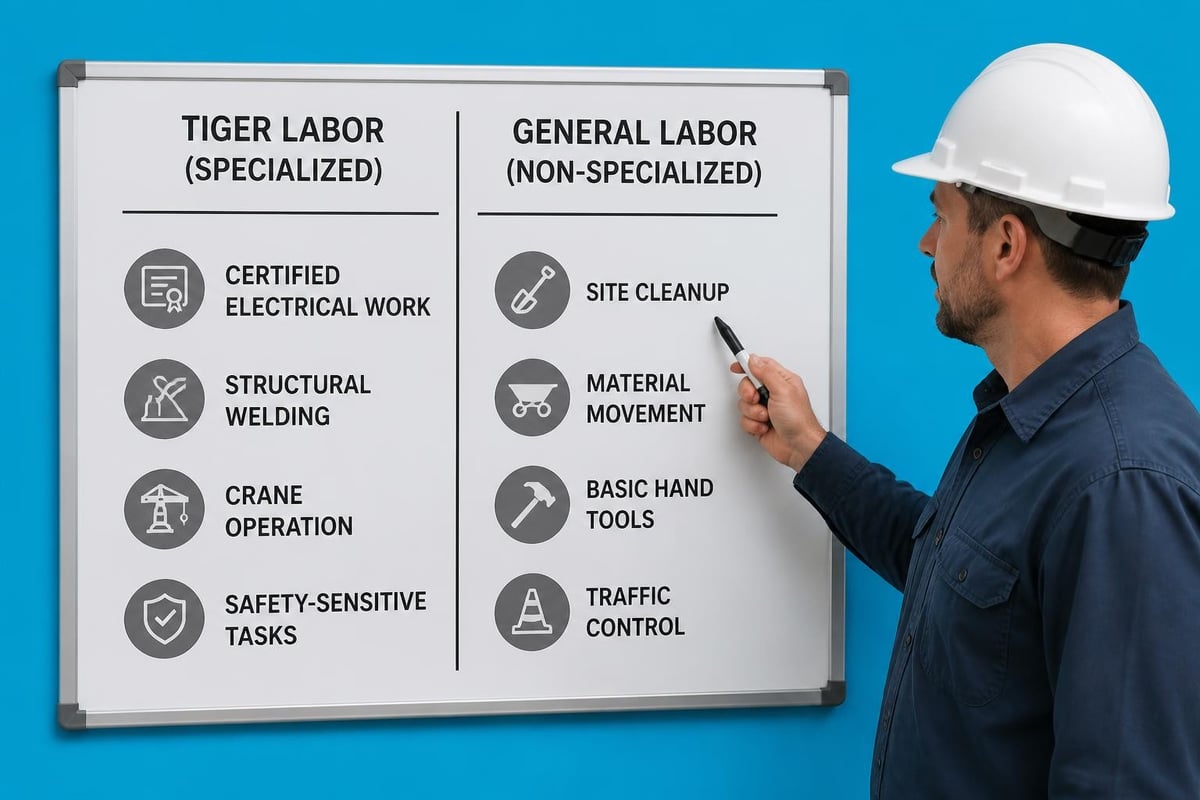
Smart contractors recognize specific tasks where general labor performs identically to higher-paid specialists:
- Site preparation and cleanup
- Material handling and transport
- Demolition and debris removal
- Concrete form assembly assistance
- Basic excavation and trenching
- Traffic control and safety watch
These essential functions consume significant labor hours but don't require the expertise that justifies premium wages. Construction labor shortages in 2024 have intensified wage pressure across all categories, making strategic labor deployment even more critical.
The Financial Impact on Total Project Costs
Labor represents approximately 40-50% of total construction costs according to the National Association of Home Builders cost breakdown. When half your budget flows to wages, even modest per-hour savings multiply into substantial bottom-line improvements.
Consider a mid-size commercial renovation requiring 10,000 labor hours. Deploying general labor for 6,000 appropriate hours at $20/hour instead of tiger labor at $45/hour saves $150,000 on that project alone.
Project Cost Modeling Example:
Total Labor Hours: 10,000
Specialized Tiger Labor Required: 4,000 hours @ $45/hour = $180,000
General Labor Opportunity: 6,000 hours @ $20/hour = $120,000
Total Labor Cost: $300,000
Alternative All-Tiger Approach:
10,000 hours @ $45/hour = $450,000
Savings: $150,000 (33% reduction)
This math explains why construction general labor cheaper than tiger labor fundamentally transforms project economics.
Hidden Cost Multipliers Beyond Base Wages
The wage differential represents only the starting point. Additional cost factors compound the advantage:
- Reduced benefit burdens since general labor often accepts lower-cost benefit packages
- Simpler recruitment costs with larger candidate pools and faster hiring cycles
- Lower overtime premiums when base rates start lower
- Decreased training investment for non-specialized roles
Union agreements often mandate wage premiums that further widen the gap. The Economic Policy Institute’s wage premium data shows unionized construction workers earn 20-30% more than non-union counterparts performing similar work, creating another lever contractors pull to control costs.
Strategic Deployment: Getting the Mix Right
The optimal labor strategy isn't wholesale replacement of skilled workers with general labor. It's precision matching of worker capability to task requirements.
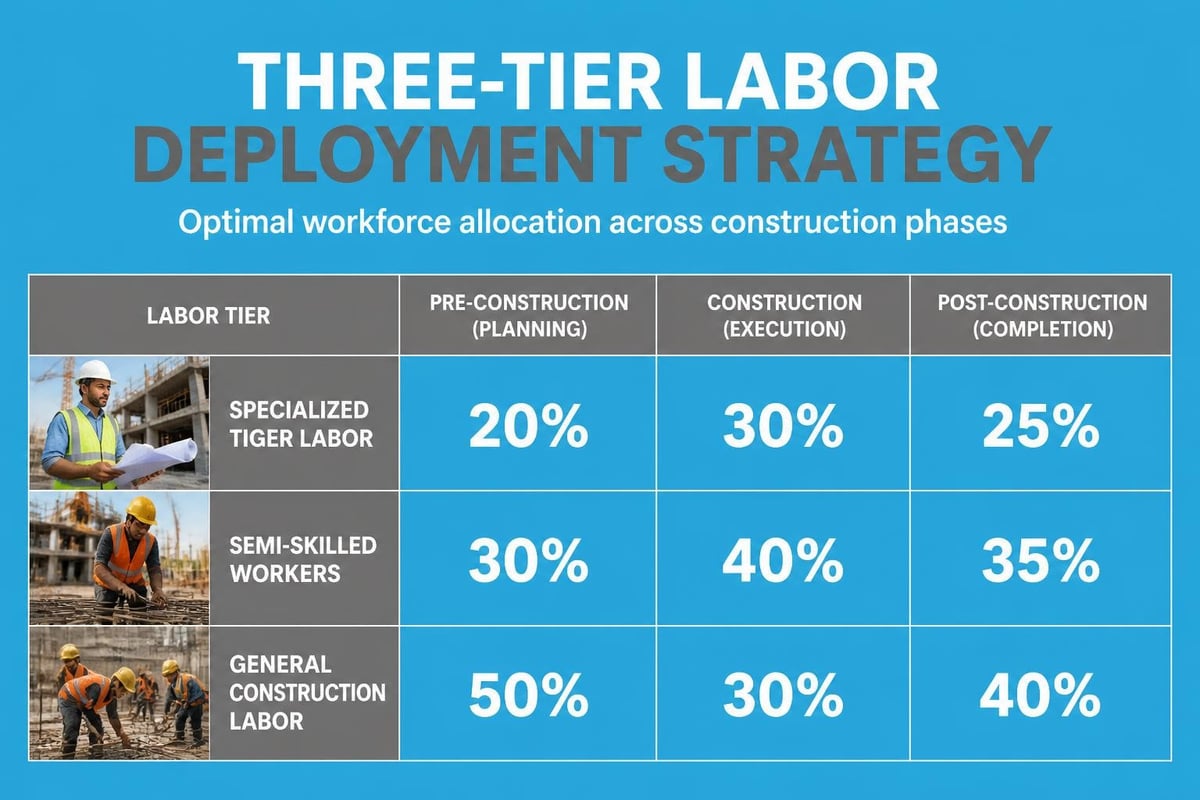
The Three-Tier Deployment Framework
Tier 1: Specialized Tiger Labor (20-40% of hours)
Tasks requiring licensure, certification, or years of apprenticeship training. Code compliance work, complex installations, quality-critical fabrication.
Tier 2: Semi-Skilled Labor (30-40% of hours)
Workers with some training but not full journeyman status. Equipment operators, experienced carpenters' helpers, concrete finishers.
Tier 3: General Labor (30-50% of hours)
Entry-level workers handling physical tasks, material logistics, site maintenance, and support functions.
Projects achieving the best margins typically deploy construction general labor cheaper than tiger labor for that critical 30-50% tier, reserving premium wages for work that genuinely demands it.
Risk Management and Quality Considerations
Cost savings mean nothing if they generate safety incidents, quality failures, or schedule delays. The construction general labor cheaper than tiger labor strategy requires robust controls.
Safety Protocol Requirements
General laborers need comprehensive safety training even though they're not performing specialized work. OSHA’s 2024 injury and illness data shows that improper training and inadequate supervision drive most preventable incidents.
Essential Safety Standards:
| Safety Element | General Labor Requirement | Verification Method |
|---|---|---|
| OSHA 10-Hour | Mandatory for all workers | Card verification |
| Site-Specific Orientation | First-day requirement | Sign-off sheet |
| PPE Training | Task-specific instruction | Supervisor observation |
| Fall Protection Awareness | Required for elevated work | Certification check |
| Hazard Communication | Chemical/material training | Training log |
Contractors who skip these fundamentals discover that injury costs and project shutdowns eliminate any wage savings multiple times over.
Quality Assurance Through Proper Supervision
The supervision ratio becomes critical when deploying lower-cost general labor. One experienced foreman can effectively oversee 6-8 general laborers on straightforward tasks. Complex or quality-sensitive work requires tighter ratios.
General labor performs excellently when given clear direction, proper tools, and immediate feedback. The failure mode isn't worker capability but inadequate supervision and unclear expectations.
The Immigration and Workforce Availability Factor
The Brookings Institution’s analysis of infrastructure workforce challenges highlights immigrant labor's essential role in construction. Latino workers represent a growing percentage of the general labor workforce, particularly in the Gulf South region.
This demographic shift creates opportunities for contractors who understand cultural competence and bilingual communication.
The Bilingual Workforce Advantage
Spanish-speaking general labor pools offer several strategic advantages:
- Larger candidate availability reducing time-to-fill
- Strong work ethic and reliability metrics
- Cultural emphasis on team collaboration
- Competitive wage expectations aligned with general labor budgets
Contractors accessing bilingual staffing partners gain workforce flexibility that monolingual-only approaches cannot match. When construction general labor cheaper than tiger labor drives your strategy, tapping the broadest possible candidate pools becomes essential.
Market Conditions Driving the Cost Calculus
The Associated General Contractors industry surveys reveal ongoing labor shortages across all construction categories. Paradoxically, shortages increase the value of general labor deployment strategies.
When specialized tiger labor becomes scarce, wage inflation accelerates faster than for general positions. The cost differential widens, making strategic substitution even more financially attractive.
2026 Market Realities
Current market conditions favor contractors who master flexible labor deployment:
- Tiger labor shortages push specialized wages 8-12% higher annually
- General labor pools remain more stable with 3-5% annual increases
- Project backlogs create schedule pressure rewarding faster crew assembly
- Material cost inflation increases the percentage emphasis on controlling labor costs
These trends ensure that construction general labor cheaper than tiger labor remains a dominant strategic consideration through 2026 and beyond.
Building Your Optimized Labor Strategy
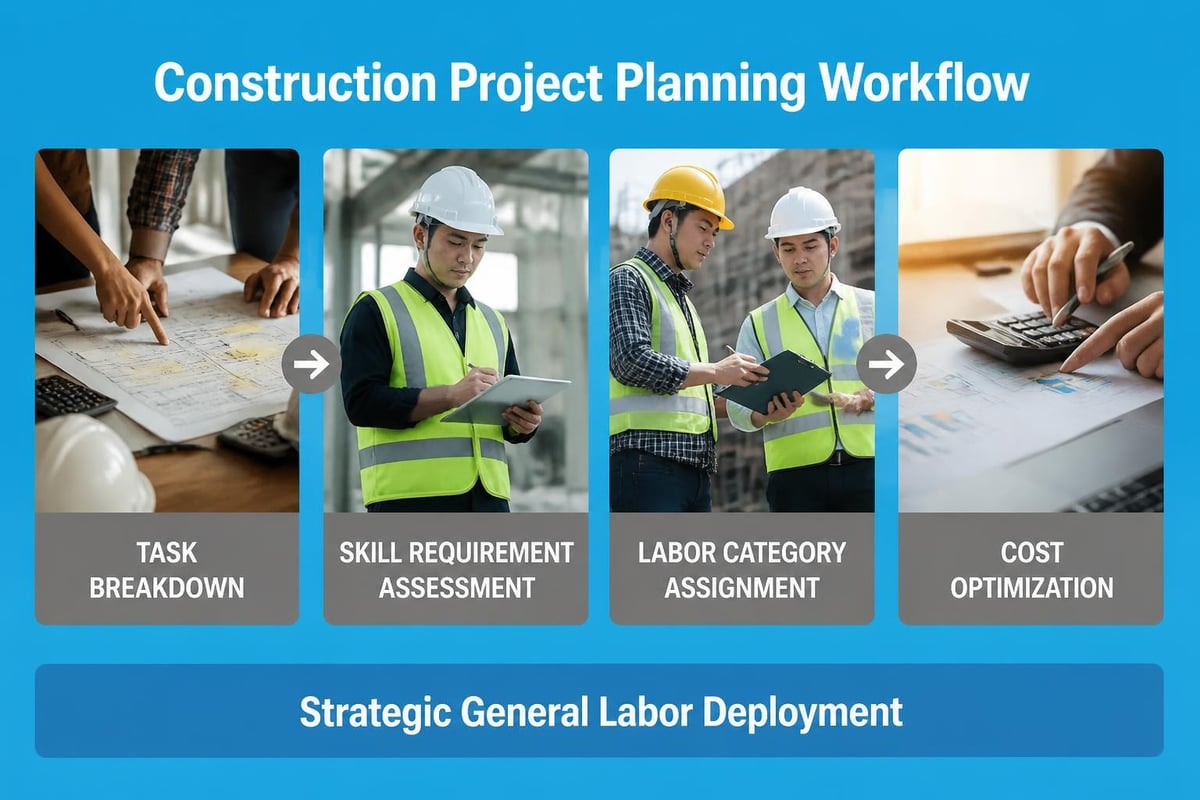
Implementing a cost-effective labor mix requires systematic planning before the first shovel hits dirt.
Step-by-Step Deployment Process
- Task Analysis: Break the project scope into discrete activities with skill requirements clearly defined
- Hour Allocation: Estimate labor hours by task category and required skill level
- Cost Modeling: Calculate total labor cost under different deployment scenarios
- Risk Assessment: Identify quality, safety, and schedule risks in each scenario
- Supervision Planning: Design oversight structure matching your labor mix
- Staffing Execution: Partner with agencies offering both specialized and general labor pools
- Performance Monitoring: Track productivity, quality, and safety metrics by labor category
This process transforms construction general labor cheaper than tiger labor from a vague concept into a concrete competitive advantage.
Staffing Partnership Selection Criteria
Your staffing partner determines whether this strategy succeeds or fails. Essential capabilities include:
- Pre-screened, safety-certified candidate pools
- Rapid deployment capability for schedule changes
- Bilingual recruiting and communication infrastructure
- Deep understanding of construction work requirements
- Proven track record across your specific project types
The wrong partner delivers warm bodies. The right partner delivers a strategic workforce advantage.
Frequently Asked Questions
What is the typical cost difference between general labor and tiger labor?
General construction laborers typically earn $15-$22 per hour in the Gulf South, while specialized tiger labor (certified welders, electricians, pipefitters) commands $35-$65 per hour. This represents a 60-195% premium for specialized workers, depending on certification level and project complexity. The total cost differential includes not just base wages but also benefits, overtime premiums, and recruiting costs.
Which construction tasks are best suited for general labor instead of specialized workers?
General labor excels at site preparation, material handling, cleanup, demolition, concrete form assembly assistance, basic excavation, and traffic control. These essential functions require physical capability and safety awareness but not specialized licensing or years of apprenticeship training. Smart contractors reserve tiger labor exclusively for code-compliance work, complex installations, and quality-critical fabrication.
Does using cheaper general labor create safety risks on construction sites?
Cost savings never justify compromised safety. General laborers require comprehensive OSHA 10-hour training, site-specific orientation, PPE instruction, and proper supervision. When contractors implement robust safety protocols and maintain appropriate supervisor-to-worker ratios, general labor performs safely. The risk emerges from inadequate training and supervision, not from the labor category itself.
How does the construction labor shortage affect the decision between general and tiger labor?
The 2026 construction labor shortage affects specialized tiger labor more severely than general labor positions. Scarcity drives faster wage inflation for specialized workers (8-12% annually) compared to general labor (3-5% annually), widening the cost differential. This makes strategic deployment of general labor increasingly valuable as the premium for specialized workers continues climbing.
What supervision ratio is needed when deploying general construction labor?
One experienced foreman can effectively oversee 6-8 general laborers on straightforward tasks like cleanup, material handling, or basic site preparation. Quality-sensitive or complex work requires tighter ratios of 1:4 or 1:5. The supervision structure determines whether lower-cost labor delivers genuine savings or creates rework and schedule delays that eliminate the wage advantage.
Can bilingual general labor provide additional project advantages?
Spanish-speaking general labor pools offer larger candidate availability, strong reliability metrics, competitive wage expectations, and cultural emphasis on teamwork. Contractors accessing bilingual staffing gain workforce flexibility and faster crew assembly. In the Gulf South region, Latino workers represent a growing percentage of available general labor, making bilingual capability a strategic advantage.
How do I calculate the total project savings from using general instead of tiger labor?
Calculate the hours required for tasks that can be performed by either category. Multiply those hours by the wage differential (typically $20-$40 per hour). For a project with 6,000 such hours, the differential at $25/hour saves $150,000. Include additional savings from reduced benefits costs, faster recruitment, and lower overtime premiums for comprehensive modeling.
What quality assurance steps prevent issues when using lower-cost general labor?
Implement clear work instructions, provide proper tools, establish immediate feedback loops, and maintain appropriate supervision ratios. Conduct regular quality checks at defined intervals rather than only final inspection. Pre-qualify your staffing partner to ensure they provide trained, safety-certified workers. Quality failures stem from poor management and unclear expectations, not from the labor category.
How can CDR General Services help optimize my construction labor costs?
CDR General Services specializes in providing safety-certified general construction labor and bilingual Spanish-speaking workforce solutions across the Gulf South. Our pre-screened, ready-to-work teams deliver immediate deployment capability while our expertise in both general and specialized labor allows strategic workforce optimization. Contact us to build a cost-effective labor strategy tailored to your specific project requirements.
Should I completely replace tiger labor with general labor to maximize savings?
Never. The optimal strategy deploys each labor category where it delivers maximum value. Reserve tiger labor (20-40% of hours) for licensed work, code compliance, and complex installations. Use general labor (30-50% of hours) for support functions, material logistics, and basic site work. Semi-skilled workers fill the middle tier. Strategic matching of capability to requirements, not wholesale replacement, generates sustainable competitive advantage.
The financial reality is clear: construction general labor cheaper than tiger labor creates measurable project savings when deployed strategically with proper safety protocols and supervision. Smart contractors in 2026 master the art of matching labor capability to task requirements, reserving premium wages for work that genuinely demands specialized expertise. CDR General Services delivers the safety-certified, bilingual general labor workforce and strategic staffing expertise that transforms this concept into competitive advantage across Louisiana, Mississippi, Alabama, and Kentucky. Our unmatched Spanish-speaking workforce specialty and rapid deployment capability give you the labor flexibility to control costs without compromising quality or safety.
Published September 3, 2026 by CDR
All articles