

When executives evaluate workforce strategies, one question dominates budget conversations: is temporary staffing cheaper than hiring full-time employees? The answer isn't simple. It depends on your industry, project timelines, labor market conditions, and hidden costs you probably haven't calculated. What looks cheaper on paper can cost you more when you factor in productivity gaps, turnover, and compliance risks. The truth is, temporary staffing delivers measurable savings in specific scenarios while direct hiring makes sense in others. This analysis breaks down the real numbers, exposes the hidden expenses, and shows you exactly when each strategy wins.
The Direct Cost Comparison: Breaking Down the Numbers
To determine if temporary staffing is cheaper than hiring, start with the obvious line items. Direct hire costs include salary, benefits, payroll taxes, and recruitment expenses. Temporary staffing costs typically show up as a markup rate over base wages.
Direct Hire Baseline Costs:
- Base salary or hourly wage
- Health insurance (averaging $7,739 annually per employee in 2026)
- Retirement contributions (3-6% of salary)
- Payroll taxes (7.65% FICA, plus state unemployment)
- Workers' compensation insurance
- Paid time off (vacation, sick days, holidays)
- Recruitment advertising and agency fees (15-25% of annual salary)
- Onboarding and training investments
Temporary Staffing Baseline Costs:
- Hourly bill rate (typically 35-75% markup over base wage)
- No benefit obligations
- No payroll tax administration
- No recruitment costs
- Minimal onboarding investment
- Flexible scaling without severance obligations
The impact of procurement strategies on external workforce management shows that many companies underestimate the total cost of employment when comparing these models.
| Cost Category | Direct Hire | Temporary Staffing |
|---|---|---|
| Base Compensation | $45,000/year (example) | $52,000/year (example with markup) |
| Benefits & Taxes | $15,750 (35% loaded cost) | $0 (agency responsibility) |
| Recruitment | $3,000-11,250 | $0 |
| Total Year One | $63,750-72,000 | $52,000 |
This simplified comparison shows temporary staffing can be cheaper, but it ignores critical variables that reverse the equation.
The Hidden Costs That Change Everything
The question "is temporary staffing cheaper than hiring" becomes more complex when you account for costs that don't appear on invoices. Research on hiring and separation costs demonstrates that labor market frictions create substantial hidden expenses.
Hidden Direct Hire Costs:
- Productivity ramp-up time (3-6 months to full productivity)
- Training investments that walk out the door with turnover
- Management time spent on performance reviews and development
- Unemployment insurance claims after termination
- Legal exposure from wrongful termination claims
- Cultural fit mistakes that damage team morale
Hidden Temporary Staffing Costs:
- Knowledge transfer gaps when workers rotate
- Reduced institutional knowledge and process improvements
- Potential quality inconsistencies with new workers
- Limited worker loyalty and engagement
- Coordination overhead managing agency relationships
- Compliance risks if worker classification is challenged

For specialized trades like certified welders or skilled industrial workers in Louisiana, the training investment difference becomes significant. A direct hire pipefitter might require $5,000-15,000 in specialized certification training, while a temporary worker arrives already certified.
When Temporary Staffing Delivers Clear Savings
Is temporary staffing cheaper than hiring for your specific situation? The answer is definitively yes in these scenarios:
1. Short-Duration Projects (Less Than 6 Months)
When you need a crew for a 90-day construction push or seasonal demand surge, temporary staffing eliminates the cost of severance, unemployment claims, and the legal complexity of layoffs. The markup you pay is substantially less than the loaded cost of hiring, training, and then terminating employees.
2. Fluctuating Demand Cycles
Industries with predictable peaks, such as construction seasons or maritime loading cycles, benefit from workforce flexibility. You scale up without the commitment, then scale down without the pain. The agency absorbs the administrative burden and compliance risk.
3. Specialized Skills for Limited Engagements
Need a certified crane operator for two weeks? A bilingual safety coordinator for a specific project phase? Temporary staffing gives you access to niche expertise without the cost of maintaining that skill set year-round.
- Avoid recruitment costs for hard-to-fill specialized roles
- Eliminate training expenses for short-term skill needs
- Access pre-certified talent without certification investment
- Test specialized workers before committing to full-time offers
The benefits of temp-to-perm hiring strategies highlight how smart companies use temporary staffing as a risk-free trial period.
4. Rapid Scaling Without Infrastructure Investment
When you win a contract that doubles your workforce requirement overnight, building the HR infrastructure to recruit, onboard, and manage that growth would cost more than the project margin. Temporary staffing lets you execute without the infrastructure investment.
The Breakeven Point: Where Direct Hire Becomes Cheaper
The question of whether temporary staffing is cheaper than hiring flips after a certain duration. For most industrial and construction roles, the breakeven point falls between 6-12 months.
Calculating Your Breakeven Timeline:
- Calculate total loaded cost of direct hire (salary + benefits + taxes + recruitment)
- Calculate annualized temporary staffing cost (hourly rate × 2,080 hours)
- Subtract direct hire recruitment and onboarding costs from year one
- Divide the remaining difference by monthly temporary staffing premium
- Result = number of months where temporary costs less
| Duration | Better Choice | Primary Reason |
|---|---|---|
| 0-3 months | Temporary | Recruitment and onboarding costs exceed markup |
| 3-6 months | Temporary (usually) | Benefit costs haven't accumulated enough to offset markup |
| 6-12 months | Case-dependent | Breakeven zone varies by role and markup rate |
| 12+ months | Direct Hire | Cumulative markup exceeds total employment cost |
This analysis assumes average turnover. High turnover rates extend the period where temporary staffing is cheaper because you avoid repeated recruitment and training cycles.
Industry-Specific Cost Analysis: Construction, Industrial, and Maritime
Is temporary staffing cheaper than hiring across different sectors? The answer varies dramatically based on industry-specific factors.
Construction Sector Economics
Construction projects have defined timelines, making temporary staffing naturally aligned with project lifecycles. A general contractor building a commercial facility requiring exterior expertise needs framers, electricians, and finish crews at different phases.
Temporary staffing advantages in construction:
- Match workforce to project phases without carrying idle labor
- Access trade certifications without sponsoring training programs
- Avoid workers' compensation claims extending beyond project completion
- Scale crews up for deadline pushes without permanent commitments
- Eliminate seasonal layoff costs and unemployment insurance spikes
The markup rate for skilled construction trades (typically 45-65%) is offset by the elimination of off-season carrying costs. If your crews work 8 months annually, the 4-month gap makes temporary staffing definitively cheaper than maintaining year-round employees who aren't billing.
Industrial Facility Staffing
Manufacturing and industrial facilities face a different calculation. Is temporary staffing cheaper than hiring for steady-state operations? Usually not. For continuous operations, the 12-month breakeven point means direct hiring wins.
But temporary staffing still delivers value for:
- Maintenance turnarounds and planned shutdowns (intense 2-6 week periods)
- Production line expansions before demand is proven
- Covering extended leaves (medical, parental, military)
- Testing new production processes before committing headcount
The key variable is predictability. Unpredictable demand favors temporary staffing even beyond the breakeven point because the cost of idle direct hires exceeds the temporary markup.

Maritime and Logistics Considerations
Maritime operations experience dramatic demand fluctuations based on shipping schedules, weather, and commodity cycles. CDL drivers, forklift operators, and dock workers face feast-or-famine demand patterns.
Studies on agency staffing costs in other industries reveal that quality concerns can make temporary labor more expensive when productivity losses and error rates are factored. In maritime logistics, where safety and efficiency are paramount, this becomes critical.
The answer to "is temporary staffing cheaper than hiring" in maritime settings depends on:
- Predictability of shipping schedules (regular routes favor direct hire)
- Safety certification requirements (specialized certs favor temporary pre-certified workers)
- Seasonal patterns (winter slowdowns favor temporary flexibility)
- Union considerations (some maritime unions restrict temporary usage)
The Competitive Advantage of Bilingual Temporary Staffing
A factor most cost analyses miss: cultural and communication efficiency. Is temporary staffing cheaper than hiring when you factor in the productivity gains from bilingual, culturally competent crews?
In the Gulf South region, construction and industrial projects increasingly require Spanish-speaking workers. The choice isn't just temporary versus direct hire, it's whether you can access qualified bilingual talent at all.
The hidden costs of monolingual staffing:
- Safety incidents from communication failures (each OSHA recordable averages $42,000)
- Rework and quality issues from misunderstood instructions (2-5% of project costs)
- Supervisor time wasted on translation and clarification (15-20% productivity loss)
- Crew cohesion problems reducing overall team efficiency
Specialized staffing providers offering bilingual crews eliminate these hidden costs entirely. The temporary staffing markup becomes cheaper than the cumulative losses from communication gaps.
When you need certified welders, pipefitters, or equipment operators who communicate seamlessly with diverse teams, the question "is temporary staffing cheaper than hiring" shifts from simple cost comparison to total value delivered.
Total Cost of Ownership: The Complete Financial Picture
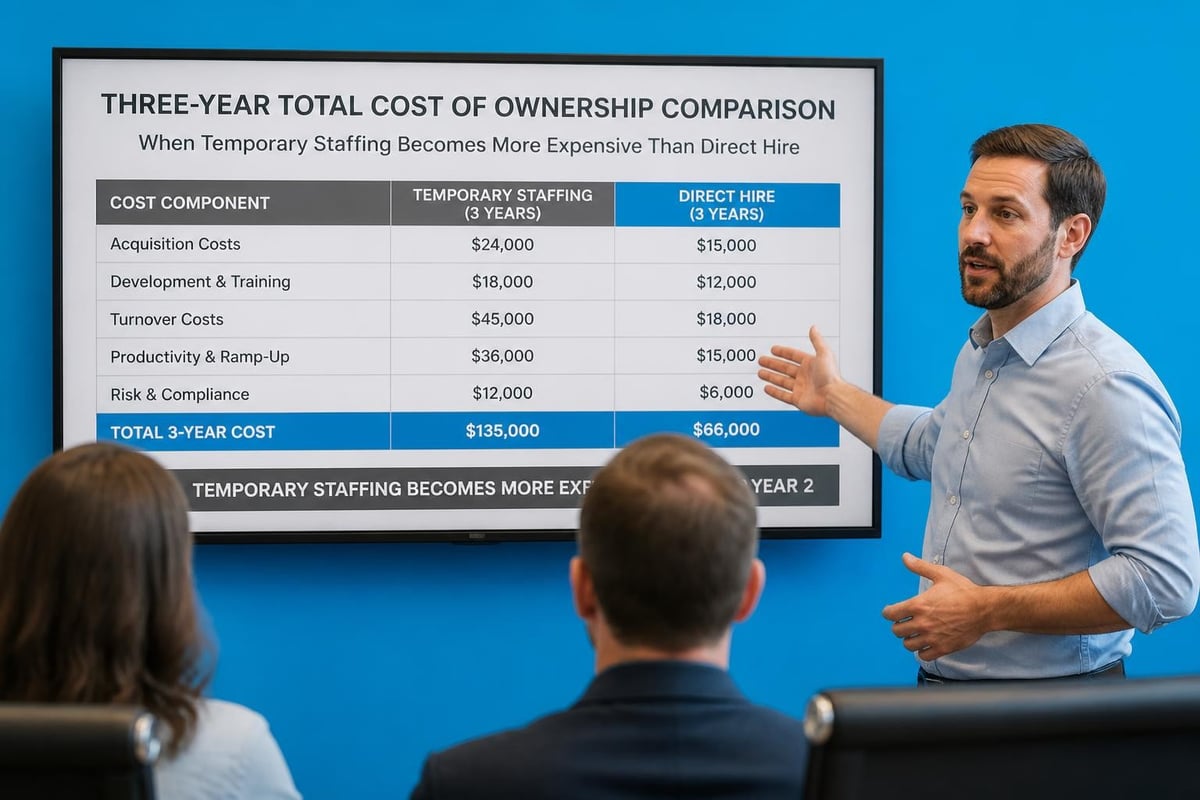
Finance executives understand that "cheaper" means total cost of ownership, not just invoice price. Is temporary staffing cheaper than hiring when you calculate TCO?
Total Cost of Ownership Components:
- Direct compensation (wages/salary)
- Loaded labor costs (benefits, taxes, insurance)
- Acquisition costs (recruitment, screening, onboarding)
- Development costs (training, certifications, skill development)
- Management overhead (HR administration, performance management)
- Turnover and separation costs (exit processes, knowledge loss, replacement recruitment)
- Productivity factors (ramp-up time, learning curve, engagement levels)
- Risk costs (compliance violations, safety incidents, legal exposure)
- Opportunity costs (management time diverted from core business)
| TCO Component | Direct Hire Impact | Temporary Staffing Impact |
|---|---|---|
| Compensation | Base salary | Markup rate (35-75% over base) |
| Benefits/Taxes | 30-40% of salary | $0 (agency pays) |
| Acquisition | $3,000-15,000 | $0 |
| Training | $2,000-20,000 | Minimal |
| Management | Ongoing performance reviews | Minimal direct management |
| Turnover | Full replacement cycle | Quick replacement by agency |
| Productivity | 6-12 month ramp to peak | Immediate contribution |
| Risk | Full employment law exposure | Shared/transferred to agency |
Over a 12-month period for a skilled industrial position at $25/hour base wage, TCO comparison looks like this:
Direct Hire TCO: $52,000 base + $18,200 benefits/taxes + $5,000 recruitment + $3,000 training + $2,500 management overhead = $80,700
Temporary Staffing TCO: $62,500 bill rate (50% markup × 2,080 hours) + $500 coordination overhead = $63,000
This 22% savings makes temporary staffing definitively cheaper for the first year. But year two reverses: direct hire TCO drops to $75,200 (no recruitment/training), while temporary remains at $63,000. By year three, cumulative direct hire cost is lower.
Strategic Decision Framework: Making the Right Choice
Is temporary staffing cheaper than hiring for your specific workforce need? Use this decision framework:
Choose Temporary Staffing When:
- Project duration is under 12 months
- Demand is unpredictable or highly variable
- You need immediate access to specialized skills
- Scaling speed is critical to capturing opportunity
- You want to "try before you buy" for permanent roles
- Seasonal patterns create predictable down periods
- Your HR infrastructure can't handle rapid growth
- You need bilingual or specialized cultural competencies quickly
Choose Direct Hire When:
- The role is permanent and continuous (24+ months)
- Institutional knowledge and process improvement matter
- Building team culture and loyalty is strategic
- Training investment will be amortized over years
- The labor market has abundant qualified candidates
- You have robust HR systems to handle recruitment and administration
- Employee development and career progression are competitive advantages
- Total cost of ownership favors direct employment beyond year two
Consider Hybrid Approaches:
- Core-flex model: Direct hire for baseline needs, temporary for peaks
- Temp-to-perm pipeline: Trial period before conversion offer
- Project-based rotation: Temporary crews for defined projects, direct hire for ongoing operations
- Specialized supplement: Direct hire for common skills, temporary for niche expertise
The smartest workforce strategies combine both approaches based on role requirements and business conditions.
Risk-Adjusted Cost Analysis: Beyond the Numbers
The final factor determining if temporary staffing is cheaper than hiring is risk tolerance. Every workforce decision carries risk, and risk has cost.
Direct Hire Risks:
- Employment law liability: Wrongful termination, discrimination, harassment claims average $75,000-160,000 in legal costs
- Turnover unpredictability: Replacing an employee costs 50-200% of annual salary
- Cultural fit failures: A bad hire damages team morale and productivity (estimated 30% loss for affected team)
- Benefits cost inflation: Healthcare and insurance costs rising 5-8% annually
- Skill obsolescence: Technology changes can make skills irrelevant before ROI is realized
Temporary Staffing Risks:
- Quality variability: Each new worker represents unknown performance
- Institutional knowledge gaps: Continuous worker rotation prevents deep expertise
- Worker classification audits: Misclassification penalties reach $5,000-25,000 per violation
- Supplier dependency: Agency relationship failures disrupt operations
- Limited worker loyalty: Temporary status reduces discretionary effort and commitment
Risk-averse organizations favor temporary staffing because it transfers employment liability to the agency. Risk-tolerant companies with strong HR capabilities favor direct hire because they can manage these exposures effectively.
The question "is temporary staffing cheaper than hiring" must include: cheaper at what level of risk?
Frequently Asked Questions
Is temporary staffing actually cheaper than hiring full-time employees?
Temporary staffing is typically cheaper than hiring for projects under 12 months, seasonal demand, or specialized short-term needs. The markup rate (35-75% over base wage) is offset by elimination of benefits, payroll taxes, recruitment costs, and training investments. Beyond 12 months, direct hire usually becomes less expensive as the cumulative markup exceeds total employment costs.
What hidden costs make temporary staffing more expensive than it appears?
Hidden temporary staffing costs include knowledge transfer gaps when workers rotate, reduced institutional knowledge limiting process improvements, coordination overhead managing agency relationships, and potential quality inconsistencies with new workers. For specialized industrial roles, the learning curve for site-specific procedures can reduce productivity 15-25% compared to experienced direct hires.
When does the breakeven point occur where direct hiring becomes cheaper?
The breakeven point typically occurs between 6-12 months for most industrial and construction roles. Calculate your specific breakeven by comparing total loaded direct hire cost (salary, benefits, taxes, recruitment, training) against annualized temporary staffing cost. High-turnover roles extend the period where temporary staffing remains cheaper because you avoid repeated recruitment and training cycles.
How do I calculate the true cost comparison between temp and direct hire?
Calculate total cost of ownership by including: (1) direct compensation, (2) benefits and payroll taxes (30-40% for direct hire, $0 for temporary), (3) recruitment costs ($3,000-15,000 for direct hire), (4) training investments, (5) management overhead, (6) turnover replacement costs, (7) productivity ramp-up time, and (8) compliance and legal risk exposure. Compare these totals across your expected duration.
Does temporary staffing save money in construction and industrial sectors?
Yes, temporary staffing typically saves money in construction and industrial sectors for project-based work, seasonal peaks, maintenance turnarounds, and specialized skill requirements. Construction projects with defined timelines benefit from matching workforce to project phases without carrying idle labor during gaps. Industrial facilities benefit most during planned shutdowns, production expansions, and demand uncertainty.
What are the tax implications of temporary versus direct hire?
Direct hire requires you to pay employer FICA taxes (7.65%), federal and state unemployment insurance, workers' compensation premiums, and potentially benefits like health insurance. Temporary staffing transfers all payroll tax obligations to the agency, which is included in their markup rate. This eliminates your tax administration burden but doesn't necessarily reduce total tax cost, it's simply included in the bill rate.
Can I save money using temporary staffing as a trial before hiring?
Yes, temp-to-perm arrangements can save money by reducing hiring mistakes. Testing workers for 90-180 days before making a permanent offer eliminates the cost of mis-hires, which average 50-200% of annual salary to replace. You pay the temporary markup during the trial but avoid recruitment costs, and if the worker succeeds, you convert them with confidence knowing they're a proven fit.
How does turnover rate affect whether temporary staffing is cheaper?
High turnover rates make temporary staffing relatively cheaper because the agency absorbs repeated recruitment and training costs. If your direct hire turnover exceeds 30% annually, you're paying recruitment and onboarding costs multiple times per position. Temporary staffing eliminates this cycle, the agency replaces workers at no additional cost to you.
Should I use temporary staffing or hire directly for bilingual workforce needs?
For immediate bilingual workforce needs, especially Spanish-speaking skilled trades in the Gulf South region, temporary staffing through specialized providers delivers faster access to culturally competent, safety-certified crews. Building your own bilingual recruitment pipeline requires significant time and local expertise. Specialized staffing agencies maintain ready talent pools you can access immediately.
How can CDR General Services help me determine the most cost-effective staffing solution?
CDR General Services offers expert consultation to analyze your specific workforce needs, project timelines, and cost structure to determine whether temporary staffing, direct hire, or a hybrid approach delivers optimal value. Our specialized bilingual workforce capabilities and safety-certified talent pools across industrial, construction, and maritime sectors provide flexible, cost-effective solutions tailored to Gulf South region employers.
The equation determining if temporary staffing is cheaper than hiring depends on duration, industry dynamics, risk tolerance, and the true total cost of ownership across your specific workforce requirements. For project-based work, seasonal peaks, and specialized bilingual needs in construction, industrial, and maritime sectors, temporary staffing delivers clear savings while eliminating administrative burden and employment risk. When you need immediate access to safety-certified, culturally competent crews ready to execute demanding Gulf South projects, CDR General Services provides the decisive workforce solution that combines cost efficiency with unmatched quality and reliability.
Published October 2, 2026 by Sanya
All articles