

The employment staffing landscape in 2026 has evolved into a sophisticated ecosystem where speed, specialization, and cultural competency determine competitive advantage. Businesses across industrial, construction, and maritime sectors face unprecedented demands for skilled personnel who can deploy immediately, work safely, and communicate effectively across diverse job sites. The companies that win are those who partner with staffing agencies that deliver not just bodies, but certified, reliable, and culturally competent talent on demand. This is where strategic employment staffing separates industry leaders from the rest of the pack.
What Employment Staffing Really Means in 2026
Employment staffing is the strategic deployment of qualified personnel to meet immediate and long-term workforce demands across industries. It's not about filling positions. It's about delivering the right talent, with the right certifications, at the right time, to keep projects moving and businesses profitable.
The staffing industry has rebounded significantly in the fourth quarter of 2025, signaling renewed confidence in workforce flexibility. Companies now recognize that employment staffing isn't a fallback option but a core business strategy. This shift reflects deeper market realities: project timelines compress, skill requirements intensify, and the cost of a bad hire escalates exponentially.
The Core Components of Modern Employment Staffing
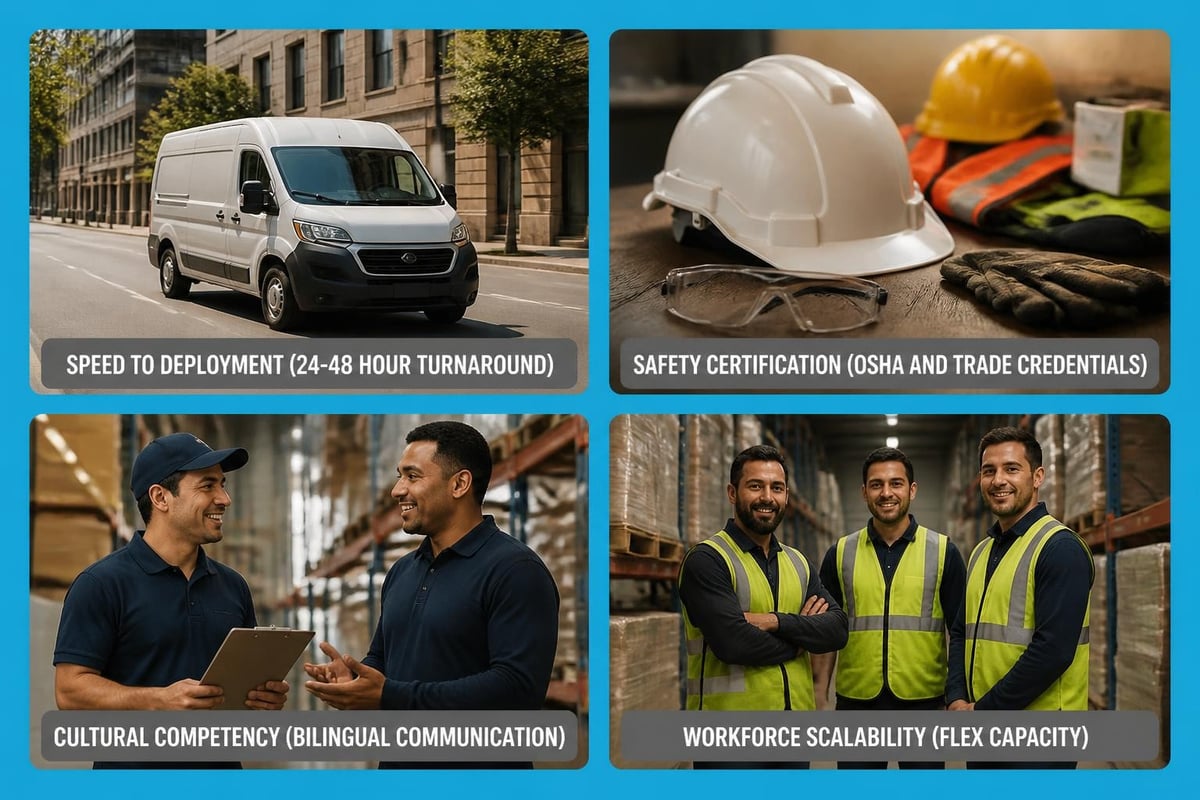
Effective employment staffing operates on four non-negotiable pillars:
- Speed to deployment – Qualified candidates ready within 24-48 hours
- Safety certification – OSHA compliance, trade-specific credentials, verified training
- Cultural competency – Bilingual capabilities and cross-cultural communication
- Scalability – Ability to ramp workforce up or down based on project demands
These elements aren't luxuries. They're baseline requirements for any staffing partner worth consideration in the Gulf South region's demanding industrial environment.
The Industrial Sector Employment Staffing Advantage
Industrial operations demand precision. A missing welder delays a pipeline project. An uncertified electrician creates liability nightmares. The right employment staffing partner eliminates these risks by maintaining a pre-vetted, certified talent pool ready for immediate deployment.
Certified welders represent the gold standard in industrial employment staffing. These professionals carry specialized certifications (6G, TIG, MIG, Stick) and understand the exacting standards of petrochemical, energy, and manufacturing facilities. The difference between a qualified welder and a merely experienced one can be measured in project delays, rework costs, and safety incidents.
Pipefitters and electricians require similar specialization. These trades demand not just technical skill but intimate knowledge of industrial safety protocols, confined space operations, and hazardous material handling. Employment staffing agencies that truly understand these sectors maintain relationships with journeyman-level professionals who can step onto a job site and produce from day one.
| Trade Specialty | Critical Certifications | Typical Deployment Time | Safety Requirements |
|---|---|---|---|
| Certified Welders | 6G, TIG, MIG, AWS D1.1 | 24-48 hours | OSHA 10/30, Confined Space |
| Pipefitters | Journeyman License, NCCER | 24-72 hours | OSHA 30, Rigging Certification |
| Industrial Electricians | Master/Journeyman, NEC | 48-72 hours | Arc Flash, LOTO, OSHA 30 |
| Heavy Equipment Operators | NCCCO, Equipment-Specific | 24-48 hours | OSHA 10, Equipment Certifications |
Construction Employment Staffing Realities
Construction projects live or die on workforce availability. Weather delays, permit issues, and material shortages already compress timelines. Labor shortages compound these challenges exponentially. Strategic employment staffing provides the buffer that keeps projects on schedule and under budget.
Ready-to-work construction teams understand job site protocols, tool safety, and the physical demands of commercial and industrial construction. General labor isn't just about showing up. It's about understanding excavation safety, material handling procedures, and the coordinated teamwork that prevents accidents and maintains productivity.
The key trends shaping the staffing industry in 2025 emphasize technology integration and specialization. These trends accelerate in 2026, particularly in construction where skilled trades shortages persist across the Gulf South.
Transportation and Logistics: The CDL Driver Shortage Solution
The commercial driver shortage represents one of the most acute employment staffing challenges across Louisiana, Mississippi, Alabama, and Kentucky. Every manufacturer, distributor, and construction operation depends on reliable CDL drivers to move materials, equipment, and finished products.
Class A CDL drivers command premium rates because they're essential and scarce. These professionals handle tractor-trailers, transport hazardous materials, and navigate complex logistics networks. The right employment staffing partner maintains relationships with licensed, experienced CDL drivers who understand regional routes, DOT compliance, and customer service expectations.
Forklift operators and warehouse personnel complete the logistics equation. These roles require precision, safety awareness, and the ability to maintain productivity in fast-paced distribution environments. OSHA-certified forklift operators prevent accidents, reduce product damage, and keep supply chains flowing.
The Bilingual Workforce Competitive Edge
Here's what separates elite employment staffing from commodity services: cultural competency and bilingual capabilities. The Gulf South's industrial landscape increasingly relies on Spanish-speaking skilled trades professionals. Companies that can't communicate effectively with their workforce face productivity losses, safety risks, and competitive disadvantages.
A highly-skilled, Spanish-speaking workforce isn't just about translation. It's about cultural understanding, team cohesion, and the ability to deliver safety training, technical instruction, and project coordination in the language that workers understand best. This capability drives measurable improvements in:
- Safety incident reduction through clear communication
- Productivity increases from better instruction comprehension
- Team morale and retention through cultural respect
- Quality outcomes from precise technical direction
Employment staffing agencies that specialize in bilingual talent placement deliver quantifiable competitive advantages that directly impact project profitability and timeline adherence.

Administrative and Clerical Employment Staffing Excellence
Industrial operations don't run on skilled trades alone. Professional office staff, project coordinators, and administrative personnel keep operations organized, compliant, and efficient. Employment staffing for administrative roles requires the same precision as skilled trades placement, but with different evaluation criteria.
Project coordinators must understand construction terminology, scheduling software, and the communication protocols that keep subcontractors, suppliers, and internal teams synchronized. These professionals bridge the gap between field operations and executive management.
Administrative assistants in industrial settings handle everything from safety documentation to vendor relations. They're not generic office workers. They're specialized professionals who understand industry-specific compliance requirements, procurement processes, and the urgency that defines project-driven environments.
The Employment Staffing Evaluation Framework
Choosing an employment staffing partner requires methodical evaluation. Research on employment flexibility demonstrates that staffing service providers who offer genuine workforce agility create measurable competitive advantages for their clients.
When evaluating employment staffing agencies, demand answers to these questions:
-
What is your average time to fill for skilled trades positions? Anything beyond 48-72 hours indicates limited talent pool depth.
-
How do you verify safety certifications and credentials? Generic background checks aren't sufficient. Demand trade-specific certification verification.
-
What percentage of your talent pool is bilingual? If the number is below 30%, you're looking at a commodity provider, not a specialized partner.
-
What are your worker retention rates on long-term placements? High turnover indicates poor screening or inadequate worker support.
-
How do you handle mid-project workforce scaling? The ability to add 10-20 workers within 24 hours reveals true operational capacity.
Regional Expertise: The Gulf South Employment Staffing Landscape
Louisiana, Mississippi, Alabama, and Kentucky share industrial characteristics that demand specialized employment staffing knowledge. These states host concentrated petrochemical operations, shipbuilding facilities, heavy manufacturing plants, and extensive construction activity. Understanding regional labor markets, prevailing wages, and local skill availability separates effective staffing partners from national commoditized services.
Louisiana's industrial corridor from Baton Rouge to New Orleans requires constant workforce deployment for refinery maintenance, chemical plant operations, and maritime services. The concentration of skilled trades demand means that employment staffing agencies need deep local networks to source qualified talent quickly.
Mississippi's manufacturing sector has expanded significantly with automotive and aerospace facilities requiring precision-skilled workers who understand tight tolerances and quality control protocols. Employment staffing for these operations demands industry-specific screening and technical assessment capabilities.
| Gulf South State | Primary Industries | Critical Skilled Trades | Bilingual Workforce Advantage |
|---|---|---|---|
| Louisiana | Petrochemical, Maritime, Energy | Welders, Pipefitters, Operators | High demand for Spanish-speaking trades |
| Mississippi | Manufacturing, Automotive, Aerospace | Machinists, Assemblers, Technicians | Growing need for bilingual supervisors |
| Alabama | Steel, Automotive, Construction | Welders, Electricians, Operators | Increasing Latino workforce participation |
| Kentucky | Manufacturing, Logistics, Construction | CDL Drivers, Warehouse, General Labor | Critical for logistics operations |
Safety-First Employment Staffing Protocols
Safety isn't a talking point in employment staffing. It's the foundational requirement that determines whether workers go home healthy and projects complete without incidents. Every placement must include verified safety training, current certifications, and demonstrated competency in hazard recognition.
OSHA 10 and OSHA 30 certifications represent baseline requirements, not differentiators. Elite employment staffing agencies ensure workers carry trade-specific safety credentials: confined space entry, fall protection, lockout/tagout, respiratory protection, and hazardous material handling. These certifications prevent accidents and demonstrate the professional-grade workforce that serious industrial operations demand.

Technology Integration in Employment Staffing Operations
Trends shaping the staffing industry in 2025 emphasize AI-powered recruitment and skills-based hiring. These technologies enhance, but don't replace, the relationship-driven fundamentals of effective employment staffing. Technology enables faster candidate matching, credential verification, and deployment coordination, but human expertise remains essential for assessing cultural fit, work ethic, and technical competency.
Sophisticated employment staffing agencies use technology for:
- Real-time credential verification – Instant confirmation of licenses, certifications, and training
- Skills assessment platforms – Objective evaluation of technical capabilities
- Mobile deployment coordination – GPS-enabled dispatch and timesheet management
- Safety compliance tracking – Automated expiration alerts for certifications and training
The integration of these tools creates operational efficiency that translates to faster placements, better matches, and reduced administrative friction for client companies.
The Employment Staffing Financial Equation
Employment staffing represents a financial decision, not just an operational one. The total cost of workforce deployment includes recruitment expenses, onboarding time, training investment, benefits administration, and turnover replacement costs. Strategic employment staffing converts these fixed costs and operational headaches into a predictable, scalable variable expense.
Direct hire costs for a single skilled tradesperson can exceed $8,000 when accounting for recruiting fees, lost productivity during search periods, and onboarding time. Employment staffing eliminates these costs while providing immediate workforce availability and risk mitigation through agency-managed workers' compensation and unemployment insurance.
Project-based scalability delivers even greater financial advantages. Construction and industrial projects require workforce flexibility that permanent employment can't provide economically. Employment staffing enables companies to scale labor up during peak project phases and reduce costs during slower periods without the complications of layoffs and rehiring.
Competitive Differentiation Through Workforce Quality
Employers increasingly recognize that hiring confidence has shifted as companies reassess growth plans and workforce strategies. This environment intensifies the importance of employment staffing partners who deliver not just availability, but demonstrable quality and reliability.
The differentiation comes from three sources:
Pre-employment screening rigor – Background checks, drug screening, reference verification, and skills testing that exceed industry standards
Continuous worker development – Ongoing safety training, skills certification support, and career advancement opportunities that improve workforce quality over time
Performance accountability – Measurable metrics for attendance, productivity, and safety that ensure workers meet or exceed client expectations
Frequently Asked Questions About Employment Staffing
What is employment staffing and how does it work?
Employment staffing is the process of recruiting, screening, and deploying qualified workers to meet client company workforce needs. Staffing agencies maintain talent pools of pre-vetted candidates, handle all employment administration, and provide workers on temporary, temp-to-hire, or direct placement bases. Companies request workers with specific skills, and the staffing agency delivers qualified candidates within 24-72 hours.
How quickly can an employment staffing agency fill positions?
Reputable employment staffing agencies specializing in industrial, construction, and skilled trades can typically deploy workers within 24-48 hours for common positions like general laborers, forklift operators, and warehouse personnel. Specialized skilled trades such as certified welders, pipefitters, and electricians may require 48-72 hours depending on certification requirements and availability.
What certifications should employment staffing workers have?
Required certifications vary by industry and role. Industrial workers need OSHA 10 or OSHA 30 safety training at minimum. Skilled trades require trade-specific certifications such as welding certifications (6G, TIG, MIG), journeyman licenses for electricians and pipefitters, NCCCO for crane operators, and Class A or B CDL licenses for commercial drivers. All certifications should be current and independently verified.
Why is bilingual capability important in employment staffing?
Bilingual workers, particularly Spanish-English speakers, improve safety outcomes, productivity, and team cohesion on job sites with diverse workforces. Clear communication prevents accidents, ensures proper understanding of technical instructions, and creates inclusive work environments. In the Gulf South region, Spanish-speaking skilled trades professionals represent a significant and growing portion of the industrial workforce.
How much does employment staffing cost compared to direct hiring?
Employment staffing typically involves a markup of 40-75% over base worker wages, which covers workers' compensation, unemployment insurance, payroll taxes, recruitment, and agency overhead. However, this eliminates direct hiring costs ($3,000-$8,000 per position), reduces onboarding time, provides workforce flexibility, and transfers employment liability to the staffing agency. For project-based work, staffing is almost always more cost-effective than direct hiring.
What industries benefit most from employment staffing services?
Industrial manufacturing, construction, maritime operations, petrochemical facilities, logistics and warehousing, and commercial building maintenance benefit significantly from employment staffing. These industries face fluctuating workforce demands, seasonal project cycles, and specialized skill requirements that make permanent employment inefficient. Employment staffing provides the flexibility to scale labor up or down as project needs change.
How do I evaluate the quality of an employment staffing agency?
Evaluate staffing agencies on time-to-fill metrics (should be under 72 hours for most positions), certification verification processes, worker retention rates, safety incident history, bilingual workforce availability, regional expertise, and client references from similar industries. Request specific examples of how they've solved complex staffing challenges and ask about their screening, testing, and ongoing worker support protocols.
Can employment staffing help with long-term workforce planning?
Absolutely. Strategic employment staffing partnerships provide workforce intelligence about labor market trends, emerging skill shortages, and wage rate benchmarking. Agencies can support succession planning through temp-to-hire programs, maintain bench strength for anticipated projects, and provide workforce analytics that inform long-term hiring strategies. The best agencies function as workforce consultants, not just placement services.
How can CDR General Services help with my employment staffing needs?
CDR General Services specializes in industrial, construction, maritime, and skilled trades employment staffing across Louisiana, Mississippi, Alabama, and Kentucky. Our unmatched expertise in bilingual, Spanish-speaking workforce deployment, combined with safety-certified personnel and 24-48 hour deployment capabilities, makes us the premier choice for companies demanding reliable, culturally competent staffing solutions. We provide certified welders, pipefitters, electricians, CDL drivers, construction crews, and administrative staff ready to deploy immediately.
What makes a staffing agency's Spanish-speaking workforce capability valuable?
A specialized Spanish-speaking workforce provides measurable competitive advantages including reduced safety incidents through clear communication, improved productivity from better comprehension of technical instructions, enhanced team morale and retention, and access to a highly skilled talent pool that many employers overlook. Agencies with deep Latino workforce expertise deliver cultural competency that creates safer, more productive job sites.
Employment staffing in 2026 demands more than commodity placement services. It requires specialized expertise, bilingual capabilities, safety-first protocols, and the operational capacity to deploy certified workers within hours, not days. CDR General Services delivers this decisive competitive advantage across the Gulf South region with our unmatched Spanish-speaking workforce specialty, comprehensive skilled trades expertise, and proven track record of keeping industrial, construction, and maritime projects fully staffed and on schedule.
Published July 13, 2026 by CDR
All articles