

The industrial, construction, and maritime sectors demand more than warm bodies to fill shifts. They require safety-certified professionals who execute with precision, communicate effectively across diverse teams, and scale seamlessly with project demands. A skilled staffing solution delivers exactly that competitive advantage, transforming workforce challenges into strategic wins. In 2026, companies that partner with specialized staffing agencies gain immediate access to vetted talent pools, bilingual capabilities, and industry-specific expertise that traditional hiring simply cannot match. This isn't about filling positions. This is about deploying the right specialists at the right time to drive measurable results.
Why Traditional Hiring Fails Industrial Operations
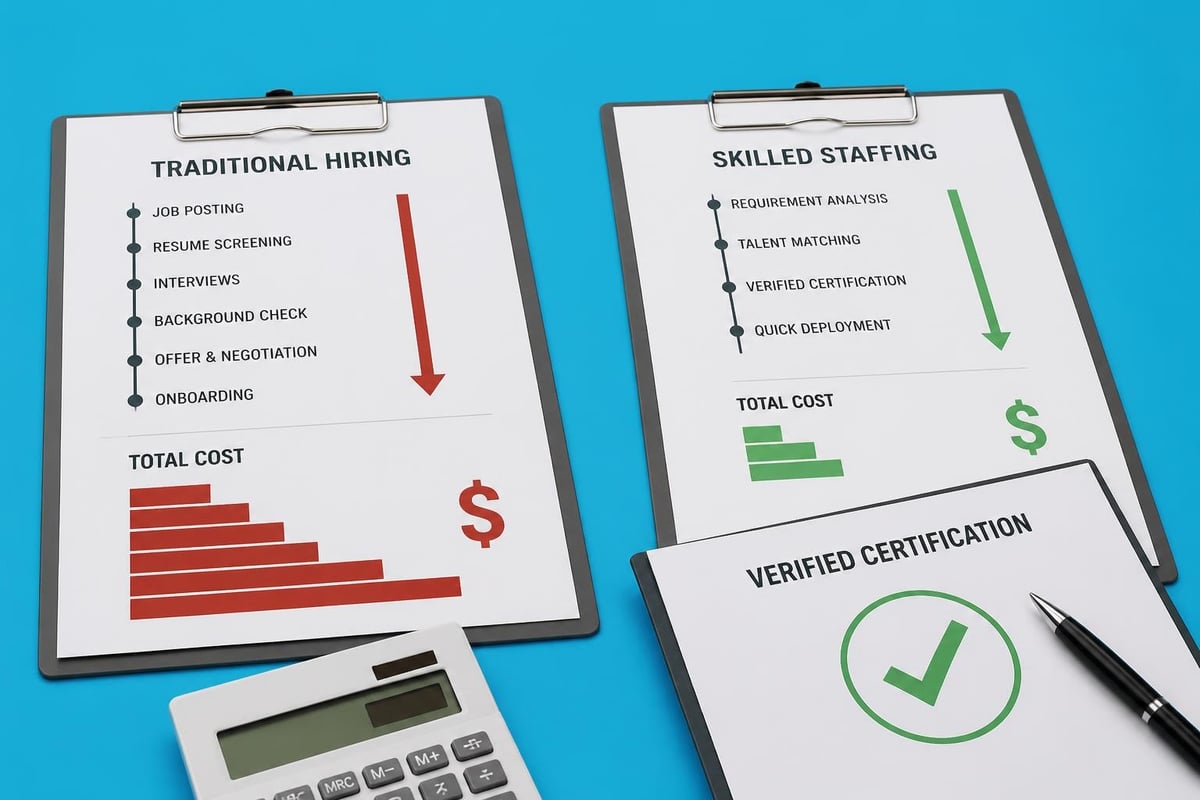
Traditional hiring processes collapse under the weight of industrial workforce demands. The timeline alone kills momentum. Posting positions, screening hundreds of unqualified applicants, conducting multiple interview rounds, verifying certifications, and onboarding consumes 45-60 days minimum. Meanwhile, projects stall, deadlines slip, and competitors advance.
The certification bottleneck compounds the problem. Industrial roles require specific safety credentials, trade licenses, and equipment certifications that most applicants lack. Verifying these credentials demands specialized knowledge and industry connections that HR departments rarely possess. A skilled staffing solution eliminates this friction entirely by maintaining pre-certified talent pools ready for immediate deployment.
The Hidden Costs of Hiring Mistakes
Hiring the wrong industrial worker costs far more than a wasted salary. Consider the cascading expenses:
- Safety incidents from unqualified operators
- Equipment damage from improper handling
- Project delays from inadequate skill levels
- Team disruption from communication barriers
- Turnover expenses when mismatches become apparent
According to staffing industry statistics, the U.S. staffing industry employs over 16 million workers annually, demonstrating how businesses increasingly rely on specialized staffing partnerships to mitigate these risks. The math is brutally simple: one critical safety incident erases months of payroll savings from cheap labor.
Core Components of an Effective Skilled Staffing Solution
The difference between average staffing and a strategic skilled staffing solution lies in systematic excellence across five critical dimensions. Each component must function flawlessly to deliver the workforce reliability industrial operations demand.
Certification Verification Infrastructure
Every credential matters. Welding certifications, OSHA 10/30 cards, TWIC credentials, CDL licenses, forklift operator certificates-these aren't paperwork formalities. They're the foundation of operational safety and regulatory compliance. Elite staffing partners maintain verification systems that authenticate credentials before candidates enter your facility.
The verification process includes:
- Primary source verification directly with issuing authorities
- Database cross-referencing against industry blacklists
- Expiration monitoring to prevent lapsed certifications
- Ongoing compliance tracking for regulatory changes
- Digital credential management for instant audit readiness
Bilingual Workforce Capabilities
The Gulf South industrial landscape increasingly requires Spanish-English bilingual communication for maximum productivity and safety. When site supervisors and crew members share common language, accidents decrease and efficiency soars. A skilled staffing solution with deep Latino talent networks provides this competitive advantage.
| Communication Barrier | Productivity Impact | Safety Risk Level |
|---|---|---|
| Monolingual crews with language gaps | 20-35% efficiency loss | High incident probability |
| Mixed crews without bilingual leadership | 15-25% coordination delays | Moderate-to-high risk |
| Fully bilingual workforce deployment | Optimal productivity | Minimal communication-based risk |
Companies that leverage bilingual staffing capabilities report measurably better project outcomes. The key trends shaping staffing in 2025 emphasize cultural competency as a defining competitive differentiator.
Scalability Mechanisms
Industrial projects fluctuate. A refinery turnaround demands 150 additional workers for six weeks. A construction phase-out requires workforce reduction without permanent layoffs. Scalability defines skilled staffing solution effectiveness.
The scalability framework includes:
- Surge capacity planning for predictable seasonal demands
- Rapid deployment protocols for emergency needs
- Flexible scheduling models matching project phases
- Workforce rotation systems preventing burnout
- Multi-site coordination capabilities for regional projects
Industry-Specific Skilled Staffing Applications
Different industrial sectors demand specialized workforce knowledge. A skilled staffing solution must demonstrate proven expertise in your specific operational environment, understanding the nuances that determine success or failure.
Industrial Manufacturing and Processing
Manufacturing facilities and processing plants require trade-certified specialists who understand complex systems. Pipefitters who can read isometric drawings. Electricians familiar with industrial control systems. Welders certified for pressure vessel work. Heavy equipment operators trained on specific machinery classes.
The technical depth matters immensely. A general labor agency cannot distinguish between a 6G welding certification and basic MIG capability. That knowledge gap becomes your production problem. Specialized industrial staffing partners maintain relationships with trade schools, apprenticeship programs, and certification bodies that general agencies lack entirely.
Construction and Infrastructure Development
Construction staffing demands shift constantly throughout project lifecycles. Foundation work requires different skill sets than framing, electrical rough-in, or finish work. A skilled staffing solution for construction provides phase-appropriate talent matched to project specifications.
Construction staffing considerations include:
- Trade specialization matching project requirements
- Union vs. non-union workforce availability
- Prevailing wage compliance expertise
- Multi-trade coordination capabilities
- Site safety protocol familiarity
The projected growth of the U.S. staffing industry in 2025 highlights construction and engineering as top sectors driving demand for specialized staffing partnerships.
Maritime and Port Operations
Maritime operations present unique staffing challenges. TWIC credential requirements. Confined space certifications. Hazmat handling clearances. Coast Guard documentation. The regulatory complexity exceeds typical industrial environments significantly.
Maritime-specific requirements:
- Transportation Worker Identification Credential (TWIC) processing
- Maritime-specific safety certifications (STCW, etc.)
- Offshore survival training documentation
- Drug testing programs meeting maritime standards
- Security clearance coordination
Port operations, shipyard work, and offshore support demand staffing partners with established maritime industry connections. Generic staffing agencies simply cannot navigate these specialized requirements effectively.
Skills-Based Hiring Revolutionizes Workforce Deployment
The staffing industry has fundamentally shifted from resume-based to skills-based hiring models. This transformation directly impacts skilled staffing solution effectiveness. Traditional hiring emphasized job titles and years of experience. Modern skills-based approaches focus on verified capabilities and demonstrated competencies.
The Skills-Based Hiring Framework
Skills-based hiring evaluates candidates through competency verification rather than credential collection. A welder demonstrates 6G position capability through actual test welds, not just certification dates. A forklift operator proves spatial awareness through practical assessments, not just license possession.
The staffing industry trends for 2026 identify skills-based hiring as a mainstream adoption priority, fundamentally changing how companies evaluate workforce readiness. This approach eliminates the resume inflation problem plaguing traditional hiring.
Competency Verification Methods
Practical assessment beats paper credentials every time. Elite staffing partners implement multi-stage verification:
- Trade skill demonstrations under supervision
- Equipment operation practical tests
- Safety protocol knowledge assessments
- Communication capability evaluations
- Team collaboration observations
These assessments identify true capability levels before candidates reach your job sites. The investment in thorough vetting prevents the costly mistakes that plague rushed hiring decisions.
Technology Integration in Modern Staffing Solutions
Technology transforms skilled staffing solution delivery in 2026. AI-powered matching algorithms, digital credential verification, real-time availability tracking, and mobile workforce management platforms create efficiency impossible just years ago.
AI-Driven Candidate Matching
Artificial intelligence analyzes thousands of data points to match candidates with positions. Skills inventories, certification databases, geographic availability, shift preferences, project history, safety records, language capabilities-AI processes these variables instantly to identify optimal matches.
The global staffing industry trends for 2026 emphasize digital transformation as the defining competitive factor separating leading staffing agencies from legacy providers. Companies partnering with technology-forward staffing solutions gain faster placements, better matches, and superior retention.
Digital Workforce Management Platforms
Real-time visibility changes everything. Modern workforce management platforms provide:
| Platform Capability | Business Impact | Competitive Advantage |
|---|---|---|
| Live availability tracking | Instant surge capacity deployment | Faster project response |
| Digital timecard management | Accurate payroll, reduced disputes | Administrative efficiency |
| Certification expiration alerts | Proactive compliance maintenance | Audit readiness |
| Performance analytics dashboards | Data-driven workforce optimization | Continuous improvement |
| Mobile communication tools | Direct worker-manager connectivity | Reduced coordination delays |
These platforms integrate with your existing project management and ERP systems, creating seamless information flow that eliminates duplicate data entry and coordination errors.

Safety-First Culture as Staffing Foundation
Safety isn't negotiable in industrial staffing. A skilled staffing solution must embed safety culture throughout every process, from candidate screening through ongoing deployment. The safety record of your staffing partner directly impacts your workplace incident rates and insurance costs.
Pre-Deployment Safety Protocols
Before any worker reaches your facility, comprehensive safety protocols must be complete:
- Background screening including criminal and driving records
- Drug testing meeting industry-specific requirements
- Safety training verification for relevant OSHA standards
- PPE familiarity assessment for site-specific equipment
- Hazard communication training documentation
The thoroughness of these protocols separates professional staffing partners from agencies chasing quick placements. Cutting corners on safety screening creates liability exposure no cost savings can justify.
Ongoing Safety Management
Safety responsibility doesn't end at placement. Elite staffing partners maintain continuous safety oversight including:
- Regular safety performance reviews
- Incident investigation participation
- Corrective action implementation
- Safety training refreshers
- Regulatory compliance updates
This ongoing commitment ensures workers maintain safety standards throughout their assignments. The partnership becomes a force multiplier for your safety culture rather than a potential weakness.
Regional Expertise Delivers Local Advantage
National staffing agencies lack the regional market intelligence that drives successful placements. Understanding Gulf South industrial dynamics, knowing which trade schools produce top talent, maintaining relationships with certification providers, and tracking regional project pipelines creates competitive advantages generic providers cannot replicate.
Gulf South Industrial Market Knowledge
The Louisiana, Mississippi, Alabama, and Kentucky industrial corridor presents unique workforce dynamics. Petrochemical facilities, maritime operations, and construction projects create demand patterns requiring specialized knowledge. When does refinery turnaround season peak? Which ports have TWIC processing bottlenecks? What construction projects will drive Q3 labor demand?
Regional expertise includes:
- Local trade union relationships and protocols
- State-specific licensing requirements
- Regional wage rate benchmarking
- Community college and trade school partnerships
- Economic development project intelligence
This knowledge allows proactive talent pipeline development rather than reactive scrambling when positions open.
Cultural Competency in Workforce Deployment
The Gulf South increasingly requires culturally competent staffing that bridges diverse workforce populations. Spanish-speaking workers represent growing percentages of skilled trades labor pools. Staffing solutions with deep Latino talent networks and bilingual coordination capabilities provide decisive advantages.
Cultural competency extends beyond language. It includes understanding work preferences, communication styles, and community connections that improve retention and productivity. Agencies specializing in multicultural workforce deployment achieve superior results compared to one-size-fits-all approaches.
Measuring Skilled Staffing Solution ROI
Quantifying staffing partnership value requires metrics beyond cost-per-hire. The true ROI emerges from productivity gains, safety improvements, scalability benefits, and competitive advantages that financial statements don't immediately capture.
Key Performance Indicators
Track these metrics to evaluate skilled staffing solution effectiveness:
- Time-to-deployment from request to worker arrival
- First-assignment completion rate measuring placement accuracy
- Safety incident rates for temporary vs. permanent workers
- Project deadline achievement when using supplemental staffing
- Supervisor satisfaction scores from workforce evaluations
- Worker retention rates throughout assignment durations
- Certification compliance percentages during audits
Cost-Benefit Analysis Framework
| Cost Factor | Traditional Hiring | Skilled Staffing Solution |
|---|---|---|
| Time to deployment | 45-60 days | 24-72 hours |
| Screening and verification | Internal HR burden | Included in service |
| Certification validation | Manual, error-prone | Automated, guaranteed |
| Scalability flexibility | Limited, expensive | Core capability |
| Regulatory compliance risk | High internal exposure | Transferred to partner |
| Bilingual coordination | Separate sourcing required | Integrated capability |
The comprehensive cost comparison reveals that skilled staffing solutions often deliver lower total cost of ownership despite higher hourly bill rates. When you factor time savings, risk mitigation, and productivity gains, the ROI becomes undeniable.
Frequently Asked Questions
What makes a skilled staffing solution different from regular temp agencies?
A skilled staffing solution specializes in trade-certified, safety-credentialed professionals for industrial, construction, and maritime sectors, unlike general temp agencies that focus on clerical or light industrial roles. The difference lies in certification verification infrastructure, industry-specific expertise, safety protocols, and access to specialized talent pools that regular agencies simply don't maintain.
How quickly can a skilled staffing solution deploy workers?
Deployment speed ranges from 24 to 72 hours for most positions, depending on certification requirements and volume. Pre-vetted talent pools allow immediate matching, while specialized certifications may require additional verification time. Emergency surge capacity can often deploy within hours when critical project needs arise.
What certifications should industrial staffing partners verify?
Essential certifications include OSHA 10/30 safety cards, trade-specific licenses (welding, electrical, pipefitting), equipment operator certifications, CDL licenses (Class A/B), TWIC credentials for maritime work, confined space entry permits, and hazmat handling clearances. Verification must include expiration dates, issuing authority confirmation, and ongoing compliance monitoring.
How does bilingual staffing improve industrial operations?
Bilingual workforce capabilities reduce safety incidents by 30-40% and improve productivity by 20-35% according to industry research. When supervisors and workers share common language, instructions are understood clearly, hazards are communicated effectively, and team coordination improves dramatically. The investment in bilingual staffing delivers measurable safety and efficiency returns.
What industries benefit most from skilled staffing solutions?
Industrial manufacturing, petrochemical processing, construction, maritime operations, warehousing and logistics, and infrastructure development gain the greatest advantages. Any sector requiring safety-certified, trade-skilled, or licensed professionals benefits from specialized staffing partnerships that maintain pre-qualified talent pools.
How should companies evaluate staffing partner safety records?
Request EMR (Experience Modification Rate) scores, OSHA incident rates, workers' compensation claims history, safety training documentation, and client references specifically about safety performance. A reputable skilled staffing solution provides transparent safety metrics and maintains lower incident rates than industry averages through rigorous screening and ongoing safety management.
What scalability advantages do staffing solutions provide?
Skilled staffing solutions enable rapid workforce expansion for project peaks, cost-effective reduction during slow periods, multi-site deployment coordination, and specialized talent access without permanent hiring commitments. This flexibility allows companies to match labor costs precisely to revenue generation without the overhead of maintaining permanent staff for fluctuating demands.
Can staffing solutions handle union and prevailing wage requirements?
Professional skilled staffing solutions navigate union protocols, prevailing wage compliance, certified payroll reporting, and Davis-Bacon Act requirements routinely. Regional expertise and established union relationships ensure compliant workforce deployment on projects with specific labor agreement requirements.
How can CDR General Services solve my specific staffing challenges?
CDR General Services delivers safety-certified, bilingual industrial workforce solutions across the Gulf South with unmatched Latino talent network access. Our specialized focus on industrial, construction, and maritime sectors, combined with cultural competency in Spanish-speaking workforce deployment, provides competitive advantages no general agency can match. We maintain pre-vetted talent pools of certified welders, pipefitters, electricians, CDL drivers, and skilled operators ready for immediate deployment to your critical projects.
A skilled staffing solution transforms workforce challenges from operational headaches into strategic competitive advantages through specialized expertise, safety commitment, and scalable deployment capabilities. When you partner with CDR General Services, you gain immediate access to safety-certified, bilingual industrial professionals backed by unmatched cultural competency and Gulf South regional expertise. Our Latino talent specialization delivers the decisive staffing edge your projects demand-contact us today to deploy the workforce your competition cannot access.
Published June 22, 2026 by CDR
All articles


