

A staffing consultant is a specialist who studies your workforce needs, then sources, screens and places workers so you can fill roles faster with less risk. For industrial, construction and logistics employers across Louisiana, Mississippi and Alabama, the right one protects your safety record and your schedule. The wrong one hands you unverified bodies and leaves you holding the liability.
This is how to separate the two.
What a Staffing Consultant Actually Does
A staffing consultant diagnoses your labor demand and delivers qualified workers matched to it, which is different from forwarding resumes. The role covers workforce planning, candidate sourcing, credential checks, placement and follow-up after the worker reports to site.
Two terms get confused constantly, so settle them now.
Recruiter vs. staffing agency
A recruiter typically works a single search for a client, often for a permanent hire, and is paid on that outcome. A staffing agency employs a pool of workers, places them on assignments, and handles payroll, onboarding and compliance for those workers. A staffing consultant sits on top of either model and advises you on which one fits the job.
For a welding crew needed in three weeks, you want an agency with a bench. For a plant manager, you want a recruiter. Know which problem you have before you call anyone.
How temp agencies make money
Temp agencies make money on the markup between what they pay the worker and what they bill you. That spread covers payroll taxes, workers' compensation insurance, recruiting costs and profit. It is why a transparent consultant will show you the bill rate structure upfront instead of burying it in a proposal.
Why Gulf South Industrial Hiring Demands a Specialist
Gulf South hiring is its own market, with plant turnarounds, port and maritime activity, hurricane-season surges and heavy fabrication all competing for the same certified trades. A consultant without regional experience can miss these rhythms.
Demand is real and constant. The BLS Job Openings and Labor Turnover Survey release of December 2025 shows manufacturing hiring and separations running at high volume, a reminder of how much churn employers manage even when hiring succeeds. Churn is expensive, and it is the problem a good consultant exists to reduce.
Local expertise shows up in practical ways:
- Knowing which certifications Louisiana petrochemical sites require versus a Mississippi distribution center
- Understanding seasonal swings tied to shipyards, ports and storm recovery
- Having a worker pool already living within commuting distance of your site
- Moving fast because relationships with candidates already exist
If you operate in Louisiana specifically, review how staffing solutions in Louisiana are structured and why Louisiana employers use staffing agencies in the first place.
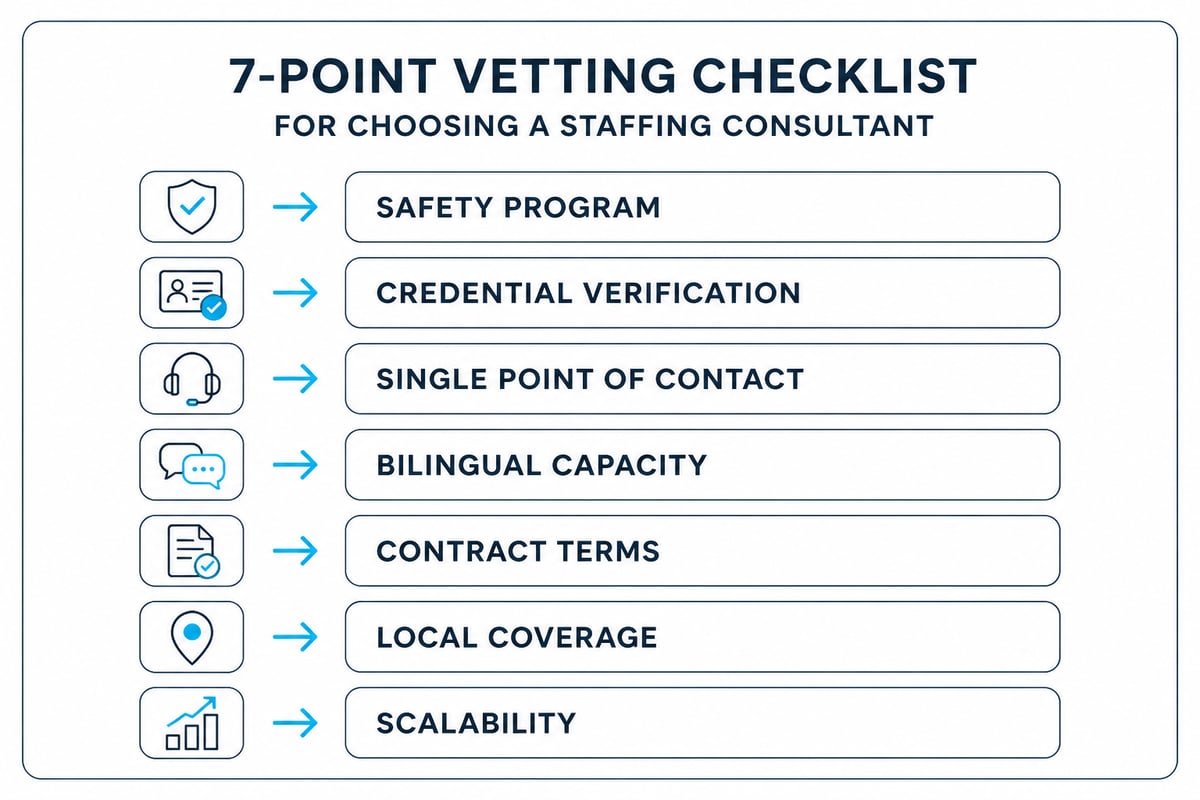
Safety Is the First Filter, Not the Last
Safety performance is the single most important screening criterion because OSHA holds staffing agencies and host employers jointly responsible for temporary workers' safety. According to OSHA's Protecting Temporary Workers guidance, that shared responsibility covers training, hazard communication and recordkeeping.
You cannot outsource the liability. You can only pick a partner who shares the work of managing it.
OSHA also recommends that agencies and hosts spell out their respective safety duties in the contract. A consultant who has never had that conversation with a client is not ready for industrial work. Ask for it in writing: who delivers site-specific hazard training, who provides PPE, who logs injuries, who investigates incidents.
OSHA further states that agencies should inquire into assigned workplaces and verify that hosts have met their safety responsibilities, while hosts should provide training specific to workplace equipment and hazards. The agency's Temporary Worker Initiative policy background recommends reviewing job assignments and hazard analyses before a placement or new project. A serious consultant will ask to walk your site or review your job hazard analyses before sending anyone.
Equipment condition is part of the same discipline. Lifting gear, pressure systems and powered equipment need documented inspection regimes, and resources like Workplace Inspection Services Ltd show what statutory inspection programs under LOLER and PUWER look like in practice, a useful benchmark for how seriously a site should treat equipment checks, even though its regulations are UK-based.
Safety questions to ask any consultant
- How often do you conduct site safety visits, and who performs them?
- What ongoing safety training do workers receive after placement?
- How do you handle an injury report on a client site?
- What is your process when a host site's conditions don't match the job description?
CDR General Services backs its position with numbers you can verify by asking: it completes over 2,000 safety visits per year, and you can ask how its workers are certified and trained.
Credential and Licence Verification Process
A trustworthy staffing consultant verifies credentials before a worker is confirmed, not after something goes wrong. For skilled trades, that means checking welding certifications, electrical licences, CDL classes and endorsements, and equipment operator tickets against the actual job requirements.
Ask the consultant to describe the process step by step. Vague answers like "we screen everyone" are a warning.
What a real verification process includes:
- Confirming credential validity and expiration dates
- Matching certifications to the specific task, not the general trade
- Checking driver classifications (Class A versus Class B) against the vehicle assigned
- Documenting the checks so you can produce records during an audit
CDR General Services confirms credentials and licences before a worker is confirmed, and applies the same verification mindset across its placements. If your work is in welding, pipefitting, electrical or heavy equipment, look at its Skilled Trades & Industrial Staffing service to see how certified trades are placed on industrial and construction sites.
Bilingual Capacity and Why It Changes Productivity
Bilingual capability is a safety and productivity issue, not a courtesy. A crew that cannot clearly understand a lockout/tagout instruction or a hazard briefing is a crew at risk, regardless of skill.
Much of the Gulf South skilled and general labor pool is Spanish-speaking. A consultant who can only recruit in English is fishing in half the pond. A consultant with a deep Spanish-speaking talent network gives you a larger candidate pool, clearer communication on site and fewer misunderstandings that become incidents.
This is where CDR General Services stands apart. Spanish specialty staffing is a core part of its offering, with access to a multicultural, bilingual workforce that scales up or down with the project. Spanish-language information is also available on pages such as soluciones de personal en Louisiana.
Ask any consultant you evaluate:
- Do you recruit bilingual workers deliberately, or only by accident?
- Can supervisors on my site brief a mixed-language crew through your team?
- Are safety materials available in Spanish?
One Point of Contact vs. a Rotating Cast
A single accountable contact from request to placement is a better operating model than a call center. When your foreman needs two more pipefitters by Monday, you want one person who knows your site, not a ticket queue.
CDR General Services says it assigns one point of contact from request to placement, so ask for that commitment in writing. That continuity means the person who understood your last request already knows your gate procedures, your PPE rules and your tolerance for no-shows.
Test this during your evaluation. Call twice at different times and see whether you reach the same person with the same knowledge.
Contract Terms That Protect You
Read the contract for responsibility language before you read it for price. The terms that matter most are the ones that assign duties when something goes wrong.
| Contract element | What to look for |
|---|---|
| Safety responsibilities | Named duties for the agency and the host, consistent with OSHA's joint-responsibility guidance |
| Workers' compensation | Who carries coverage and who files claims |
| Conversion terms | Cost and timing if you hire a temp permanently |
| Replacement process | How a poor-fit worker is swapped out |
| Billing structure | Clear bill rates and overtime treatment |
| Termination | Notice requirements for scaling down |
Ask direct questions about anything you cannot find in writing. For specifics on CDR General Services terms, pricing and turnaround, contact the team rather than assuming industry norms apply.
If cost is your main concern, understand whether temporary staffing is cheaper than hiring for your volume and duration before negotiating rates.
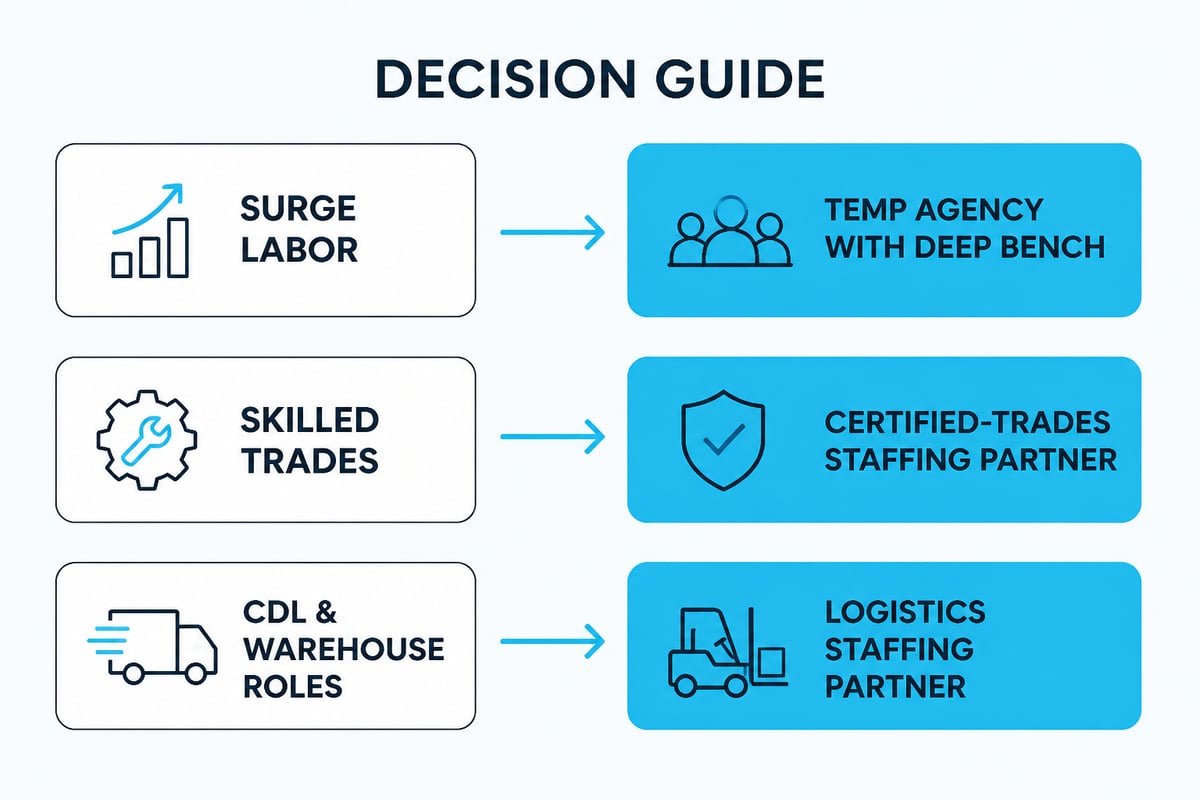
Matching Consultant Type to Your Hiring Need
The best consultant for you depends on the problem, so match the model to the need instead of chasing a ranking of "the best recruiting agency."
- Surge or project labor: Choose an agency with a deep, ready bench and fast mobilization. See how temporary staffing services fit short-term demand, including temp staffing for warehouses.
- Ongoing skilled trades: Choose one with verified certifications and repeatable placement.
- Logistics and transportation: Choose one with licensed CDL drivers and forklift operators on hand.
- Facility upkeep: Support roles around the plant, such as integrated maintenance providers like MetroKleen MKMaintX, complement industrial staffing, and a good consultant will coordinate around them.
One caution. If you need an executive search or a highly specialized professional role outside industrial, construction, maritime, transportation and clerical work, a general industrial staffing firm is the wrong tool. Hire a retained search firm for that.
Red Flags That Should End the Conversation
Walk away from a consultant who shows any of these signs:
- Cannot explain their credential verification process
- Pushes speed over safety and downplays OSHA responsibilities
- Offers no named contact and hands you off repeatedly
- Won't show how bill rates are built
- Has no local bench and promises to "find someone"
- Treats language barriers as your problem
A strong consultant also asks you hard questions: about your hazards, your training, your schedule. Questions are a sign of competence. Silence and quick promises are not.
How to Run the Evaluation in One Week
You can vet a staffing consultant in a week if you structure it.
- Day 1: Write your requirements: roles, certifications, headcount range, start date, languages needed.
- Day 2: Request safety documentation, injury recordkeeping practices and training descriptions from two or three candidates.
- Day 3: Ask each to walk through credential verification for a sample role, such as a Class A CDL driver or a certified welder.
- Day 4: Review contract language on safety duties, replacement and conversion.
- Day 5: Call references and ask about no-shows, incident handling and responsiveness.
Compare answers side by side. The firm that answers specifically and documents everything is almost always the right choice. If you are weighing options in a specific market, it helps to compare staffing agencies in Baton Rouge or a nearby metro against the same checklist.
A logistics partner for your supply chain, such as BJH Logistics Services Ltd. for freight coordination out of Ghana, handles a different layer than workforce staffing. Keep the vendors' roles distinct and ask your consultant how they coordinate with other contractors on site.
FAQ
What does a staffing consultant do?
A staffing consultant assesses your workforce needs, sources and screens qualified workers, verifies credentials and manages placement. For industrial employers, the role also includes safety coordination and scaling headcount up or down with project demand.
What is consulting recruitment?
Consulting recruitment is a service where the recruiter first advises on your hiring strategy, role definitions and timing before sourcing candidates. It differs from transactional recruiting because the advice shapes who you hire and how you structure the work.
How much does a staffing consultant cost?
Cost usually comes through a markup on the worker's hourly pay for temporary placements, or a fee tied to a direct hire. Terms vary by role, volume and duration, so request a written rate structure from each firm you evaluate.
What is the difference between a recruiter and a staffing agency?
A recruiter typically fills a specific position, often permanent, for a fee. A staffing agency employs workers directly and places them on assignments, handling payroll, insurance and compliance for them.
How do temp agencies make money?
Temp agencies earn the difference between the bill rate charged to you and the wage and costs paid for the worker. That margin covers payroll taxes, workers' compensation, recruiting and overhead.
Who is responsible for temporary worker safety?
Both the staffing agency and the host employer share responsibility under OSHA guidance. The contract should define who handles training, hazard communication and recordkeeping.
Why does bilingual staffing matter for industrial sites?
Clear communication prevents injuries and rework. A Spanish-speaking crew that receives briefings and safety training in a language they fully understand works more safely and productively. Contact CDR General Services to staff bilingual, safety-certified crews for your Gulf South projects.
How fast can a staffing consultant fill industrial roles?
Speed depends on the role, the certifications required and the size of the firm's local bench. Ask each consultant for realistic timelines in writing, and contact CDR General Services to discuss your specific timeline and headcount.
Should a business use a staffing agency instead of hiring directly?
Agencies make sense for surge demand, seasonal swings and hard-to-fill trades because they carry sourcing, screening and compliance work. Read whether companies should use staffing agencies to weigh the tradeoffs for your operation.

Start this week by writing down your roles, required certifications and start dates, then hold every consultant you contact to the safety and verification checklist above. If you need certified, bilingual, safety-trained workers across Louisiana, Mississippi or Alabama, CDR General Services pairs its Skilled Trades & Industrial Staffing with a single point of contact from request to placement. Tell the team what your sites need and Request a Workforce Plan built around your project and headcount.
Published November 9, 2026 by Sanya
All articles