

Temp services hiring means a staffing agency recruits, screens and places you on short-term or contract jobs with its client employers, and the agency, not the jobsite, handles your hiring paperwork and payroll. For workers in Louisiana, Mississippi and Alabama, that is often the fastest route into welding, construction, warehouse, driving and office work. For employers, it is the fastest way to add certified people without carrying the full cost of a permanent hire.
This guide covers how the process works, what employers screen for, how to prepare, and how to turn a temporary assignment into steady work.
How Temp Services Hiring Works Step by Step
The process follows the same six steps at nearly every reputable agency, and knowing them lets you move through it faster.
- Application. You submit your work history, certifications and availability, online or in person.
- Screening interview. A recruiter confirms your trade, shift preferences, transportation and eligibility to work.
- Verification. The agency checks identity, licenses and certifications, and typically runs the background and drug screening the client requires.
- Safety orientation. You review jobsite rules, PPE requirements and reporting procedures before your first shift.
- Placement. The agency matches you to an open client order and tells you where, when and who to report to.
- Assignment and follow-up. You work the assignment while the agency handles payroll, and a coordinator checks in on performance and safety.
The agency is your employer of record. The client directs your daily work, but pay, taxes and workers' compensation run through the agency. If you want a plain-language primer on that structure, what a temp agency is covers the basics.
Which Jobs Are Hiring Through Temp Agencies in the Gulf South
Industrial, construction, transportation and administrative roles dominate temp orders in the Gulf South, because those sectors swing hard with project schedules, turnarounds and seasonal freight.
| Sector | Typical temp roles | What clients usually ask for |
|---|---|---|
| Industrial and skilled trades | Welders, pipefitters, electricians, heavy equipment operators | Trade certifications, safety cards, proof of experience |
| Construction and general labor | Laborers, site cleanup crews, helpers | Reliability, PPE, basic safety training |
| Transportation and logistics | CDL Class A and B drivers, forklift operators, warehouse staff | Valid license, clean record, equipment certification |
| Administrative and clerical | Office assistants, data entry, front desk | Software skills, accuracy, professional communication |
Maritime and shipyard work adds another layer along the Gulf Coast, and it comes with its own credential requirements. Agencies that specialize in maritime staffing know which cards and clearances a yard will demand before a worker ever shows up at the gate.
What Employers Screen For Before You Start
Employers and agencies verify four things before putting you on a job: identity and work eligibility, credentials, safety readiness and reliability.
- Identity and eligibility. Expect to present documents that satisfy federal employment verification.
- Credentials. Welders may be asked for weld test records. Drivers need a valid CDL with the right class and endorsements. Forklift operators need current operator certification.
- Safety readiness. Clients on industrial and construction sites want workers who already understand lockout/tagout, fall protection and hazard communication. Standard courses such as fall protection, forklift and first aid are common requirements, though you should confirm which certifications your Gulf South client recognizes.
- Reliability. Attendance and punctuality count as much as skill. A temp who shows up on time, every shift, gets called back first.
Agencies that verify credentials before confirming a placement protect both sides. CDR General Services, for example, verifies credentials and licenses before confirming a placement, and it provides safety training to its workers.
How to Prepare So You Get Placed Faster
Workers who arrive organized get placed first, because recruiters fill orders from the people they can confirm today.
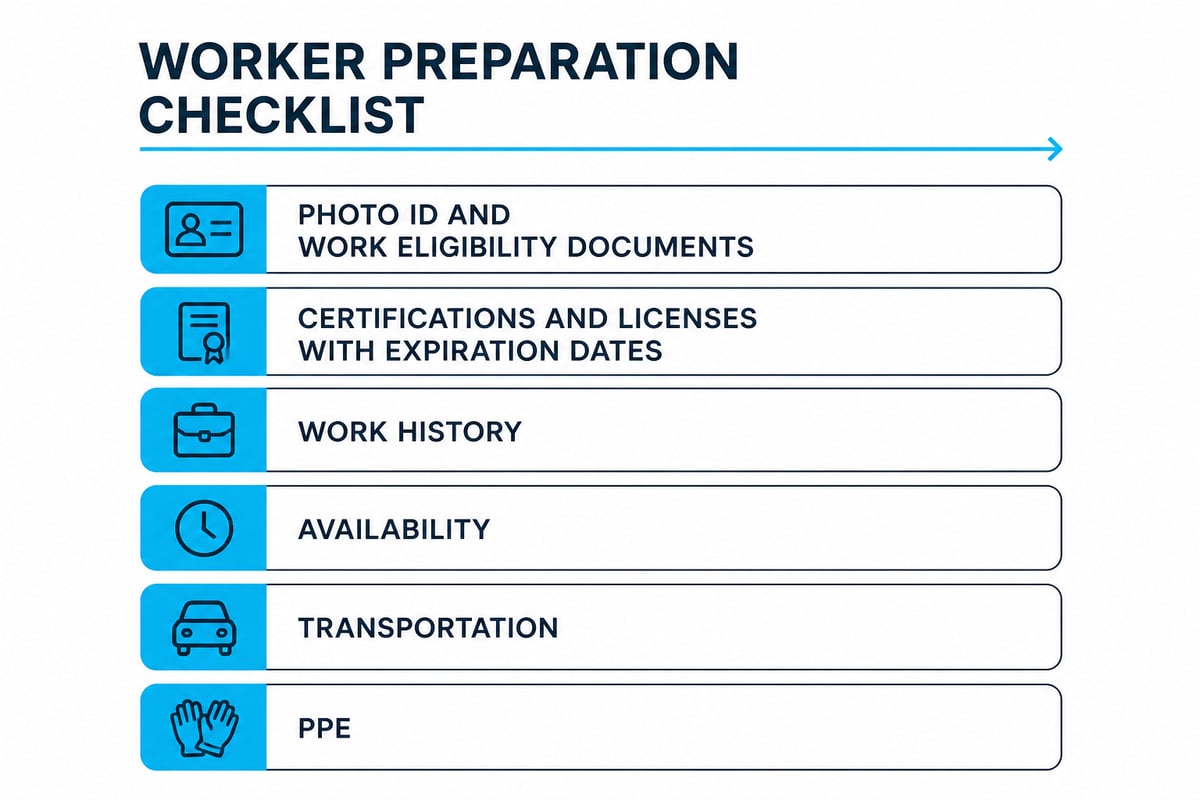
Prepare this list before you apply:
- Government-issued photo ID and the documents that prove work eligibility
- Copies of certifications, licenses and safety cards, with expiration dates visible
- A short work history with employer names, dates and what you actually did
- Your availability, including nights, weekends and overtime
- Reliable transportation to your likely jobsite, since many industrial sites sit outside town
- Steel-toe boots, hard hat and basic PPE if your trade expects you to bring your own
Be specific about your skills. "General labor" gets you a general order. "Three years framing, can read a tape, own my tools" gets you a better one. If you can run a forklift or hold a CDL, say it first.
Pay, Hours and Benefits You Should Ask About
Ask about pay rate, pay frequency, overtime rules and benefit eligibility before accepting any assignment, and get the answers in writing.
Pay varies by trade, client and local demand, so no honest article can promise a number. Skilled trades like welding and pipefitting command more than entry-level labor, and CDL drivers are paid on their license class and endorsements. Questions worth asking:
- What is the hourly rate, and is overtime paid after 40 hours?
- How often am I paid, and by what method?
- Is there a guaranteed minimum number of hours, or can the assignment end early?
- What is the expected duration of this assignment?
- Am I eligible for benefits, and when do they start?
- Who do I call if there is a safety concern or a pay problem?
Temporary workers are covered by workers' compensation through the staffing agency. If you are hurt on a jobsite, report it immediately to both the site supervisor and your agency contact.
Temp Services Hiring for Employers: Getting Reliable Crews Fast
For employers, the value of temp services hiring is speed and scalability: you describe the need, the agency supplies screened, certified workers, and you scale headcount up or down with the project.
A clear order gets a better result. Give the agency:
- The trade or role, and the certifications that are non-negotiable
- Start date, shift pattern and expected duration
- Site location, site-specific PPE and orientation requirements
- Whether the role could convert to a permanent position
- Language needs on the crew, which matters more than many project managers expect
That last point deserves attention. On many Gulf South jobsites, a significant share of skilled and general labor is Spanish-speaking. A crew that cannot follow safety instructions in the language it speaks is a liability, not just a communication problem. Bilingual supervisors and Spanish-speaking workers reduce misunderstandings on lifts, hot work and confined space entry. CDR General Services builds its model around this, with access to a multicultural, bilingual workforce that scales up or down with the project, as described on its bilingual industrial workforce solutions page.
For construction contractors who need crews on short notice for site work, cleanup and logistics support, CDR's General Labor & Construction Staffing offers ready-to-work crews built for projects of any scale.

Temp, Temp-to-Hire and Direct Hire: Which Path Fits
Temp work, temp-to-hire and direct hire differ in who carries risk, how long the commitment lasts and how fast you can start.
| Path | How it works | Best used when |
|---|---|---|
| Temporary | Worker is employed by the agency for a set assignment or project | Seasonal peaks, turnarounds, short builds, coverage for absences |
| Temp-to-hire | Worker starts as a temp, with the option to convert to the client's payroll | You want to evaluate performance before committing |
| Direct hire | Agency recruits, client hires the worker directly | The role is permanent from day one |
Temp-to-hire is the strongest option when both sides want certainty. The employer sees the worker on the actual job, and the worker sees the actual site, supervisors and schedule before signing on. You can read more about how temp-to-hire arrangements are structured.
Safety on a Temporary Assignment
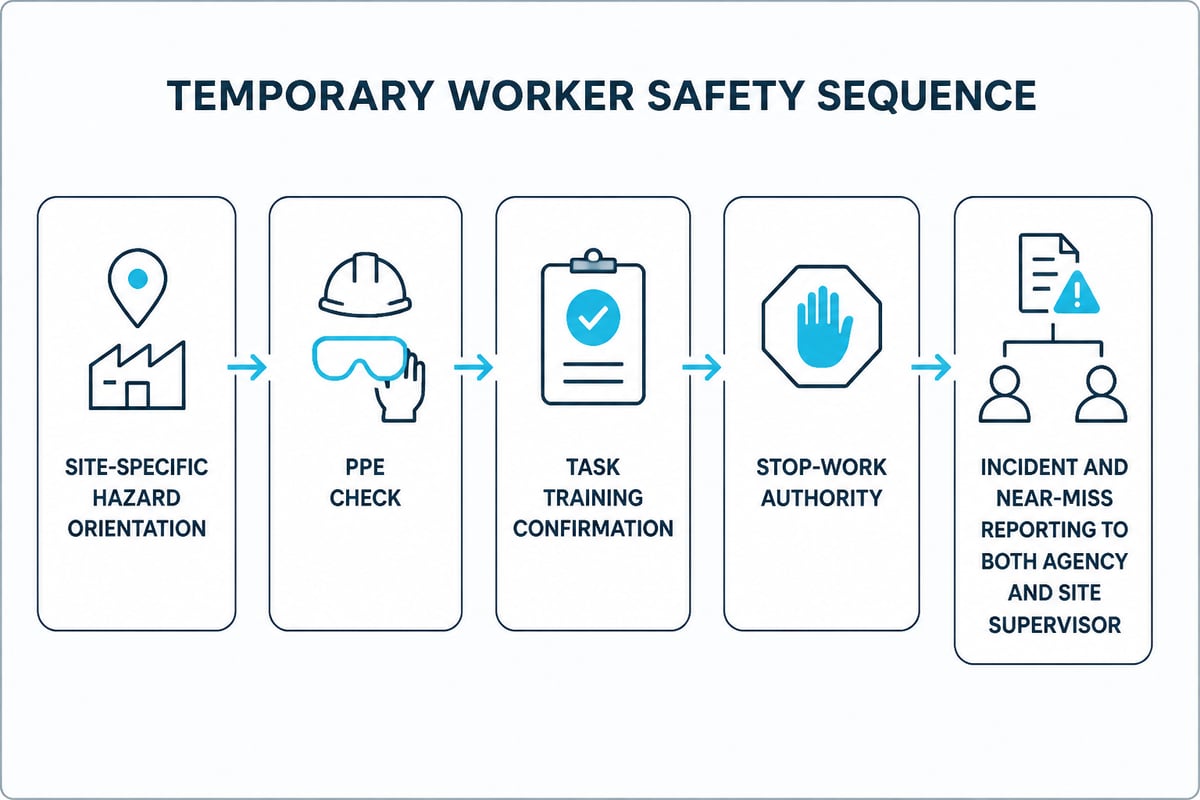
New workers face higher risk in their first weeks on a site, so safety orientation is not optional and you should ask for it if it is not offered.
Temporary workers have the same right to a safe workplace as permanent employees, and both the staffing agency and the host employer share responsibility for it. In practice:
- Ask for site-specific hazard training before you start work.
- Refuse any task you have not been trained or certified to do.
- Know your stop-work authority and who to tell.
- Report near misses, not just injuries.
Agencies with active safety programs show it in their practice. CDR General Services conducts safety visits to jobsites throughout the year, which means someone is actually on the jobsites checking conditions and talking to workers.
Finding Temp Work Near You in Louisiana, Mississippi and Alabama
The quickest way to find temp work near you is to apply with agencies that already serve your local industrial and construction base, then keep your availability current.
Job boards such as Indeed's staffing agency listings show how many openings are posted at any moment, but a posting is only a starting point. Agencies with recruiters in your area often fill orders before they are ever advertised, so a direct application and a phone call move you up the list.
Local knowledge matters. Hiring patterns in Baton Rouge tied to petrochemical turnarounds look different from those in Tuscaloosa or on the Mississippi side near Southaven. Look for an agency with real regional presence rather than a call center that has never seen your jobsite.
Once placed, treat every assignment as an audition:
- Arrive early and stay through the end of the shift
- Ask questions before starting an unfamiliar task, not after
- Keep your certifications current and tell your recruiter when you earn new ones
- Stay in touch between assignments so you are the first call for the next order
Turning a Temp Assignment Into a Permanent Job
Workers convert from temp to permanent by being the person a supervisor does not want to lose, and that comes from reliability, safety habits and willingness to learn the next skill.
Supervisors notice who covers a shift, who follows procedure when no one is watching and who keeps the crew communicating. Bilingual workers hold a particular edge on mixed crews, since they can pass instructions between English and Spanish speakers and prevent errors before they happen.
Tell your agency coordinator you want a permanent role. They hear from the client about who is performing, and they can raise your name when a conversion opens.
Temp Services Hiring: Frequently Asked Questions
What is temp services hiring?
Temp services hiring is the process in which a staffing agency recruits, screens and places workers on temporary assignments with client employers. The agency handles payroll and paperwork while the client directs the daily work.
How fast can I get placed through a temp agency?
Timing depends on open orders, your trade and how quickly your documents are verified. Workers with current certifications and clear availability are usually placed faster, and you should ask your recruiter for a realistic timeline.
Do I need certifications to get hired through a temp agency?
General labor roles often need only basic safety readiness, while welders, electricians, CDL drivers and forklift operators need current credentials. Bring copies of every certification you hold.
Are temp workers covered by workers' compensation?
Yes. The staffing agency, as employer of record, carries workers' compensation for temporary employees. Report any injury to your site supervisor and your agency contact right away.
Can a temp job turn into a full-time position?
Yes, many do. Temp-to-hire arrangements are designed for this, and strong attendance, safe work habits and communication with your coordinator improve your odds.
Does temp services hiring cost job seekers anything?
Reputable agencies do not charge workers a fee to be placed. If an agency asks you to pay for a placement, treat it as a warning sign.
How do employers request temporary workers?
Employers submit an order with the role, certifications, schedule, location and duration. Contact the agency directly, and ask about CDR General Services' temporary staffing services to start the conversation for your project.
Does CDR General Services place Spanish-speaking and bilingual workers?
Yes. Spanish-speaking and bilingual personnel are CDR General Services' specialty, which helps employers across industrial, construction and logistics sites keep crews safe and productive. Contact CDR General Services to staff your next project with a bilingual, certified workforce.
How can I get hired by CDR General Services as a worker?
Job seekers in skilled trades, general labor, transportation and clerical work can apply through CDR's career opportunities page. Apply today to be considered for open assignments across the Gulf South.
Start today by gathering your IDs, certifications and availability into one folder, or, if you are an employer, by writing down the roles, start dates and credentials your next project demands. From there, CDR General Services can match you with certified, safety-trained and bilingual workers through its General Labor & Construction Staffing service, with one point of contact from request to placement. Reach out to Request a Workforce Plan built around your sites, your crew size and your timeline.
Published November 11, 2026 by Sanya
All articles