


Staffing Places: Workforce Solutions That Deliver


Staffing places serve as the critical bridge between employers demanding skilled talent and workers seeking meaningful employment opportunities. In 2026, these workforce hubs have evolved far beyond simple job boards, becoming strategic partners that deliver comprehensive talent solutions across industrial, construction, maritime, and specialized sectors. The question isn't whether you need a staffing partner, it's whether you're choosing one with the capability, cultural competence, and commitment to safety that your business demands.
Why Staffing Places Matter More Than Ever in 2026
The workforce landscape has fundamentally shifted. Employers no longer have the luxury of waiting months to fill critical positions. Projects demand immediate deployment of safety-certified, ready-to-work personnel who can integrate seamlessly into existing teams.
Staffing places address three critical business challenges:
- Speed to deployment: Immediate access to pre-vetted, certified talent pools
- Risk mitigation: Safety compliance, licensing verification, and regulatory adherence
- Scalability: Rapid workforce expansion or reduction based on project demands
According to staffing industry trends in 2025, the market has stabilized with strategic firms gaining competitive advantage through specialization and cultural competency. Generic staffing approaches no longer cut it. Employers require partners who understand their industry's unique demands and can deliver talent that matches those specific requirements.

The Competitive Edge: Specialized Workforce Solutions
Not all staffing places operate equally. The differentiator lies in specialization and cultural competence. A staffing agency focused on administrative roles cannot suddenly deliver certified pipefitters or licensed CDL drivers. Industry expertise matters.
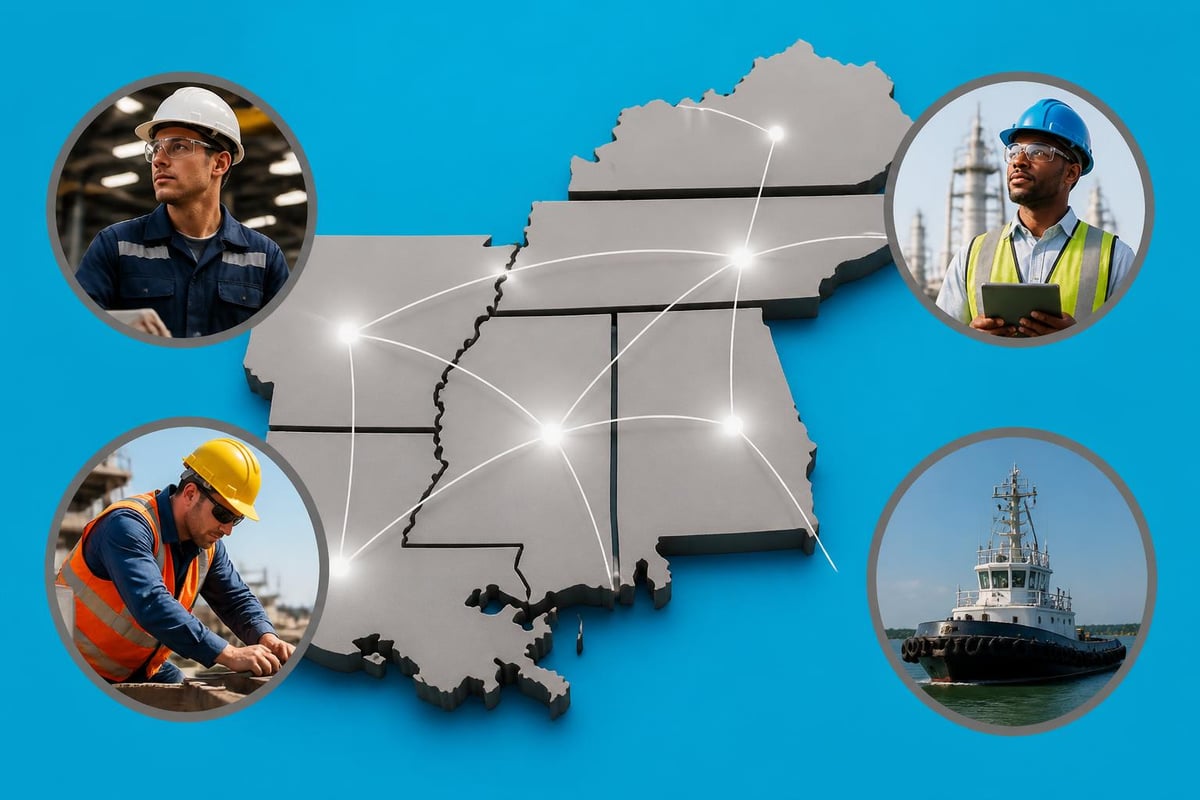
The Gulf South region (Louisiana, Mississippi, Alabama, and Kentucky) presents unique workforce demands. Maritime operations require TWIC-certified personnel. Construction projects need OSHA-trained teams. Industrial facilities demand workers with specific safety certifications and technical competencies.
Critical capabilities that distinguish top-tier staffing places:
- Industry-specific talent networks: Deep connections within targeted sectors
- Certification verification: Rigorous validation of licenses, safety training, and technical qualifications
- Bilingual workforce access: Spanish-speaking and multilingual personnel for diverse project teams
- Local market expertise: Understanding regional labor dynamics and availability
This specialization creates measurable outcomes. Projects launch on schedule. Safety incidents decrease. Communication improves across diverse teams. Productivity increases when workers possess both technical skills and cultural alignment.
Core Services Provided by Professional Staffing Places
Understanding what comprehensive staffing places deliver helps employers evaluate potential partners. The scope extends far beyond simply sending resumes. Professional workforce solutions encompass the entire talent lifecycle.
Industrial and Skilled Trades Placement
Industrial staffing places maintain networks of certified professionals across multiple disciplines. These aren't casual laborers, they're highly trained technicians with verifiable credentials.
| Trade Category | Typical Certifications | Experience Level |
|---|---|---|
| Certified Welders | AWS, ASME, API | 3-15+ years |
| Pipefitters | Journeyman, Master | 5-20+ years |
| Electricians | Licensed, Journeyman | 4-15+ years |
| Heavy Equipment Operators | NCCCO, OSHA | 2-10+ years |
The staffing employment trends demonstrate consistent demand for these skilled positions. Companies cannot afford downtime waiting for talent. Professional staffing places maintain ready-to-deploy talent pools specifically for these critical roles.
Construction and General Labor Solutions
Construction projects operate on tight schedules with zero tolerance for workforce gaps. Quality staffing places provide scalable teams that can mobilize within hours, not weeks.
Construction staffing encompasses:
- Site preparation teams: Clearing, grading, and foundational work
- General construction labor: Framing, concrete, finishing
- Specialized trades: HVAC, plumbing, electrical (coordinated with appropriate licensing)
- Safety personnel: OSHA-certified site safety coordinators
The ability to scale workforce up or down based on project phases delivers substantial cost control. You pay for the talent you need exactly when you need it.

Transportation and Logistics Personnel
Supply chain efficiency depends entirely on qualified operators and drivers. Staffing places specializing in transportation provide licensed, background-checked personnel with clean driving records.
Transportation staffing includes:
- Class A CDL drivers: Long-haul, regional, and local routes
- Class B CDL drivers: Delivery, shuttle, and specialized vehicles
- Forklift operators: Certified across multiple equipment types
- Warehouse personnel: Inventory management, shipping/receiving, logistics coordination
According to 2025 recruitment trends, skills-based hiring has become paramount. Transportation staffing places verify not just licenses, but actual operational competency and safety records.
Administrative and Professional Staffing
Every project requires administrative coordination. Professional staffing places provide office personnel who understand industrial, construction, and maritime operations.
Administrative placement covers project coordinators, safety documentation specialists, bilingual office managers, and executive assistants with industry knowledge. These professionals understand the terminology, regulatory requirements, and operational tempo of industrial environments.
The Spanish Specialty Advantage: Cultural Competence in Staffing Places
Here's the reality most staffing places won't tell you: cultural and linguistic alignment dramatically impacts project outcomes. A workforce that communicates effectively, understands instructions clearly, and integrates culturally performs measurably better.
The competitive advantage of bilingual staffing:
- Safety improvements: Instructions understood in native language reduce accidents
- Productivity gains: Immediate comprehension eliminates translation delays
- Team cohesion: Cultural alignment creates stronger working relationships
- Compliance enhancement: Documentation and training delivered in preferred language
The Latino workforce represents a substantial talent pool with exceptional work ethic, technical skills, and reliability. Staffing places that specialize in this demographic deliver talent that competitors simply cannot access. This isn't about language alone. It's about cultural understanding, community connections, and trust-based relationships that produce superior talent.
In the Gulf South, where diverse workforces are increasingly common, bilingual capability isn't optional. It's essential. Projects with Spanish-speaking supervisors, bilingual safety coordinators, and culturally competent teams consistently outperform homogeneous workforces in safety metrics, retention rates, and overall productivity.
Evaluating Staffing Places: Critical Selection Criteria
Choosing a staffing partner requires due diligence. The wrong choice costs money, delays projects, and creates safety risks. Apply these decisive criteria when evaluating staffing places.
Safety Certification and Compliance
Safety isn't negotiable in industrial, construction, and maritime sectors. Your staffing partner must demonstrate ironclad safety protocols.
Non-negotiable safety requirements:
- OSHA 10/30 certification programs
- Drug screening and background checks
- Safety training documentation and verification
- Workers' compensation coverage and insurance compliance
- Industry-specific certifications (TWIC, confined space, fall protection)
Request safety statistics. Legitimate staffing places track incident rates, near-misses, and safety training completion. If they can't produce these metrics, walk away.
Local Market Expertise
National staffing chains lack the local relationships that drive quality placements. Regional staffing places understand Gulf South labor markets, wage expectations, seasonal availability, and community dynamics.
| Advantage | National Chain | Regional Specialist |
|---|---|---|
| Local talent networks | Limited | Extensive |
| Regional wage knowledge | Generic | Precise |
| Community relationships | Minimal | Deep-rooted |
| Cultural understanding | Corporate | Authentic |
| Response time | Days | Hours |
The employment trends in Q4 2025 showed regional specialists gaining market share precisely because of this local advantage. Generic approaches don't work when you need certified welders in Baton Rouge or bilingual forklift operators in Mobile within 48 hours.
Scalability and Deployment Speed
Projects don't wait. Your staffing partner must demonstrate the capacity to scale rapidly. Ask specific questions about their talent pipeline, database size, and average deployment timeframes.
Critical scalability questions:
- How many pre-screened candidates do you maintain in each trade category?
- What's your average time-to-deployment for urgent requests?
- Can you provide bilingual supervisors and coordinators?
- How do you handle workforce expansion for multi-phase projects?
- What's your replacement guarantee if a worker doesn't meet expectations?
Vague answers indicate limited capacity. Professional staffing places provide specific metrics because they track performance religiously.
Industry Trends Reshaping Staffing Places in 2026
The staffing industry continues evolving rapidly. Understanding current trends helps employers identify forward-thinking partners versus those clinging to outdated models.
Skills-Based Hiring Dominates
Traditional resume screening has given way to competency-based evaluation. According to staffing trends reshaping recruitment, skills verification now drives placement decisions. Staffing places implementing practical skills assessments, certification validation, and hands-on evaluations deliver superior talent matches.
Skills-based evaluation includes:
- Practical demonstrations (welding tests, equipment operation)
- Certification verification through issuing bodies
- Reference checks with previous supervisors
- Safety knowledge assessments
- Communication and teamwork evaluations
This approach eliminates the resume inflation problem. You get workers who can actually perform, not just claim competency.
Technology Integration for Efficiency
Leading staffing places leverage technology for candidate tracking, compliance documentation, and deployment coordination. Digital platforms enable real-time workforce visibility, credential verification, and communication between employers and placed personnel.
However, technology serves the relationship, it doesn't replace it. The best staffing places combine digital efficiency with personal service and human judgment.
Demographic Shifts and Workforce Diversity
The demographic challenges facing staffing in 2025 highlight the critical importance of diverse talent pipelines. Latino workforce participation continues growing across industrial sectors. Staffing places positioned to access this demographic hold decisive competitive advantage.
Bilingual capability, cultural competence, and community relationships within Latino populations create talent access that competitors cannot replicate. This isn't about diversity initiatives. It's about business reality. The workforce is diversifying. Staffing partners must diversify accordingly.
The Safety-First Commitment in Professional Staffing Places
Safety transcends compliance. It's the foundation of sustainable workforce solutions. Every worker returning home safely, every day, represents the only acceptable outcome.
Comprehensive safety protocols include:
- Pre-employment safety training and certification
- Ongoing safety reinforcement and updates
- Incident reporting and investigation procedures
- Bilingual safety communication (critical for diverse workforces)
- Regular safety audits and performance reviews
Staffing places with genuine safety commitment track leading indicators (near-misses, safety observations, training completion) alongside lagging indicators (incidents, injuries). This proactive approach prevents accidents rather than simply documenting them.
When evaluating CDR General Services or any staffing partner, demand transparency around safety metrics. Request specific incident rates, workers' compensation claims history, and safety certification standards. Legitimate partners provide this information immediately.
Regional Advantage: Gulf South Staffing Expertise
The Gulf South presents unique workforce challenges and opportunities. Hurricane season impacts availability. Maritime operations require specific certifications. Industrial facilities operate 24/7 with demanding schedules. Oil and gas, petrochemical, shipbuilding, and construction sectors all require specialized talent.
Staffing places with deep Gulf South roots understand these dynamics. They maintain relationships with technical schools, trade unions, and community organizations that produce qualified candidates. They understand seasonal patterns, wage expectations, and local regulations across Louisiana, Mississippi, Alabama, and Kentucky.
Regional expertise delivers:
- Faster deployment in emergency situations
- Better cultural fit with local project teams
- Understanding of regional regulatory requirements
- Established relationships with certification bodies
- Knowledge of competing employers and market conditions
National staffing chains simply cannot replicate decades of regional relationship-building. This local advantage translates directly into better talent, faster deployment, and superior project outcomes.
Measuring Performance: How to Evaluate Your Staffing Partner
Once you select staffing places, measuring their performance ensures continued value. Establish clear metrics and review them quarterly.
| Performance Metric | Target | Measurement Method |
|---|---|---|
| Time-to-fill | 48-72 hours | Average deployment time |
| Retention rate | 85%+ after 90 days | Worker continuity tracking |
| Safety incident rate | Zero recordables | OSHA reporting |
| Quality scores | 4.5+ out of 5 | Supervisor evaluations |
| Diversity metrics | Reflects community | Demographic tracking |
Poor performance in any category warrants immediate conversation with your staffing partner. Exceptional partners welcome this accountability and use metrics to drive continuous improvement.
Frequently Asked Questions About Staffing Places
What makes staffing places different from direct hiring?
Staffing places provide pre-vetted, safety-certified talent with immediate availability. They handle payroll, workers' compensation, and compliance requirements, allowing you to focus on project execution rather than HR administration. The speed and reduced administrative burden deliver substantial value, especially for project-based work or seasonal demand fluctuations.
How quickly can staffing places deploy workers?
Professional staffing places maintain ready-to-work talent pools and can deploy workers within 24-48 hours for most positions. Specialized roles requiring rare certifications may take 3-5 days. Emergency situations often receive same-day response, depending on the specific requirements and staffing agency capabilities.
Do staffing places provide bilingual workers?
Leading staffing places specializing in industrial, construction, and maritime sectors maintain bilingual talent pools, particularly Spanish-speaking workers. This capability ensures effective communication across diverse project teams and improves safety outcomes by delivering instructions in workers' preferred language.
What industries do staffing places serve?
Professional staffing places typically specialize in specific industries. Industrial staffing focuses on manufacturing, petrochemical, and energy sectors. Construction staffing serves residential, commercial, and infrastructure projects. Maritime staffing provides TWIC-certified personnel for shipyards, ports, and vessel operations. Administrative staffing supports all industries with office personnel.
How do staffing places verify worker certifications?
Reputable staffing places verify certifications directly with issuing bodies, conduct background checks, and maintain detailed credential documentation. They track expiration dates and ensure workers maintain current certifications. This verification process protects employers from liability and ensures workers possess claimed qualifications.
What geographic areas do Gulf South staffing places cover?
Regional staffing places serving the Gulf South typically cover Louisiana, Mississippi, Alabama, and Kentucky. Some extend into Texas, Tennessee, and Florida depending on client needs. Local expertise in these regions provides advantages in talent access, wage knowledge, and regulatory compliance.
Are staffing places responsible for workers' compensation?
Yes, professional staffing places carry workers' compensation insurance covering placed employees. This transfers liability from the client company to the staffing agency, providing significant risk mitigation. Always verify insurance coverage and request certificates before workers begin assignments.
How much do staffing places charge for their services?
Staffing fees vary based on position complexity, required certifications, and market conditions. Typical markups range from 35-65% above base wages, covering payroll taxes, insurance, administrative costs, and profit margin. Specialized positions command higher markups, while general labor positions fall at the lower end.
What should I do if I need reliable staffing for an upcoming industrial or construction project?
Contact experienced staffing partners who specialize in your industry and region. Discuss your specific requirements, timeline, and safety standards. For Gulf South projects requiring bilingual capability, safety-certified personnel, and rapid deployment, partnering with specialized providers like CDR General Services ensures access to the diverse, skilled workforce your project demands.
Selecting the right staffing places determines whether your projects succeed or struggle with workforce challenges. The difference lies in specialization, cultural competence, safety commitment, and regional expertise. When you need safety-certified, bilingual, ready-to-work talent across industrial, construction, and maritime sectors in the Gulf South, CDR General Services delivers the unmatched workforce solutions your business demands. Contact us today to experience the decisive advantage of specialized staffing expertise.