

Businesses across the industrial, construction, and maritime sectors face constant workforce fluctuations. Project timelines shift, seasonal demands spike, and specialized roles emerge with zero warning. Traditional hiring simply cannot keep pace with these realities. Temporary recruitment services deliver the decisive answer: scalable, safety-certified personnel deployed exactly when and where you need them, without the burden of permanent employment overhead. This workforce model has become the backbone of competitive operations throughout the Gulf South, transforming how companies tackle their most demanding projects while maintaining cost control and operational flexibility.
Understanding the Strategic Value of Temporary Recruitment Services
Temporary recruitment services represent far more than a stopgap measure for understaffed projects. These solutions provide strategic workforce architecture that enables businesses to scale operations up or down based on real-time needs. The temporary help services sector has evolved into a sophisticated industry delivering specialized talent across every trade and skill level.
The fundamental advantages include:
- Immediate workforce availability without lengthy hiring processes
- Zero long-term employment commitments or benefit obligations
- Access to pre-vetted, certified professionals ready for deployment
- Flexibility to adjust team size as project scopes change
- Reduced administrative burden for payroll, workers' compensation, and compliance
For industrial operations requiring certified welders, pipefitters, or heavy equipment operators, temporary recruitment services eliminate the months-long process of sourcing, vetting, and onboarding specialized tradespeople. Construction firms launching new projects can deploy entire ready-to-work crews within days. Maritime operations can access licensed personnel for short-term vessel maintenance or loading operations without maintaining year-round overhead.

Market Dynamics Driving Temporary Staffing Adoption
The shift toward flexible workforce models reflects fundamental changes in how industries operate. Temporary staffing industry statistics reveal consistent growth driven by technological advancement, project-based work structures, and the need for specialized skills that permanent teams cannot economically maintain.
Consider a construction project requiring 15 certified forklift operators for a three-month logistics push. Hiring permanent employees means ongoing salary obligations long after project completion. Temporary recruitment services deliver those operators for precisely the required duration, then seamlessly transition them to the next deployment. This model has become standard practice for competitive operations.
| Traditional Hiring | Temporary Recruitment Services |
|---|---|
| 30-90 day hiring cycle | 24-72 hour deployment |
| Long-term salary commitment | Project-duration only |
| Benefits package required | Agency handles all benefits |
| Training investment risk | Pre-certified personnel |
| Limited flexibility | Scale up/down instantly |
The data demonstrates why smart operators have embraced this approach. Companies deploying temporary recruitment services report significant cost savings, improved project completion rates, and enhanced ability to pursue opportunities that would otherwise require excessive permanent headcount.
Best Practices for Leveraging Temporary Recruitment Services
Maximizing the value from temporary recruitment services requires strategic implementation. Organizations that treat temporary staffing as a tactical tool rather than a strategic asset leave money on the table. Best practices for hiring temporary staff emphasize clear communication, defined expectations, and partnership with staffing providers who understand your industry.
Define Precise Role Requirements
Vague job descriptions produce vague results. Specify exactly what certifications, experience levels, and safety qualifications your projects demand. For industrial settings, this means identifying:
- Required trade certifications (welding certifications, electrical licenses, etc.)
- Safety training completion (OSHA 10/30, confined space, fall protection)
- Equipment operation credentials (crane operator, forklift licenses)
- Language capabilities for multicultural teams
- Physical requirements and work environment conditions
Companies serving diverse worksites benefit enormously from bilingual personnel who can bridge communication gaps. A Spanish-speaking pipefitter who can interpret safety protocols for team members creates safer, more productive job sites than relying on makeshift translation.
Build Strategic Staffing Partnerships
The temporary recruitment services provider you choose becomes an extension of your HR department. Select partners who demonstrate deep industry knowledge, maintain rigorous vetting processes, and understand the specific demands of your sector. Effective temporary recruitment practices emphasize relationship-building over transactional engagements.
Evaluate potential staffing partners on:
- Industry specialization and trade expertise
- Safety certification verification processes
- Geographic coverage and deployment speed
- Cultural competency and bilingual capabilities
- Track record with similar projects
- Workers' compensation and liability insurance
Premium staffing agencies invest heavily in worker certification, ongoing safety training, and retention programs that ensure you receive experienced professionals rather than untested laborers. This quality differential becomes immediately apparent on job sites where safety and productivity directly impact profitability.

Implement Rapid Onboarding Systems
Even with pre-certified temporary workers, your organization must execute efficient site-specific orientation. Successful companies develop streamlined onboarding that covers:
- Site safety protocols and emergency procedures
- Project-specific requirements and quality standards
- Equipment locations and operational boundaries
- Reporting structures and communication channels
- Cultural expectations and team integration
Companies operating heavy equipment or specialized machinery benefit from partnerships with industrial equipment suppliers who understand workforce integration. For example, operations utilizing specialized equipment from suppliers like OTR TIRE THAI for forklift and heavy machinery applications can coordinate with temporary recruitment services to ensure operators arrive with the specific tire and equipment knowledge required for safe operation.
Specialized Workforce Solutions Across Industries
Different sectors demand distinct approaches to temporary recruitment services. Understanding these nuances separates adequate staffing from strategic workforce deployment that drives competitive advantage.
Industrial and Manufacturing Environments
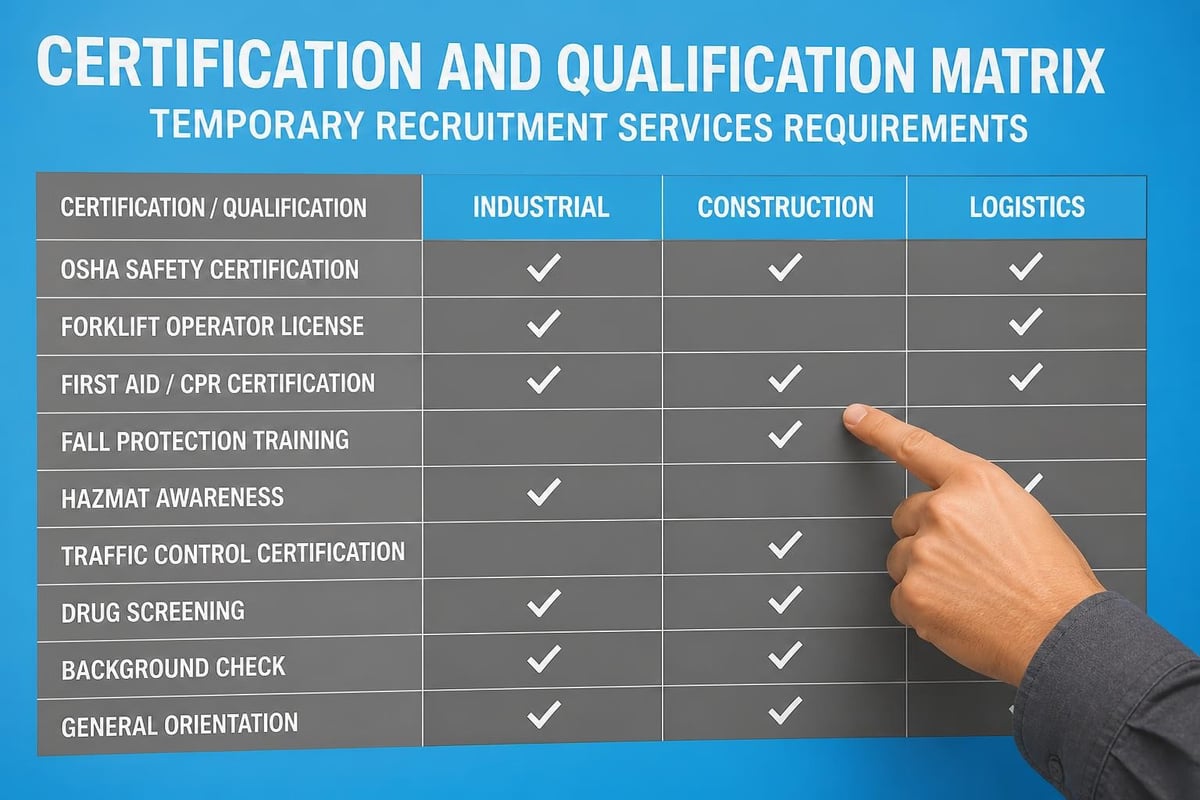
Industrial facilities require workers with precise technical certifications and proven safety records. Recruiting temporary industrial staff demands verification of trade credentials, safety training completion, and often industry-specific experience. A certified welder for pipeline work requires different qualifications than a structural welder for building construction.
The most effective temporary recruitment services maintain databases of pre-screened industrial workers categorized by specific certifications:
- AWS (American Welding Society) certifications by process and material
- Electrical licenses (Journeyman, Master) by state
- Pipefitting and plumbing credentials
- HVAC certifications and refrigerant handling
- Heavy equipment operation licenses by equipment class
These granular qualifications matter enormously when project specifications demand documented expertise. Regulatory compliance in industrial settings leaves zero room for unqualified personnel.
Construction and General Labor Deployment
Construction projects cycle through distinct phases requiring different workforce compositions. Foundation work needs concrete specialists and equipment operators. Framing requires carpenters and laborers. Finishing demands skilled tradespeople across multiple disciplines. Temporary recruitment services enable contractors to match workforce composition to current project phases without maintaining excess permanent staff.
Smart contractors leverage temporary staffing for:
- Project launch surges requiring immediate large crews
- Specialized trade phases needing certified electricians, plumbers, or HVAC technicians
- General labor scaling for material handling and site preparation
- Equipment operation requiring licensed operators for cranes, excavators, or loaders
- Safety personnel including flaggers, spotters, and site safety coordinators
Construction operations utilizing prefabricated metal structures from suppliers like Metal Structure Sales LLC can coordinate installation crews through temporary recruitment services, ensuring specialized erection teams arrive with the precise skills required for efficient assembly and proper structural integration.
Transportation and Logistics Personnel
The transportation sector faces unique challenges securing properly licensed drivers and logistics personnel. CDL driver shortages, seasonal shipping spikes, and fluctuating freight volumes make temporary recruitment services essential for maintaining operational capacity.
| Position Type | Key Requirements | Typical Deployment |
|---|---|---|
| Class A CDL Driver | Valid CDL-A, clean MVR, endorsements | Long-haul, regional freight |
| Class B CDL Driver | Valid CDL-B, passenger/airbrake endorsements | Local delivery, dump trucks |
| Forklift Operator | OSHA certification, equipment-specific training | Warehouse, loading operations |
| Warehouse Personnel | Physical capability, safety training | Picking, packing, inventory |
| Logistics Coordinator | Scheduling software, multilingual preferred | Distribution management |
The emphasis on multilingual capabilities reflects operational reality. Warehouse and logistics operations increasingly rely on diverse workforces where bilingual supervisors and coordinators prevent miscommunication that leads to safety incidents and productivity losses.
Financial and Operational Advantages
The economic case for temporary recruitment services extends beyond obvious payroll savings. Sophisticated financial analysis reveals multiple cost avoidance categories that significantly impact bottom-line performance.
Direct Cost Reductions
Immediate financial benefits include:
- Elimination of recruiting costs (job postings, screening, background checks)
- Zero benefits expense (health insurance, retirement, paid time off)
- No unemployment insurance liability for temporary workers
- Reduced workers' compensation premium basis
- Avoided severance and termination costs
A construction firm deploying 20 temporary workers for a six-month project avoids approximately $40,000-$60,000 in benefits costs alone, not counting recruiting expenses, onboarding investment, and potential severance obligations if permanent hires were later reduced.
Operational Efficiency Gains
Beyond direct costs, temporary recruitment services deliver operational improvements that enhance project profitability:
- Faster project launches without delayed starts waiting for hiring completion
- Improved safety records from pre-certified, experienced workers
- Reduced training costs deploying workers already possessing required skills
- Enhanced flexibility to pursue opportunities without headcount concerns
- Better workforce utilization matching staffing levels precisely to workload
These operational advantages compound over time. Companies maintaining strong relationships with quality staffing providers build competitive moats that enable faster response to market opportunities while competitors struggle with workforce constraints.
Frequently Asked Questions
What are temporary recruitment services?
Temporary recruitment services provide businesses with qualified workers for specific time periods or projects. These services handle recruitment, screening, payroll, and compliance while companies gain flexible access to skilled personnel without permanent employment obligations.
How quickly can temporary recruitment services deploy workers?
Quality staffing agencies can deploy pre-screened workers within 24-72 hours for most positions. Specialized roles requiring specific certifications may take slightly longer, but response times remain significantly faster than traditional hiring processes.
What industries benefit most from temporary recruitment services?
Industrial, construction, maritime, manufacturing, logistics, and warehouse operations gain the most value from temporary staffing. These sectors experience project-based work, seasonal fluctuations, and specialized skill requirements that make flexible workforce solutions essential.
Are temporary workers properly certified and safety-trained?
Reputable temporary recruitment services maintain rigorous certification verification and safety training programs. Workers arrive with current credentials, OSHA training, and industry-specific qualifications required for safe, compliant operations.
How do temporary recruitment services handle payroll and workers' compensation?
The staffing agency serves as the employer of record, handling all payroll processing, tax withholding, workers' compensation insurance, and employment liability. Client companies receive a single invoice covering all workforce costs without administrative burden.
Can temporary workers become permanent employees?
Most staffing agreements include temp-to-perm conversion options. After a specified period, companies can hire temporary workers as permanent employees, often with conversion fees that remain far below traditional recruiting costs.
What makes bilingual temporary workers valuable?
Bilingual personnel bridge communication gaps on diverse worksites, improving safety compliance, productivity, and team cohesion. Spanish-speaking supervisors and skilled tradespeople ensure instructions and safety protocols reach all team members effectively.
How do I ensure quality when using temporary recruitment services?
Partner with staffing agencies demonstrating industry specialization, rigorous vetting processes, and proven track records in your sector. Clear communication of requirements, expectations, and performance standards ensures quality results.
How can CDR General Services help with my temporary staffing needs?
CDR General Services specializes in providing safety-certified, skilled temporary workers across industrial, construction, and maritime sectors throughout the Gulf South. Our unique Spanish-speaking workforce expertise and rapid deployment capabilities deliver the qualified personnel your projects demand exactly when you need them.
Building a Competitive Workforce Strategy
The organizations winning in today's industrial marketplace share a common characteristic: workforce agility. They scale operations seamlessly, pursue opportunities without headcount constraints, and deploy specialized expertise precisely when projects demand it. Temporary recruitment services provide the foundation for this strategic flexibility.
Success requires moving beyond viewing temporary staffing as a backup plan and embracing it as a core component of workforce architecture. Companies that integrate temporary recruitment services into their operational DNA gain decisive advantages over competitors locked into rigid permanent staffing models.
The competitive edge intensifies when partnering with staffing providers offering specialized capabilities others cannot match. Access to bilingual personnel, Spanish-speaking supervisors, and culturally competent teams transforms challenging worksites into smoothly operating operations where communication barriers disappear and productivity soars.
Strategic workforce planning in 2026 means recognizing that the best team for today's project looks different from next quarter's requirements. Temporary recruitment services deliver this adaptability while maintaining quality, safety, and cost control that permanent hiring simply cannot match for project-based work.
Temporary recruitment services have evolved from contingency staffing into strategic workforce solutions that enable competitive operations across industrial, construction, and maritime sectors. The flexibility, cost control, and access to specialized talent these services provide have become essential for companies pursuing growth without excessive permanent headcount risk. When you need safety-certified, bilingual personnel deployed rapidly across the Gulf South region, CDR General Services delivers the industry-leading temporary recruitment services and Spanish-speaking workforce expertise that set your operations apart from the competition.
Published July 15, 2026 by CDR
All articles