
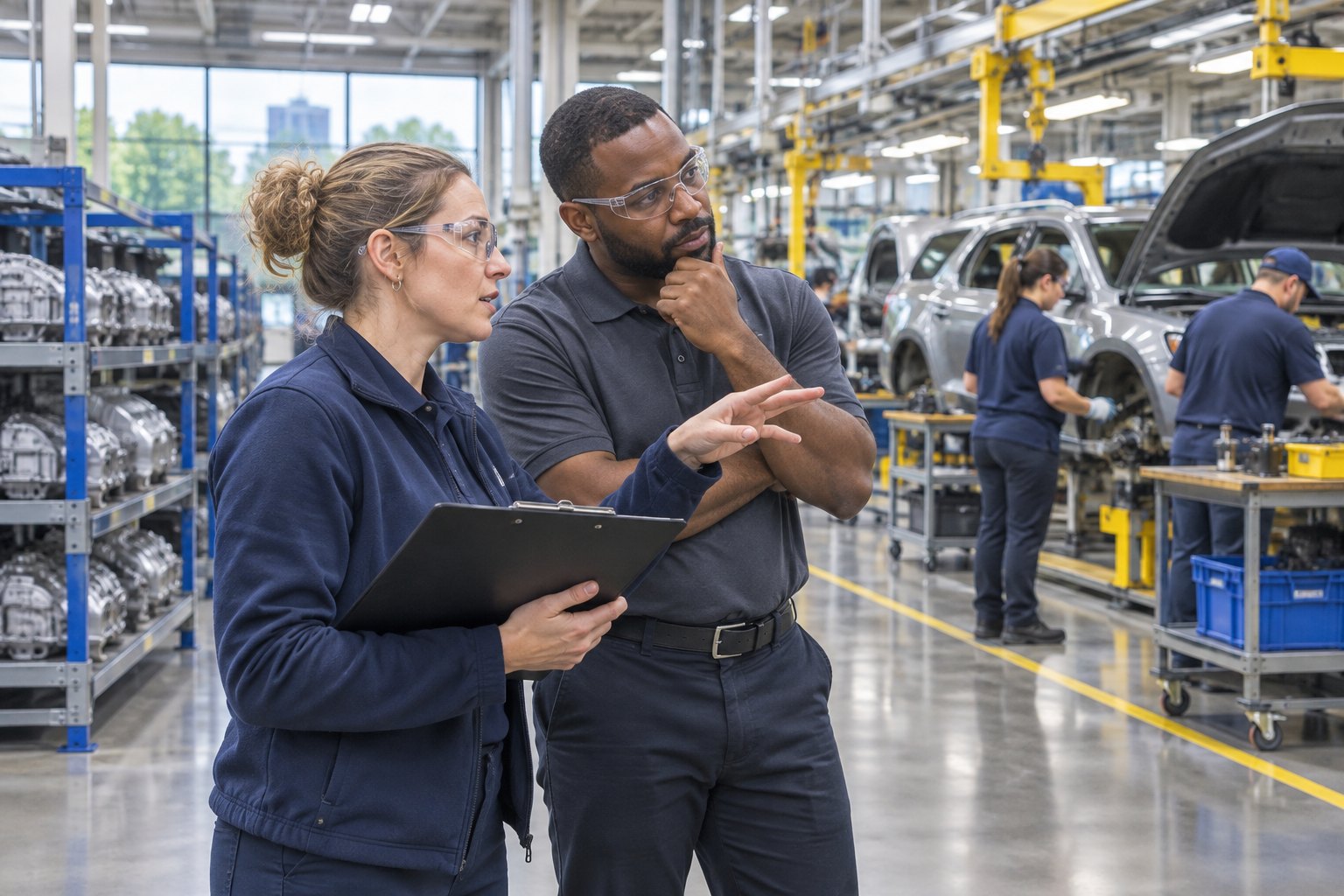
If you are hiring for an automotive supplier plant in Michigan, the first decision is not who to call for resumes. It is which hiring model fits the gap on your floor. Temporary staffing covers absenteeism, launch pressure, vacation gaps, and short production swings. Temp-to-hire lets you watch attendance, pace, and coachability before moving someone to your payroll. Direct hire makes sense when you already know the role, the shift, and the long-term headcount need. In most cases, pre-screened workers can be on site in 24 to 48 hours, depending on the role and the location.
What Michigan supplier plants usually need filled first
Plant-floor production support
Most supplier hiring starts with work that keeps the line moving. That can mean production associates, assembly support, packaging help, material handlers, and general labor assigned to one department or cell. The issue is usually not a job description problem. It is coverage. A line has to run, and supervisors need people who can show up, take instruction, and stay with the pace of the shift.
In Michigan, that demand often sits around Detroit, Warren, Sterling Heights, Dearborn, Lansing, and Grand Rapids, where plant-floor and supplier work stays tied to production schedules and shipping windows.
Warehouse and shipping support tied to the plant
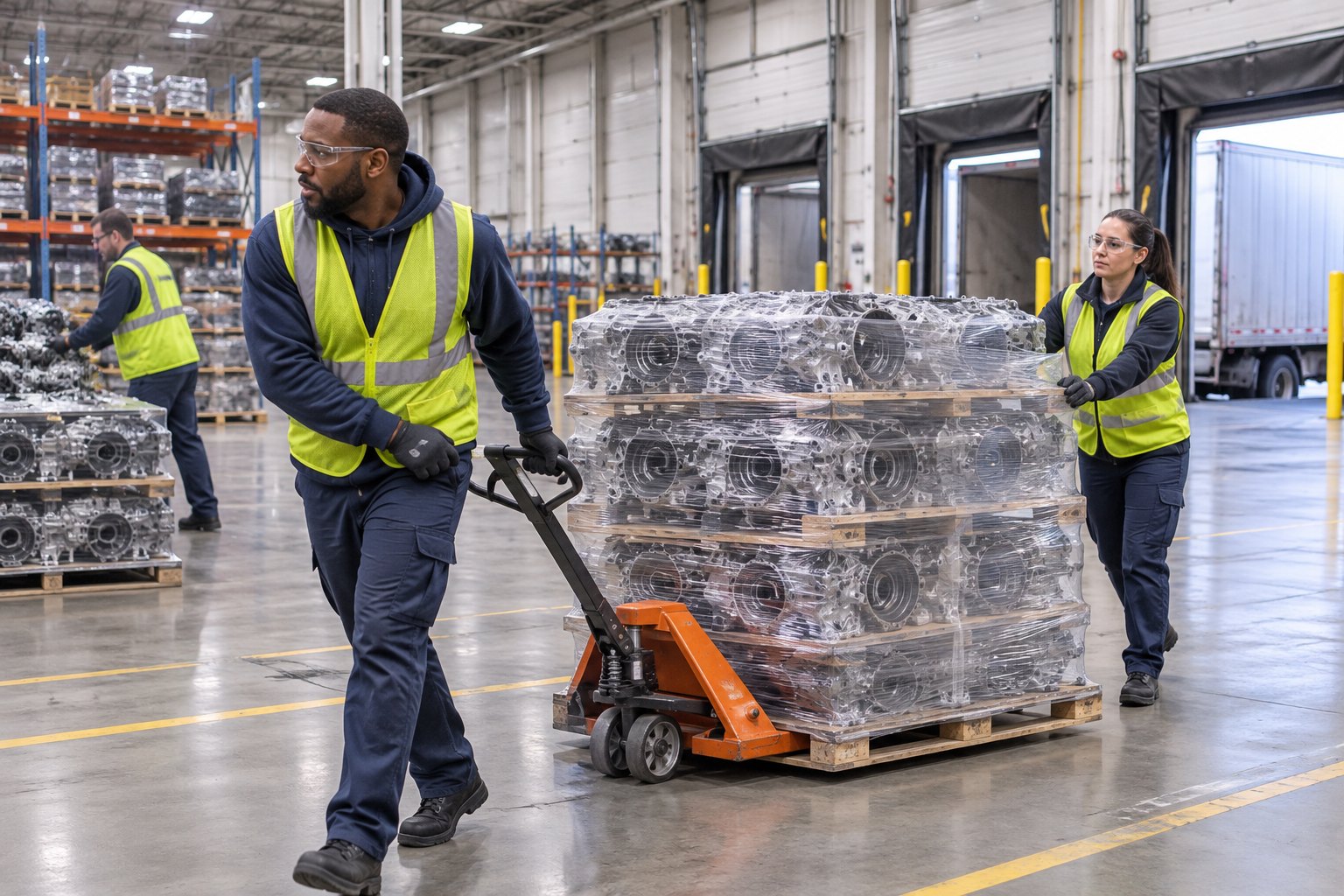
Supplier plants also need warehouse labor that is close to production, not separate from it. That includes shipping and receiving clerks, forklift operators, dock crews, inventory support, and people who move parts, packaging, and finished goods between the floor and the warehouse.
When a plant says it needs warehouse help, it often means the shipping side is backing up and that delay is starting to affect the floor. Staffing has to account for both sides of that handoff.
Clerical coverage inside operations
Administrative and clerical hiring matters more in supplier plants than many people expect. Dispatch clerks, plant-office administrators, shipping office support, bilingual front desk coverage, and short-term office replacement can all affect production when they are missing. Bills of lading, receiving logs, visitor processing, and driver communication still have to be handled on time.
This is where employers often need someone who can work with floor leads, office staff, and drivers without a long ramp-up.
Choose the hiring model before you release the order
Temporary staffing for short pressure
Use temporary staffing when the problem is immediate coverage. A supplier may be dealing with call-offs, backlog, a launch, a shutdown restart, a vacation cluster, or a short run increase. In that case, CDR employs the worker for the assignment. The plant gets labor on site without adding that person to its own payroll during the temp period.
This model works well when the volume may change quickly. You can add people, hold steady, or scale down as the work changes.
Temp-to-hire for jobs that need a working interview
Many supplier roles look simple on paper and are harder in practice. Pace, attendance, safety habits, hand skills, and shift fit show up after the worker starts, not during the interview. Temp-to-hire gives the plant time to see the person on the job before deciding whether to hire them directly.
This is often the better option for production, warehouse, and shipping roles where reliability matters as much as prior experience.
Direct hire for fixed openings
Direct hire is recruiting support for a role the plant intends to fill on its own payroll from day one. CDR recruits, screens to the job requirement, and sends candidates for the employer's hiring process. This is useful when a supplier plant has a defined opening, an established pay structure, and a clear reporting line.
| Hiring model | Best fit | Who employs the worker at the start | What changes later |
|---|---|---|---|
| Temporary staffing | Coverage for peaks, absences, launches, and short-term gaps | CDR | The assignment can end, extend, or scale with demand |
| Temp-to-hire | Roles that need a working interview before a decision | CDR | The employer may later move the worker to its own payroll |
| Direct hire | Permanent openings with a defined long-term need | The employer | No temp period; CDR handles recruiting |
What the employer needs to give before recruiting starts
Shift, schedule, and start conditions
The fastest orders are the clearest ones. A supplier plant should be ready to state the shift, the start time, the expected schedule, whether overtime is common, and whether the assignment is open-ended or tied to a known period. If a worker is reporting to a plant, a warehouse, a shipping office, or a separate building, that should be clear at the start.
Without that, recruiting slows down because candidates are being sold on half a job.
Actual job duties, not broad labels
“General labor” is too wide by itself. A stronger order explains what the worker will do for most of the shift. Packing. Sorting. Staging racks. Feeding a line. Breaking down materials. Scanning inventory. Cleaning a work area. Moving totes. Supporting shipping paperwork. Running a forklift if required by the employer.
The more exact the task list, the better the fit on day one.
Screening and site rules
CDR pre-screens workers to the job, and the screen changes with the employer's requirement. For many assignments, that can include the usual background check and drug screen. Some plants also have site-specific onboarding, PPE rules, visitor procedures, or safety expectations that need to be explained before arrival.
That matters because a good worker can still become a bad placement if the site requirement is not communicated up front.

How the staffing sequence works from order to start
Step 1: Intake with one point of contact
The process works best when the plant gives one manager or lead authority to release the order and answer follow-up questions. That person explains the role, shift, supervisor, work environment, and screening requirement. They also confirm whether the request is for temporary staffing, temp-to-hire, or direct hire.
One point of contact keeps the order from changing shape halfway through recruiting.
Step 2: Recruiting and pre-screening
CDR recruits for the assignment and screens to the role. For a supplier plant, that can include work history review, availability, shift fit, transportation, and any employer-required screening. If the role involves plant-floor pace, warehouse movement, or bilingual communication, that should be matched before the worker is sent.
For bilingual English and Spanish needs, the practical question is simple: can the worker take instruction, communicate with the lead, and function inside the actual work area or front desk role.
Step 3: Dispatch and first-day reporting
Once candidates are cleared for the assignment, they are dispatched with reporting details. The employer should know who is arriving, where they report, what PPE is expected, and who receives them. The worker should know the shift, arrival point, and what the first day asks of them.
Most first-day problems are not skill problems. They are reporting problems. Wrong gate, wrong time, wrong contact, or missing site instructions.
Step 4: Supervision on site and payroll during the assignment
During a temporary or temp-to-hire assignment, the plant supervises the work on site. CDR employs the worker for that assignment. That means the worker is sent to perform under the plant's day-to-day direction, while payroll remains with CDR during the temp period.
This is the part many employers want stated plainly. The plant runs the shift. CDR handles employment for the temporary assignment.
What screening should match in an automotive supplier setting
Shift reliability matters as much as past titles
Supplier plants often ask for prior manufacturing experience, but the stronger predictor is whether the worker can keep the schedule. A person who can consistently report for a fast-paced line, warehouse dock, or shipping office is usually more useful than a resume full of broad industry labels.
That is why scheduling, transportation, and willingness to work the actual shift matter during screening.
Safety and work environment fit
Safety training is part of the work, but the plant still needs workers who understand basic shop expectations: reporting on time, following instructions, wearing required PPE, and working cleanly around equipment, materials, and other crews. A supplier environment can be repetitive, loud, and production-driven. The screening should reflect that reality.
If the assignment involves site cleanup, material movement, or dock activity, that should be described clearly before dispatch.
Bilingual communication where it helps operations
Some Michigan plants and plant offices need bilingual English and Spanish support for practical reasons. A lead may need a worker who can take instruction in English and explain a task in Spanish. A front desk may need someone who can receive drivers and visitors. A shipping office may need smoother handoff communication with a mixed-language crew.
This should be handled as an operations need, not a slogan. The question is whether communication on the shift gets easier and safer with that skill.
Common breakdowns in supplier plant hiring
The order changes after recruiting starts
A plant asks for packers and then decides it wants forklift support, inventory scanning, and shipping backup in the same order. That usually creates misalignment. It is better to separate the jobs or clearly rank the duties before recruiting starts.
A broad order can still be filled, but only if the plant is honest about the main task and what would make someone fail the assignment.
The supervisor expects a finished employee on day one
Even strong workers need a site handoff. They need to know where to report, who their lead is, what line or area they are supporting, and what the first hours look like. If the supervisor is unavailable and the worker gets parked in a break room or bounced between entrances, the plant loses the start before the shift is underway.
Staffing solves recruiting. It does not replace first-day plant management.
The plant waits too long to choose temp-to-hire
Some employers use straight temporary staffing when the real need is a trial period for a permanent seat. That can create confusion about expectations. If the plant already knows it wants to evaluate a worker for long-term fit, temp-to-hire is cleaner. Everyone understands that the assignment is a working interview that may convert later.

How temp-to-hire should work in a Michigan supplier plant
Set the review points early
Temp-to-hire works best when the plant decides in advance what it is judging. Attendance. Shift reliability. Coachability. Production pace. Safety habits. Basic teamwork. If those points are left vague, the assignment drifts and nobody knows when a decision is supposed to happen.
You do not need a complicated scorecard. You need a shared understanding of what would make the person worth converting.
Keep feedback moving during the assignment
If a worker is doing well, say so early. If there is a problem, raise it while it can still be corrected. Temp-to-hire is not only about watching. It is about giving the plant a chance to confirm fit and the worker a chance to improve in a real environment.
That communication also helps when the employer wants more people in the same role, because the recruiting profile becomes sharper after the first starts.
Know what changes at conversion
During the temp-to-hire period, CDR employs the worker for the assignment. If the plant chooses to hire that person onto its own payroll, the employment relationship changes at conversion. The worker then becomes the employer's employee under the employer's own payroll and internal process.
That sequence matters because it keeps roles clear for the worker, the supervisor, and payroll.
Frequently Asked Questions
How fast can a Michigan supplier plant get workers on site?
In most cases, pre-screened workers can be on site in 24 to 48 hours, depending on the role and the location. More specialized roles, harder shifts, or locations with a tighter labor pool may take longer.
Who pays the worker during a temporary assignment?
For temporary staffing and temp-to-hire, CDR employs the worker during the assignment period. The plant supervises the work on site. If the employer later converts the worker in a temp-to-hire arrangement, the worker moves to the employer's payroll at that point.
Can you help with bilingual English and Spanish workers?
Yes. Bilingual English and Spanish staffing can be part of plant-floor, warehouse, clerical, and customer-facing support when the assignment calls for it. The practical focus is whether the worker can communicate effectively in the role.
What roles can be filled for automotive supplier plants?
Common requests include production associates, material handlers, dock crews, site cleanup labor, warehouse support, shipping and receiving clerks, plant-office administrators, forklift operators, and other general labor and clerical roles tied to plant operations.
What a good first day looks like at the plant
A named supervisor receives the worker
The worker should arrive knowing where to report and who to ask for. The supervisor or lead should expect them, place them quickly, and explain the work area. A confused handoff wastes the start and raises the chance of early turnover.
The simplest plants to staff are not always the easiest jobs. They are the sites with clear reporting lines.
The assignment starts with real task instruction
The worker does not need a speech. They need the actual task, the pace, the quality expectation, and the safety rules for that area. If the job is packing, show the pack standard. If it is staging materials, show the route and the handoff point. If it is clerical support, show the forms, calls, or system steps that matter first.
Specific instruction is what turns a dispatched worker into productive labor.
The plant reports back quickly if the fit is off
If the worker is not matching the assignment, the employer should say so fast and specifically. Not “not a fit,” but “missed the reporting time,” “could not keep up with line pace,” or “needed stronger shipping office experience.” That helps protect the shift and improves the next dispatch.
How CDR supports Michigan automotive supplier hiring
One office, multi-state coverage
CDR General Services is a veteran-owned staffing agency headquartered in Baton Rouge, Louisiana, serving employers across 12 states. There is one headquarters, not a branch in every city. Michigan employers still get the same staffing sequence: intake, recruiting, pre-screening to the role, dispatch, and follow-up tied to the assignment type.
That matters if you need a staffing partner that explains the process clearly instead of selling a loose promise.
Support across plant, warehouse, and clerical work
For Michigan supplier plants, the most common fit is across General Labor & Warehouse and Administrative & Clerical. That includes line support, warehouse coverage, dock labor, shipping office help, plant-office support, and bilingual front desk or clerical roles where needed. Skilled industrial and driver-related recruiting can also sit inside the same practice when the assignment requires it.
The point is not to create separate labels. The point is to staff the actual work that keeps the plant moving.
Start with the role, the shift, and the reporting path
The fastest way to fill a supplier plant order is to define three things clearly: what the worker will do, when they will do it, and who receives them on site. Once that is in place, the rest of the staffing process becomes straightforward.
That is how you avoid vague orders, bad first days, and preventable turnover when the line needs help now.
Published November 24, 2026 by CDR General Services
All articles