

The modern workforce landscape demands agility. When project timelines compress, seasonal demands surge, or critical positions open unexpectedly, businesses need immediate access to qualified talent. That's precisely where temporary placement agencies deliver unmatched value. These specialized partners bridge the gap between fluctuating workforce needs and the operational reality of maintaining lean, efficient teams. For industries like construction, maritime, and industrial manufacturing, the right agency doesn't just fill seats-it deploys safety-certified, job-ready professionals who perform from day one.
What Temporary Placement Agencies Actually Do
Temporary placement agencies function as strategic workforce partners, not simple resume forwarders. They maintain pre-vetted talent pools, handle all employment administration, and assume liability for worker classification and compliance. When you engage a temporary placement agency, you're outsourcing recruitment, screening, payroll, benefits administration, and often workers' compensation to a specialized provider.
The core value proposition is speed and risk transfer. According to staffing industry statistics from the American Staffing Association, temporary and contract employees represent a significant portion of the U.S. workforce, with agencies employing millions of workers annually. This scale enables agencies to respond faster than internal HR departments could ever match.
The Operational Model Explained
Here's how the relationship actually works in practice:
- Client intake and job specification: The agency conducts detailed consultation to understand not just the role, but safety requirements, cultural fit, language needs, and technical certifications.
- Candidate sourcing and screening: Agencies tap existing talent networks, conduct skills assessments, verify certifications, and perform background checks before any candidate reaches your desk.
- Placement and onboarding: The worker becomes a W-2 employee of the agency while working at your facility, creating clear lines of authority and compliance.
- Ongoing administration: Payroll, tax withholding, benefits, and unemployment insurance remain the agency's responsibility throughout the assignment.
- Performance management and replacement: If a placement doesn't work out, the agency provides rapid replacement at no additional search fee.

This structure matters because it addresses the complex joint employment considerations outlined by the Department of Labor, ensuring wage-and-hour compliance while maintaining operational flexibility.
Industries That Depend on Temporary Placement Agencies
Certain sectors simply cannot function without reliable temporary staffing. The nature of project-based work, seasonal fluctuations, and safety-critical positions creates an inherent need for flexible workforce solutions.
| Industry | Primary Use Cases | Critical Certifications |
|---|---|---|
| Industrial Manufacturing | Production surges, equipment maintenance shutdowns, new line launches | OSHA-10, confined space, forklift, lockout/tagout |
| Construction | Project-specific crews, specialty trades, seasonal demand | OSHA-30, scaffolding, rigging, equipment operation |
| Maritime & Offshore | Turnarounds, dry-dock operations, emergency repairs | TWIC cards, HUET, H2S, offshore survival training |
| Logistics & Warehousing | Peak season staffing, distribution center operations | CDL licenses (Class A/B), hazmat endorsements, inventory systems |
Why These Industries Need Specialized Agencies
Generic staffing firms cannot serve high-stakes industrial environments. The difference between an adequate agency and a specialist like CDR General Services comes down to three factors: safety certification expertise, sector-specific talent networks, and cultural competency.
In Gulf South markets-Louisiana, Mississippi, Alabama, and Kentucky-the workforce is increasingly diverse. A temporary placement agency that provides bilingual supervisors and a Spanish-speaking workforce delivers measurable productivity gains on multicultural job sites. This isn't optional anymore; it's a competitive requirement.
The Compliance Advantage You Cannot Ignore
Employment law complexity has exploded. Co-employment liability, joint employer status, and wage-and-hour regulations create significant risk for companies using temporary workers. SHRM's guidance on contract and temporary staffing policy makes clear that proper policy frameworks are essential to mitigate these exposures.
When you work with temporary placement agencies, you transfer substantial compliance burden to a specialist who manages these issues daily:
- Worker classification: Ensuring temporary workers are properly classified as W-2 employees, not independent contractors
- Overtime calculation: Managing hours, breaks, and premium pay across multiple client sites
- Workers' compensation: Maintaining appropriate coverage and handling claims administration
- Unemployment insurance: Funding and managing UI claims for temporary employees
- Immigration compliance: I-9 verification, work authorization, and documentation for foreign-national workers
Regulatory Developments Affecting Temporary Staffing
The landscape continues to shift. Recent federal rule changes affecting joint employment have refined how agencies and client companies share responsibility for labor law compliance. These developments reinforce why partnering with knowledgeable temporary placement agencies is essential-they monitor regulatory changes and adjust practices proactively.
The bottom line: regulatory risk is real, expensive, and constantly evolving. Agencies absorb this complexity so you can focus on operations.
Cost Structure and ROI Calculation
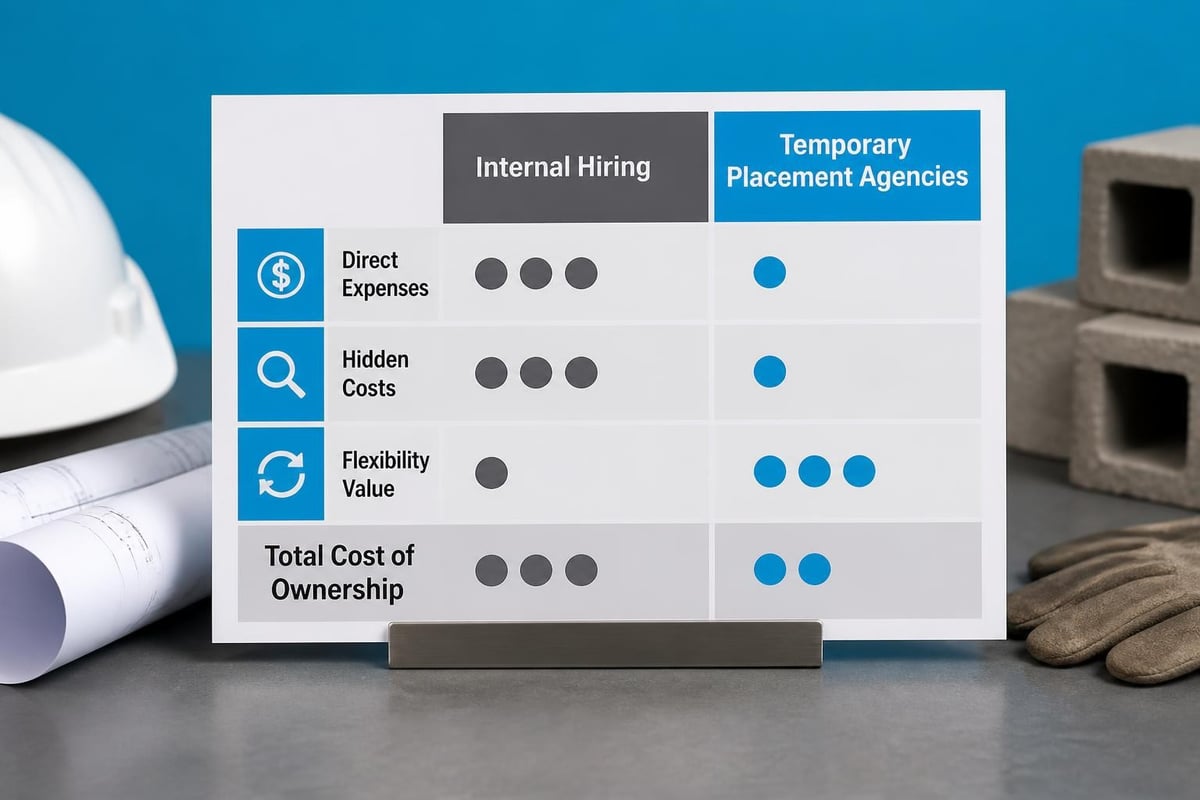
Temporary placement agencies charge a markup over the worker's hourly wage-typically 35% to 75% depending on skill level, certification requirements, and assignment duration. At first glance, this seems expensive. A more sophisticated analysis reveals substantial hidden savings.
Direct cost comparison:
- Internal hiring: Job posting fees, recruiter time, background checks, onboarding administration, payroll processing, benefits, unemployment insurance, workers' comp premiums
- Agency staffing: Single all-inclusive bill rate covering all of the above plus replacement guarantees
Indirect value drivers:
- Reduced time-to-fill from weeks to hours or days
- Zero severance or unemployment liability when assignments end
- Scalability without permanent headcount commitments
- Access to pre-certified specialists who require minimal training
- Elimination of recruiting department overhead for temporary needs
For project-driven businesses, the flexibility alone justifies the premium. You pay only for productive hours worked, with none of the carrying costs of permanent employees during slow periods.
Specialty Staffing: The Decisive Competitive Edge
Not all temporary placement agencies are created equal. Generic firms dabble across industries with shallow talent pools and minimal sector expertise. Specialist agencies dominate specific niches through deep networks, technical knowledge, and proven track records.
The Spanish-Speaking Workforce Advantage
The Gulf South region faces a documented skilled-trades shortage at precisely the moment Latino workforce participation is growing rapidly. Agencies with genuine Spanish specialty staffing capabilities-not just token bilingual recruiters-deliver three critical advantages:
- Deeper talent pools: Direct access to skilled Spanish-speaking welders, pipefitters, riggers, and operators who might never respond to English-only job postings
- Cultural competency: Understanding work authorization nuances, family scheduling needs, and communication preferences that improve retention
- On-site effectiveness: Bilingual supervision and documentation that prevents miscommunication on safety-critical tasks
This isn't about checking diversity boxes. It's about accessing proven, hard-working talent that competitors overlook. Companies working with agencies offering Louisiana staffing solutions that include robust Spanish-language capabilities report measurably higher productivity and lower turnover on complex projects.
Skilled Trades and Technical Certifications
The real differentiator is certification depth. Premium temporary placement agencies maintain workers with current, verified credentials:
- Welding: AWS D1.1, API 1104, specialized processes (TIG, MIG, stick, flux-core)
- Electrical: Journeyman licenses, NFPA 70E arc flash training, instrumentation experience
- Heavy equipment: NCCCO crane certifications, excavator operation, specialized rigging
- Transportation: CDL Class A with tanker/hazmat endorsements, clean driving records, TWIC clearances
Generic agencies claim they can find "certified welders." Specialists maintain rosters of certified welders with documented experience on specific codes, materials, and positions. That difference determines whether your project stays on schedule or grinds to a halt waiting for qualified replacements.
Evaluating and Selecting the Right Agency Partner
Choosing temporary placement agencies demands the same rigor you'd apply to any critical vendor relationship. The wrong partner creates more problems than they solve. The right partner becomes an extension of your operations team.
Non-Negotiable Selection Criteria
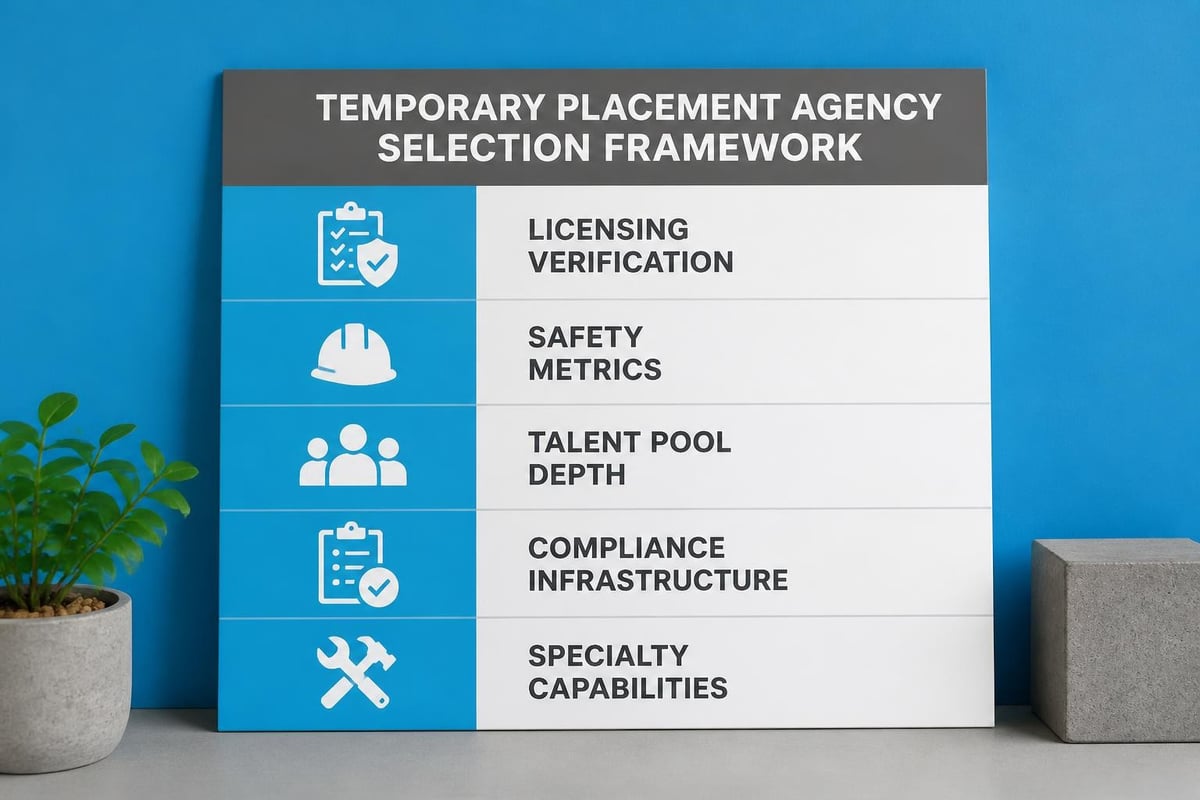
Start with these baseline requirements:
- Valid business licensing and insurance: General liability, professional liability, and workers' compensation with limits appropriate to your risk profile
- Industry-specific experience: Documented placements in your sector, not adjacent industries
- Safety record: EMR (Experience Modification Rate) below 1.0, TRIR (Total Recordable Incident Rate) data, safety training programs
- Compliance infrastructure: Dedicated compliance staff, audit trail documentation, policies aligned with current regulations
- Replacement guarantees: Clear service-level agreements on placement replacement timeframes and terms
Beyond baseline requirements, investigate cultural fit and strategic alignment. Does the agency understand your operational reality, or are they pushing generic solutions?
Questions That Reveal True Capability
| Question Category | What to Ask | What Great Answers Sound Like |
|---|---|---|
| Talent depth | "How many certified welders (or specific role) do you have available in our region right now?" | Specific numbers, breakdown by certification type, availability within 24-48 hours |
| Safety culture | "Describe your safety training process and incident reporting procedures." | Detailed pre-assignment orientation, clear escalation protocols, proactive safety communications |
| Specialty capability | "What percentage of your workforce is Spanish-speaking, and how do you handle bilingual supervision?" | Concrete percentages, examples of bilingual job-site coordination, culturally appropriate retention programs |
| Compliance management | "How do you handle joint employer liability and wage-hour compliance?" | Reference to specific DOL guidance, clear delineation of responsibilities, audit preparedness |
Watch for agencies that answer with specifics, not marketing speak. If they cannot cite numbers, certifications, or processes immediately, they're not operating at the level you need.
Best Practices for Client Companies
Working effectively with temporary placement agencies requires clear internal processes and realistic expectations. The partnership succeeds when both parties understand their roles and communicate proactively.
Establish clear onboarding and supervision protocols:
- Designate specific supervisors responsible for temporary worker direction and safety oversight
- Create standardized site orientation covering facility-specific hazards, emergency procedures, and reporting requirements
- Implement clear escalation procedures for performance issues, safety concerns, or credential questions
Communicate requirements with precision:
- Provide detailed job descriptions including physical demands, environmental conditions, and specific technical skills
- Specify mandatory certifications, licenses, and clearances before the search begins
- Set realistic timelines that account for verification and documentation processes
Monitor performance and provide feedback:
- Track key metrics like attendance, quality, safety incidents, and productivity by worker and by agency
- Share performance data regularly so the agency can improve matching and address issues proactively
- Recognize that the first week is diagnostic-rapid replacement of poor matches prevents extended problems
Integrate temporary workers into your safety culture:
- Include temporary employees in safety meetings, toolbox talks, and incident investigations
- Provide the same PPE, training, and hazard communication you extend to permanent employees
- Remember that joint employment responsibilities mean you share accountability for workplace safety regardless of employment status
The companies achieving the best results treat temporary placement agencies as strategic partners, not transactional vendors. They invest time in relationship building, provide candid feedback, and plan ahead for known demand fluctuations.
Global Context and Future Trends
The temporary staffing industry operates at massive scale globally. The World Employment Confederation reports demonstrate that private employment services place millions of workers worldwide annually, contributing substantially to labor market flexibility and economic growth. Understanding these broader trends provides context for domestic market developments.
International Labor Standards and Worker Protections
Organizations like the International Labour Organization publish comprehensive guidance on temporary agency work and private employment agencies, establishing frameworks for worker protection, equal treatment, and collective bargaining rights. While these international standards don't directly govern U.S. operations, they shape regulatory discussions and influence best practices globally.
The convergence trend is clear: expectations around temporary worker treatment, wage parity, and benefits access are rising worldwide. Forward-looking temporary placement agencies are already moving beyond minimum compliance toward competitive total rewards programs that improve worker retention and client service.
Technology and Market Evolution
The industry is undergoing digital transformation. Advanced temporary placement agencies now leverage:
- Applicant tracking systems with skills taxonomies and credential verification automation
- Mobile apps that enable workers to claim shifts, submit timecards, and access training materials
- Predictive analytics that forecast demand patterns and optimize talent pool development
- Integration platforms that connect agency systems with client HRIS, timekeeping, and procurement systems
These tools don't replace human expertise in sectors like industrial, construction, and maritime staffing. They augment it, enabling faster matching, better documentation, and more transparent performance tracking.
Technology enables scale, but relationships win projects. The agencies investing in both digital infrastructure and deep human expertise will dominate the next decade.
Frequently Asked Questions
What exactly are temporary placement agencies?
Temporary placement agencies are specialized workforce partners that maintain pools of pre-vetted talent, handle all employment administration, and deploy qualified workers to client companies on a temporary basis. The agency remains the legal employer, managing payroll, benefits, workers' compensation, and compliance while the worker performs duties at the client's facility under the client's supervision.
How much do temporary placement agencies typically charge?
Temporary placement agencies typically charge a bill rate that includes a markup of 35% to 75% over the worker's base wage, depending on skill level, certifications required, and assignment duration. This all-inclusive rate covers not just wages but also payroll taxes, workers' compensation insurance, unemployment insurance, benefits administration, recruiting costs, and replacement guarantees-representing substantial value when compared to the total cost of internal hiring.
What industries use temporary placement agencies most frequently?
Industries with project-based work, seasonal demand fluctuations, or safety-critical positions rely heavily on temporary placement agencies. These include industrial manufacturing, construction, maritime and offshore operations, logistics and warehousing, administrative and clerical services, and transportation. These sectors require rapid access to certified, job-ready professionals who can perform immediately without extended training periods.
How do temporary placement agencies handle worker safety and certifications?
Reputable temporary placement agencies maintain comprehensive safety programs including pre-assignment orientation, ongoing safety training, OSHA compliance management, and certification verification systems. They track worker certifications (welding credentials, CDL licenses, OSHA cards, specialized equipment training) and ensure all credentials remain current before deployment. The best agencies maintain EMR rates below 1.0 and share safety performance data transparently with clients.
What is the difference between a temp agency and a temporary placement agency?
The terms are often used interchangeably, but "temporary placement agency" typically emphasizes the professional matching and placement process rather than just filling bodies. Premium temporary placement agencies focus on specialized industries, maintain deeper talent pools with verified credentials, and provide higher-touch service including performance management, compliance consultation, and strategic workforce planning-distinguishing them from high-volume, low-skill temp services.
How quickly can temporary placement agencies fill open positions?
Specialized temporary placement agencies with robust talent pools can often fill positions within 24 to 48 hours for common roles with standard certifications. More specialized positions requiring unique credential combinations may take 3 to 5 business days. Speed depends on specificity of requirements, certification verification needs, geographic location, and current talent availability. Agencies maintaining pre-certified talent pools and proactive recruiting programs deliver the fastest placements.
What are the compliance risks when using temporary workers?
Key compliance risks include joint employer liability under wage-and-hour laws, workers' compensation coverage gaps, unemployment insurance obligations, worker misclassification (employee vs. independent contractor), immigration verification requirements, and anti-discrimination laws. Working with established temporary placement agencies that maintain robust compliance programs, clear policies, and proper insurance coverage substantially reduces these risks by transferring administrative burden to specialists who manage these issues daily.
Do temporary placement agencies provide bilingual or Spanish-speaking workers?
The best temporary placement agencies specializing in industrial, construction, and maritime sectors maintain Spanish-speaking talent pools and provide bilingual supervisory staff to support multicultural job sites. This capability is particularly valuable in Gulf South markets where Latino workforce participation is growing rapidly. Agencies with genuine Spanish specialty staffing-not just token bilingual recruiters-deliver measurable productivity and safety improvements through culturally competent placement and on-site communication support.
How can CDR General Services help with my temporary staffing needs?
CDR General Services specializes in providing safety-certified, job-ready temporary workers across industrial, construction, maritime, and logistics sectors throughout the Gulf South region. Our unmatched competitive advantage is our Spanish specialty staffing capability-we maintain the largest pool of skilled, bilingual Latino workers in the region, including certified welders, pipefitters, electricians, CDL drivers, and heavy equipment operators. Whether you need rapid project staffing, seasonal workforce scaling, or specialized trade professionals, our team delivers qualified talent within 24-48 hours backed by comprehensive safety programs and compliance management.
Should I use multiple temporary placement agencies or establish an exclusive partnership?
The optimal approach depends on your volume, geographic footprint, and specialty needs. High-volume operations often benefit from a tiered vendor management program with a primary agency handling 70-80% of placements and specialty providers for niche requirements. Mid-sized operations typically achieve best results with one strategic partner who learns your culture, anticipates needs, and prioritizes your requisitions. Exclusive partnerships deliver better service, faster fills, and lower effective costs when the agency earns enough business to justify dedicated account management and proactive talent pool development.
Temporary placement agencies deliver speed, flexibility, and compliance expertise that internal recruiting simply cannot match in today's dynamic industrial environment. When you partner with a specialist who maintains deep talent pools, sector-specific knowledge, and genuine cultural competency, you gain competitive advantage through workforce agility. CDR General Services combines all these elements with our unmatched Spanish specialty staffing capability, delivering safety-certified, bilingual professionals across the Gulf South region who perform from day one.
Published September 16, 2026 by Sanya
All articles