

The staffing industry has undergone a seismic shift in recent years, driven by technology and changing workforce expectations. Mobile staffing solutions have emerged as the definitive answer to managing dispersed teams, accelerating placements, and maintaining real-time visibility across operations. For staffing agencies serving the Industrial, Construction, and Maritime sectors throughout Louisiana, Mississippi, Alabama, and Kentucky, mobile capabilities aren’t just convenient; they’re mission-critical. The old paper-based systems and desk-bound processes are relics of a bygone era. Today’s staffing leaders demand instant access to candidate data, real-time job assignments, and immediate safety certification verification, all from the palm of their hand.
The Strategic Imperative Behind Mobile Workforce Management
Mobile staffing solutions represent far more than digitizing old processes. They fundamentally transform how staffing agencies operate, compete, and deliver value to clients. The statistics underscore this reality: mobile usage in job searches has reached unprecedented levels, with candidates expecting seamless mobile experiences throughout their employment journey.
The Gulf South region presents unique challenges that make mobile capabilities non-negotiable. Construction sites span vast geographic areas. Maritime operations demand 24/7 availability. Industrial facilities require immediate replacement personnel when safety incidents or equipment failures occur. Paper timesheets, phone-based check-ins, and delayed status updates create bottlenecks that cost clients thousands of dollars in downtime.
Key drivers for mobile adoption include:
- Instant candidate communication and job offer acceptance
- Real-time timesheet submission and approval workflows
- Immediate safety incident reporting and documentation
- GPS-verified clock-in/clock-out at job sites
- Mobile access to certification and credential databases
- Rapid replacement requests and emergency staffing responses
The competitive advantage becomes clear. Agencies equipped with robust mobile staffing solutions place candidates faster, reduce administrative overhead, and provide clients with transparency that traditional staffing firms simply cannot match.
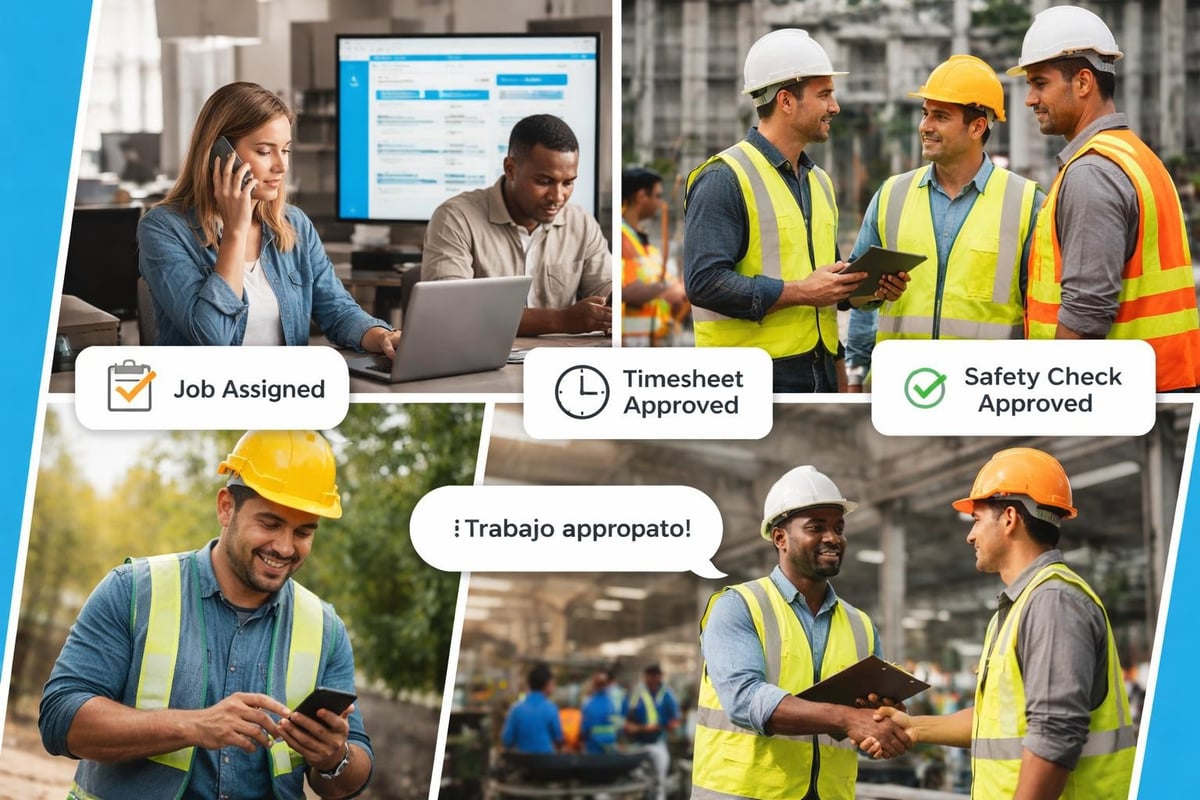
Transforming Industrial and Construction Staffing Operations
Industrial and construction environments demand staffing precision that desktop-bound processes cannot deliver. When a certified welder calls in sick at 5:00 AM, clients need replacement personnel on-site within hours, not days. Mobile staffing solutions enable recruiters to instantly search available talent pools, verify current certifications, and dispatch qualified replacements before the morning shift begins.
The bilingual workforce dimension adds another layer of operational complexity and opportunity. Spanish-speaking crews represent a substantial portion of the Gulf South’s industrial and construction workforce. Mobile platforms that support bilingual interfaces and real-time translation capabilities ensure seamless communication between English-speaking supervisors, Spanish-speaking field workers, and staffing coordinators managing the entire operation.
Consider the typical morning scenario at a major industrial facility:
- 5:30 AM: Three pipefitters scheduled for the day shift are unavailable due to family emergencies
- 5:35 AM: Site supervisor submits replacement request via mobile portal
- 5:40 AM: Staffing coordinator receives alert, searches certified pipefitter database
- 5:50 AM: Coordinator contacts three qualified candidates via mobile app push notifications
- 6:10 AM: Two candidates confirm availability, receive GPS directions to job site
- 6:45 AM: Replacements arrive on-site, complete mobile safety orientation
- 7:00 AM: Full crew operational with zero production delays
This 90-minute turnaround simply isn’t possible without mobile staffing solutions. Traditional methods involving phone calls, email confirmations, and manual paperwork would extend this timeline to several hours or require the client to operate short-handed.
Essential Features That Define Effective Mobile Solutions
Not all mobile platforms deliver equal value. The best mobile staffing solutions incorporate specific capabilities tailored to the demanding realities of industrial, construction, and maritime environments. Understanding these features separates industry leaders from followers who simply digitized old processes.
Core Mobile Capabilities
| Feature Category | Business Impact | Implementation Priority |
|---|---|---|
| Real-time job matching | 60% faster placements | Critical |
| Mobile timesheets | 45% reduction in payroll errors | Critical |
| GPS verification | Eliminates time theft, ensures site compliance | High |
| Digital credential storage | Instant certification verification | Critical |
| Bilingual interface | Expands talent pool, improves communication | High |
| Push notifications | 3x improvement in candidate response rates | Medium |
| Offline functionality | Ensures operation in low-connectivity areas | High |
| Safety reporting | Real-time incident documentation | Critical |
The credential verification component deserves special emphasis. Staffing best practices for employee safety mandate that agencies verify certifications before placement. Mobile access to digital credential databases ensures that only properly certified welders, electricians, heavy equipment operators, and CDL drivers receive assignments. This protects clients from liability and maintains the safety-first culture demanded by industrial operations.
Specialized Functions for Diverse Workforce Management
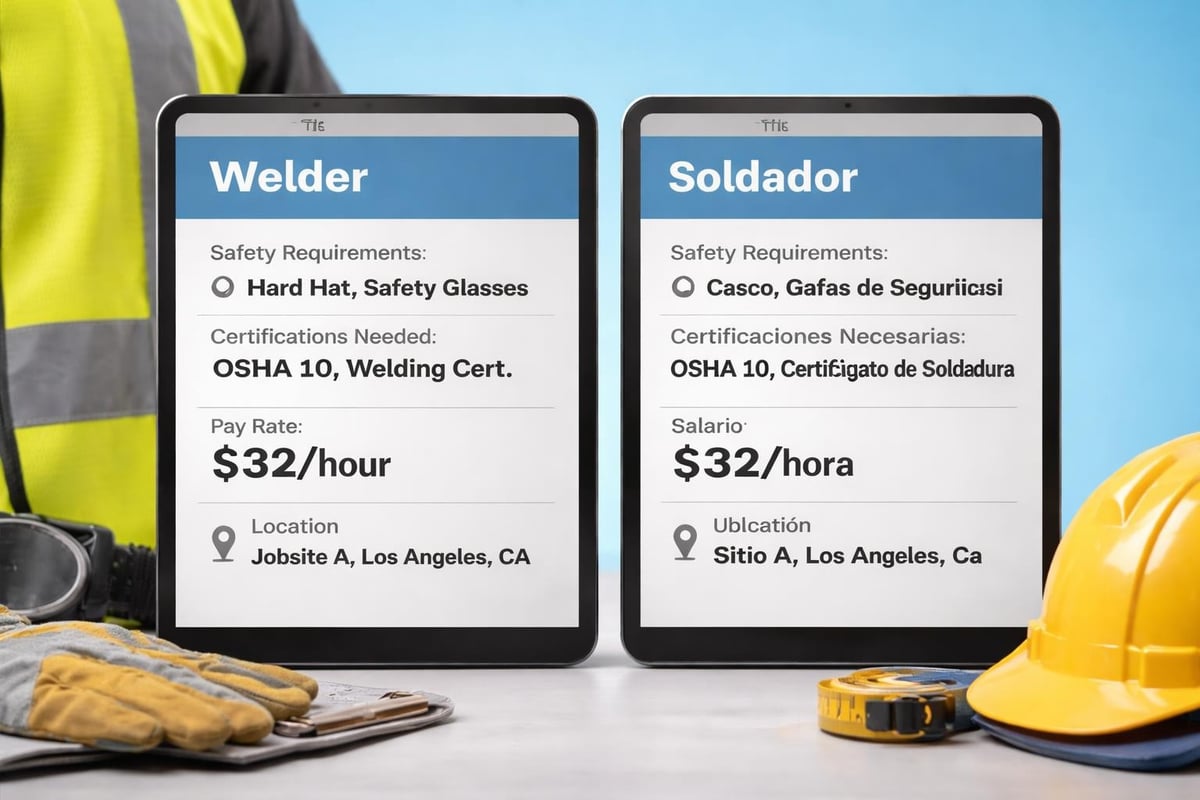
Managing a multicultural workforce requires functionality beyond standard mobile platforms. Spanish-speaking personnel need access to job postings, safety materials, and company policies in their native language. Mobile staffing solutions that incorporate professional translation and culturally competent interfaces dramatically expand the available talent pool while improving compliance and safety outcomes.
Bilingual mobile features include:
- Job descriptions and requirements in English and Spanish
- Safety training modules with Spanish audio and text
- Mobile onboarding documentation in multiple languages
- Real-time translation for supervisor-worker communications
- Cultural competency resources for site managers
- Compliance materials tailored to diverse workforce needs
These capabilities transform staffing operations from simple placement services into strategic workforce solutions. Clients gain access to highly skilled Latino talent that competitors cannot effectively recruit, communicate with, or manage. The staffing agency becomes an indispensable partner rather than a transactional vendor.
Implementing Best Practices for Mobile Workforce Success
Technology alone doesn’t guarantee results. Effective mobile workforce management demands strategic implementation, comprehensive training, and continuous optimization based on real-world performance data. Staffing agencies that treat mobile solutions as mere apps rather than operational transformations consistently underperform competitors who embrace holistic change.
Strategic Implementation Framework
The transition to mobile staffing solutions follows a predictable pattern among successful agencies. Those who skip steps or rush implementation face adoption resistance, data quality issues, and frustrated users who revert to familiar manual processes.
Phase 1: Foundation Building (Weeks 1-4)
- Audit current processes to identify mobile-ready workflows
- Define user roles and permission structures
- Establish data migration protocols for candidate and client information
- Configure bilingual interfaces and translation services
- Develop mobile-first safety and compliance protocols
Phase 2: Pilot Testing (Weeks 5-8)
- Select diverse user group representing all stakeholder types
- Deploy mobile access to limited candidate and client populations
- Monitor adoption metrics and identify friction points
- Gather feedback from Spanish-speaking and English-speaking users
- Refine workflows based on real-world usage patterns
Phase 3: Full Deployment (Weeks 9-12)
- Roll out mobile access to entire candidate database
- Train all internal staff on mobile-first procedures
- Transition clients to mobile status tracking and approval workflows
- Implement mobile-based reporting and analytics dashboards
- Establish ongoing optimization and feature enhancement cycles
The training component determines success or failure. Field workers accustomed to paper timesheets won’t automatically embrace mobile alternatives without hands-on guidance. Providing training materials in both English and Spanish, offering one-on-one support during the transition period, and celebrating early adopters creates momentum that drives organization-wide acceptance.
Security and Compliance Considerations
Mobile staffing solutions handle sensitive personal information, employment records, and certification data that must remain secure and compliant with federal and state regulations. Managing a mobile workforce requires robust security protocols that protect data without creating friction that discourages adoption.
Critical security measures include:
- Multi-factor authentication for all user access levels
- Role-based permissions limiting data visibility
- Encrypted data transmission and storage
- Automatic session timeouts on mobile devices
- Remote wipe capabilities for lost or stolen devices
- Audit trails documenting all data access and modifications
- Regular security training for staff and field workers
- Compliance monitoring for I-9, right-to-work, and certification requirements
The regulatory landscape adds complexity for staffing agencies operating across multiple states. Louisiana, Mississippi, Alabama, and Kentucky each maintain specific employment regulations, workers’ compensation requirements, and safety standards. Mobile platforms must accommodate these variations while maintaining consistent user experiences.
Measuring ROI and Performance Optimization
Investment in mobile staffing solutions demands measurable returns. Forward-thinking agencies track specific metrics that quantify operational improvements, cost reductions, and competitive advantages gained through mobile capabilities.
Key Performance Indicators
| Metric | Pre-Mobile Baseline | Post-Mobile Target | Measurement Method |
|---|---|---|---|
| Time-to-fill (hours) | 48-72 | 12-24 | Timestamp analysis |
| Payroll error rate | 8-12% | 2-3% | Error tracking reports |
| Candidate response time | 4-6 hours | 15-30 minutes | Communication logs |
| No-show rate | 12-15% | 4-6% | Attendance records |
| Administrative cost per placement | $175-225 | $85-115 | Cost accounting |
| Client satisfaction score | 7.2/10 | 8.8/10 | Quarterly surveys |
| Safety incident reporting time | 2-4 hours | 5-15 minutes | Incident timestamps |
These metrics tell the complete performance story. Faster time-to-fill directly impacts client revenue by minimizing downtime. Reduced payroll errors improve profit margins and eliminate client disputes. Improved candidate response times expand the effective talent pool by capturing workers before competitors do. Lower no-show rates increase reliability and strengthen client relationships.
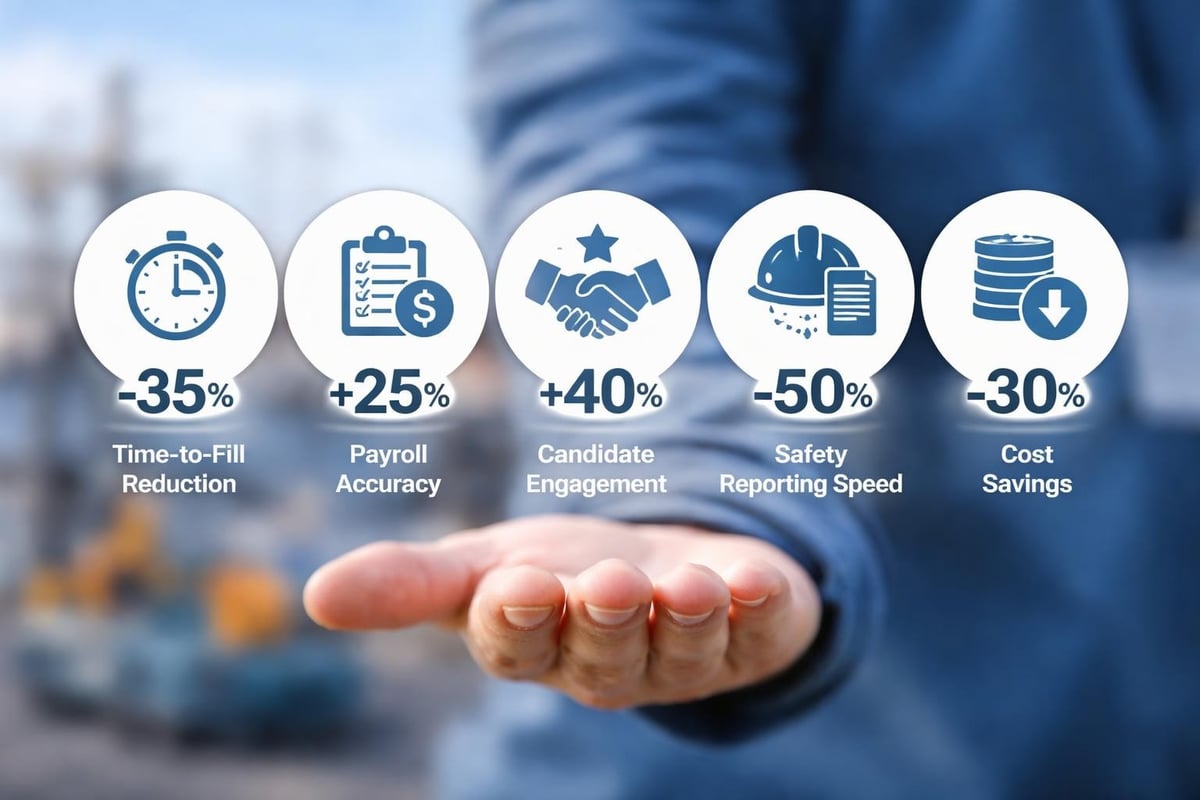
The administrative cost reduction deserves particular attention. Traditional staffing workflows require extensive manual data entry, phone-based coordination, paper processing, and reconciliation. Mobile staffing solutions automate these processes, freeing recruiters and coordinators to focus on relationship-building, talent development, and strategic account management rather than paperwork.
Continuous Improvement Strategies
Market leaders don’t simply implement mobile solutions and declare victory. They establish continuous improvement frameworks that evolve capabilities based on changing market conditions, emerging technologies, and competitive pressures.
Quarterly optimization activities:
- Review user adoption metrics and identify resistance points
- Analyze feature utilization to eliminate unused functionality
- Survey candidates and clients for enhancement suggestions
- Benchmark performance against industry standards
- Test emerging capabilities like AI-powered matching
- Update bilingual content based on workforce feedback
- Refine safety protocols incorporating incident learnings
- Expand integration with complementary business systems
The mobile workforce solutions market continues rapid evolution, with new capabilities emerging regularly. Agencies that maintain awareness of industry trends and selectively adopt proven innovations maintain competitive advantages over firms content with static systems.
The Competitive Edge in Specialized Markets
Mobile staffing solutions level the playing field in some respects, allowing smaller agencies to compete with national firms through operational efficiency. However, they simultaneously amplify competitive advantages rooted in specialized expertise, particularly in serving diverse, bilingual workforces across demanding industrial sectors.
Specialized Talent Access Through Mobile Platforms
The Gulf South’s industrial, construction, and maritime sectors demand highly specialized skills. Certified welders, experienced pipefitters, licensed heavy equipment operators, and qualified CDL drivers represent scarce resources that multiple employers compete to secure. Mobile staffing solutions that maintain comprehensive databases of specialized, safety-certified talent deliver decisive competitive advantages.
The bilingual dimension creates an unmatched differentiator. Many industrial and construction workers in Louisiana, Mississippi, Alabama, and Kentucky are native Spanish speakers with exceptional technical skills but limited English proficiency. Staffing agencies equipped with bilingual mobile platforms can effectively recruit, communicate with, and deploy this talent pool while competitors struggle with language barriers.
This specialized access manifests in multiple competitive advantages:
- Deeper talent pools providing faster placements
- Access to skilled workers unavailable to monolingual competitors
- Improved safety outcomes through clear communication
- Enhanced crew productivity via culturally competent management
- Stronger candidate loyalty reducing turnover
- Premium pricing justified by superior service delivery
Clients recognize the value proposition immediately. A construction firm facing tight deadlines doesn’t care about theoretical capabilities. They need qualified crews on-site tomorrow morning, communicating effectively with supervisors, working safely, and delivering quality results. Staffing agencies that deploy mobile solutions optimized for bilingual coordination win these high-value accounts.
Integration With Existing Business Systems
Mobile staffing solutions don’t operate in isolation. Maximum value emerges when mobile capabilities integrate seamlessly with applicant tracking systems, payroll platforms, safety management systems, and client communication portals. This integration eliminates duplicate data entry, reduces errors, and provides comprehensive visibility across the entire staffing operation.
Critical integration points include:
- Applicant Tracking Systems: Mobile applications sync with candidate databases, ensuring recruiters access current information regardless of device or location
- Payroll Processing: Mobile timesheet data flows directly into payroll systems, eliminating manual entry and reconciliation
- Safety Management: Incident reports, safety training records, and certification expirations sync across platforms
- Client Portals: Job orders, status updates, and approval workflows connect mobile and desktop experiences
- Credential Verification: Real-time checks against certification databases prevent non-compliant placements
- Background Screening: Mobile-initiated checks streamline onboarding without sacrificing thoroughness
These integrations transform mobile staffing solutions from standalone tools into comprehensive operational platforms. The result is truly mobile-first operations where location becomes irrelevant to productivity.
Frequently Asked Questions
What exactly are mobile staffing solutions?
Mobile staffing solutions are comprehensive technology platforms that enable staffing agencies, clients, and candidates to manage the entire employment lifecycle through smartphones and tablets. These systems include job matching, applications, onboarding, timesheets, safety reporting, and communication tools accessible from any location with internet connectivity.
How do mobile staffing solutions improve placement speed?
Mobile platforms accelerate placements by enabling instant candidate notifications, real-time availability checks, immediate job offer acceptance, and rapid onboarding completion. What traditionally required 48-72 hours of phone calls and paperwork now occurs in 12-24 hours through automated mobile workflows.
Can mobile staffing solutions work for bilingual workforces?
Advanced mobile staffing solutions support multiple languages, allowing Spanish-speaking workers to access job postings, complete applications, submit timesheets, and receive safety training in their native language. This capability dramatically expands the available talent pool while improving communication and compliance.
What security measures protect sensitive employment data on mobile devices?
Enterprise-grade mobile staffing solutions implement multi-factor authentication, encrypted data transmission, role-based access controls, automatic session timeouts, remote wipe capabilities, and comprehensive audit trails to protect candidate and client information while maintaining compliance with employment regulations.
How do mobile timesheets reduce payroll errors?
Mobile timesheets incorporate GPS verification confirming workers’ physical presence at job sites, automatic calculations eliminating math errors, real-time approval workflows catching discrepancies immediately, and direct integration with payroll systems removing manual data entry that causes most errors.
What happens when mobile workers enter areas without internet connectivity?
Quality mobile staffing solutions include offline functionality allowing workers to clock in, submit timesheets, and access critical information without active internet connections. Data automatically syncs when connectivity resumes, ensuring no information is lost.
How quickly can staffing agencies implement mobile solutions?
Full implementation typically requires 8-12 weeks including data migration, configuration, pilot testing, training, and deployment. Agencies may see benefits within the first 30 days as initial user groups adopt mobile workflows for common tasks.
What ROI should agencies expect from mobile staffing investments?
Leading agencies report 40-60% reductions in time-to-fill, 50-70% decreases in payroll errors, 35-45% improvements in candidate engagement, and 30-50% reductions in administrative costs per placement within six months of full deployment.
Why should I choose CDR General Services for my staffing needs?
CDR General Services combines cutting-edge mobile staffing solutions with unmatched expertise in bilingual workforce management across Industrial, Construction, and Maritime sectors throughout the Gulf South. Our specialized Spanish-speaking talent access and safety-first commitment deliver results that generic staffing firms cannot match.
Mobile staffing solutions have fundamentally transformed how staffing agencies operate, compete, and deliver value across industrial, construction, and maritime sectors. The agencies that embrace these technologies while maintaining specialized expertise in bilingual workforce management will dominate their markets throughout 2026 and beyond. CDR General Services delivers exactly this combination: advanced mobile capabilities paired with unparalleled access to skilled, Spanish-speaking personnel throughout Louisiana, Mississippi, Alabama, and Kentucky. Our safety-certified, culturally competent staffing solutions provide the decisive competitive advantage your projects demand. Partner with the Gulf South’s premier minority-owned staffing leader today.
Published April 1, 2026 by CDR
All articles