

When your construction site needs certified welders tomorrow or your industrial facility requires a full crew by Monday, the decision between staffing agency vs hiring employees directly becomes mission-critical. This choice impacts your bottom line, operational efficiency, and project timelines in ways that compound over months and years. The staffing landscape in 2026 demands strategic thinking, particularly across the Industrial, Construction, and Maritime sectors throughout the Gulf South, where labor shortages and specialized skill requirements create unique challenges.
The Real Cost Comparison: Beyond the Hourly Rate
Most employers make the critical mistake of comparing only the surface-level hourly wage. That's precisely where the analysis falls apart.
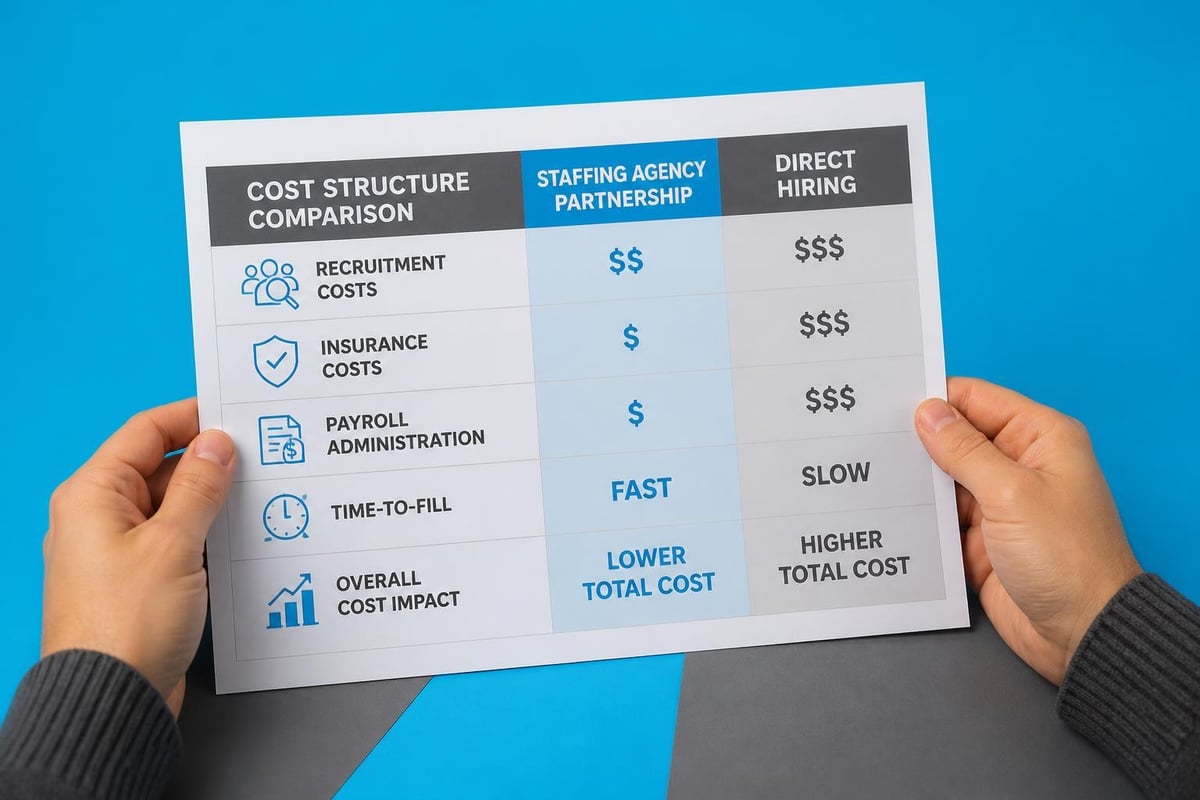
Direct hiring involves substantial hidden costs that rarely appear in initial budget projections. Calculating your true cost per hire reveals expenses you didn't anticipate: job board postings, background screening services, drug testing facilities, safety certification verification, HR administrative time, interviewing hours from multiple managers, and the productivity loss during the 60-90 day ramp-up period.
The staffing agency model consolidates these expenses into a transparent markup. You pay one rate, and the agency absorbs recruitment costs, payroll taxes, workers' compensation insurance, unemployment insurance, and administrative overhead.
| Cost Category | Direct Hire | Staffing Agency |
|---|---|---|
| Recruitment advertising | $500-$2,000 per position | $0 (included) |
| Background checks & drug tests | $75-$200 per candidate | $0 (included) |
| Workers' compensation insurance | Ongoing annual cost | $0 (included) |
| Payroll administration | Internal staff time + software | $0 (included) |
| Unemployment insurance | Ongoing quarterly cost | $0 (included) |
| Training & onboarding time | 40-80 hours management time | Minimal supervision |
| Time to fill position | 45-60 days average | 24-72 hours |
The debate around staffing agency vs hiring employees directly intensifies when considering specialized trades. Finding a certified Spanish-speaking welder who meets OSHA requirements and can communicate seamlessly with your bilingual team? That search extends your direct hiring timeline by weeks while your project sits incomplete.
Speed to Workforce: Time Is Money
Construction deadlines don't negotiate. Maritime projects don't wait. Industrial maintenance shutdowns operate on fixed schedules.
Direct hiring for skilled trades requires posting positions, screening applications, conducting multiple interview rounds, verifying certifications, performing background checks, completing drug screenings, and finalizing offer negotiations. This process consumes 45-60 days minimum for standard positions. For specialized roles requiring bilingual capabilities or niche certifications, you're looking at 90+ days.
Staffing agencies maintain pre-vetted talent pools. The verification work is already complete. Safety certifications are current. Background checks are on file. When you call with an urgent need for five pipefitters or ten general laborers, deployment happens within 24-72 hours.
- Emergency project requirements: Staffing agencies respond immediately
- Seasonal volume fluctuations: Scale up or down without hiring/firing cycles
- Unexpected absences: Same-day replacements available
- Project-based work: No long-term employment obligations
The differences between direct hiring and staffing agencies become starkest during crisis moments-when a crew walks off mid-project, when weather delays compress your timeline, or when client demands suddenly double your labor requirements.
Quality Control and Worker Reliability
Here's the uncomfortable truth: your internal HR team processes perhaps 50-100 hires annually. A specialized staffing agency processes thousands.
That volume creates pattern recognition impossible to replicate internally. We identify red flags in resumes instantly. We recognize credential discrepancies immediately. We verify work history with surgical precision because our reputation depends on placement quality.
The Vetting Process Comparison
When evaluating staffing agency vs hiring employees directly, consider the screening depth:
Direct Hiring Process:
- Review submitted resume (candidate-provided information)
- Conduct phone screen (30 minutes)
- Schedule in-person interview (1-2 hours)
- Check 1-2 references (if time permits)
- Order background check (3-7 day turnaround)
- Verify certifications (if remembered)
- Conduct drug test (after conditional offer)
Staffing Agency Process:
- Multi-point application review against specific role requirements
- Comprehensive background investigation (criminal, employment, education)
- Professional reference verification (3+ contacts)
- Skills assessment testing for trade-specific competencies
- Certification verification through issuing bodies
- Drug screening (pre-placement)
- OSHA safety training confirmation
- Behavioral interviewing for culture fit and reliability
- Ongoing performance tracking across multiple placements
The agency maintains performance data from previous assignments. Did this welder show up on time consistently? Did this forklift operator follow safety protocols? Did this administrative professional communicate effectively with bilingual team members? This intelligence is unavailable when hiring employees directly.
Risk Management and Legal Compliance
Employment law in 2026 is a minefield. Misclassification penalties, OSHA violations, workers' compensation disputes, unemployment claims, wrongful termination lawsuits, and discrimination allegations represent existential threats to your business.
The staffing agency becomes the employer of record. That designation transfers substantial liability off your balance sheet.
| Risk Category | Your Liability (Direct Hire) | Agency Liability (Staffing Model) |
|---|---|---|
| Workers' Compensation Claims | Full responsibility | Agency responsibility |
| Unemployment Insurance | Your experience rating affected | Agency experience rating affected |
| Payroll Tax Compliance | Your responsibility | Agency responsibility |
| Wage & Hour Violations | Direct exposure | Agency assumes compliance burden |
| Employee Misclassification | DOL penalties apply to you | Agency handles classification |
| OSHA Safety Violations | Your OSHA record | Shared responsibility |
Understanding contract versus direct hire staffing considerations reveals how risk allocation affects your operational stability. When a temporary worker files an injury claim, the staffing agency manages the workers' compensation process. When payroll tax questions arise, the agency maintains compliance documentation.
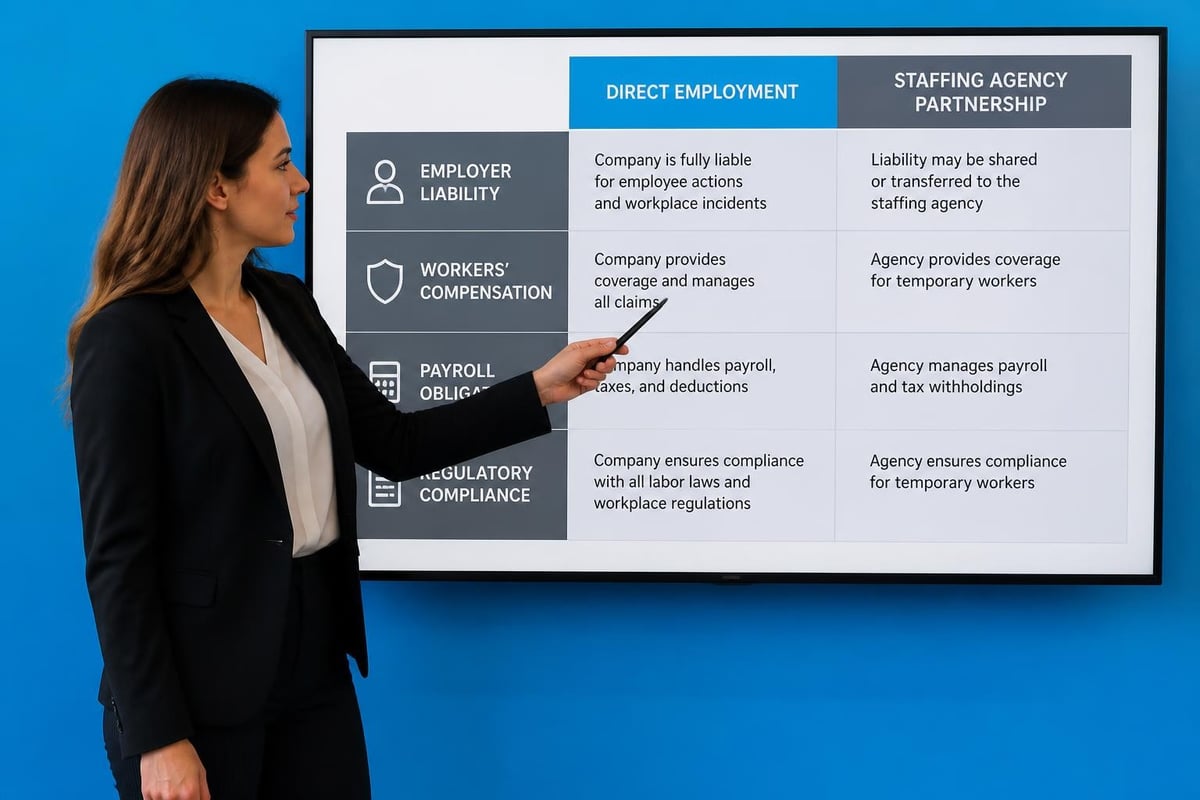
This doesn't eliminate your safety responsibilities. You still maintain a safe worksite. You still provide proper equipment. You still supervise work activities. But the administrative burden and legal complexity transfers to the agency's HR infrastructure.
Flexibility and Scalability Advantages
Market conditions change rapidly. Project scopes expand. Client demands shift. Economic uncertainty requires adaptive workforce strategies.
The traditional model of staffing agency vs hiring employees directly assumed permanent full-time employment represented the gold standard. That assumption no longer holds in 2026's dynamic industrial landscape.
Consider seasonal construction cycles across Louisiana, Mississippi, Alabama, and Kentucky. Summer months demand maximum crews. Winter months require minimal staffing. Direct hiring forces you to either maintain excess headcount year-round (destroying profitability) or execute repeated layoff/rehire cycles (destroying morale and community reputation).
Staffing partnerships enable precision workforce management:
- Project initiation: Rapidly scale up to meet aggressive timelines
- Project completion: Scale down without severance costs or unemployment implications
- Scope changes: Adjust crew size and skill mix mid-project
- Try-before-you-buy: Evaluate worker performance before extending permanent offers
- Specialized expertise: Access niche skills for limited durations without permanent headcount
The temp-to-hire versus direct hire analysis demonstrates how staffing agencies provide the ultimate flexibility-temporary workers who prove exceptional can transition to your permanent team, while poor performers are simply not reassigned.
The Bilingual Workforce Advantage
Here's where the staffing agency vs hiring employees directly equation transforms entirely for Gulf South employers.
Finding Spanish-speaking certified welders, bilingual pipefitters, or multilingual administrative professionals through traditional recruitment channels? Nearly impossible. The qualified candidates exist, but they're not browsing Indeed or LinkedIn. They're embedded in tight-knit community networks that require cultural competency and established relationships to access.
Specialized staffing agencies with deep Latino talent connections deliver this workforce immediately. No translation apps. No communication barriers. No cultural misunderstandings that create safety risks or productivity losses. Just safety-certified, trade-qualified, ready-to-work professionals who integrate seamlessly with diverse teams.
Administrative Burden and Management Focus
Your core competency is not HR administration. It's delivering projects, manufacturing products, or operating maritime facilities.
Every hour your management team spends screening resumes, conducting interviews, processing payroll, managing benefits enrollment, tracking PTO accruals, handling unemployment claims, and resolving HR disputes is an hour not focused on operational excellence.
Direct hiring creates an administrative burden that scales with headcount:
- Weekly payroll processing and tax withholding calculations
- Benefits administration for health insurance, retirement plans, PTO tracking
- Performance review cycles and documentation
- Disciplinary action processes and termination procedures
- Unemployment claim responses and hearings
- Workers' compensation claim management
- OSHA recordkeeping and reporting
- I-9 compliance and E-Verify documentation
- New hire onboarding and orientation programs
Multiply these tasks across 50, 100, or 200 employees, and you're operating a full-scale HR department. That requires dedicated staff, HR software systems, legal counsel on retainer, and constant regulatory compliance monitoring.
The staffing agency handles this infrastructure. Your operational managers focus on production, quality, safety, and client satisfaction. The agency manages timesheets, processes payroll, resolves worker issues, and handles replacement workers when someone doesn't show.

Industry-Specific Considerations for 2026
The conversation around staffing agency vs hiring employees directly varies dramatically by sector.
Industrial and Manufacturing Operations
Safety certifications dominate hiring criteria. OSHA-10, OSHA-30, confined space training, fall protection, hazmat handling, lockout-tagout procedures-verifying these credentials consumes substantial time. Staffing agencies maintain current certification databases and won't send unqualified workers to your facility.
Shift work patterns create additional complexity. Finding qualified third-shift welders or weekend maintenance crews through direct hiring takes months. Agencies maintain 24/7 talent pools.
Construction and General Contracting
Project-based work makes permanent employment economically irrational for many positions. You need framers for eight weeks, electricians for six weeks, then finish carpenters for four weeks. Direct hiring for these timelines means constant turnover, which destroys your workers' compensation modifier and unemployment insurance rating.
Weather-dependent scheduling requires workforce elasticity. When three days of rain delays your concrete work, do you pay idle crews or implement complex furlough procedures? Staffing agencies enable you to pause and resume labor deployment matching actual work availability.
Maritime and Transportation
CDL driver shortages plague the transportation sector. Finding Class A drivers with clean records, hazmat endorsements, and verifiable experience requires specialized recruitment networks. The reliability factors between direct hiring and staffing agencies in trades demonstrates how agencies with transportation specialization outperform general hiring approaches.
Maritime dock operations demand rapid crew assembly for vessel loading/unloading operations. When a ship arrives off-schedule at 2 AM, your staffing agency provides the certified forklift operators and dock workers within hours.
Making the Strategic Decision
The staffing agency vs hiring employees directly question isn't binary. The optimal workforce strategy combines both approaches strategically.
Use direct hiring for:
- Core permanent positions requiring deep institutional knowledge
- Senior management and specialized technical roles
- Positions where long-term cultural integration is critical
- Roles with proprietary information access requirements
Use staffing agencies for:
- Seasonal volume fluctuations and project-based work
- Rapid response to unexpected absences or turnover
- Specialized skills needed for limited durations
- Testing worker performance before permanent hiring commitments
- Accessing hard-to-find bilingual or multicultural talent pools
- Reducing administrative burden and compliance risk
- Maintaining workforce flexibility during economic uncertainty
| Evaluation Criteria | Direct Hire Better | Staffing Agency Better |
|---|---|---|
| Duration of need | Permanent, indefinite | Temporary, project-based, seasonal |
| Time urgency | 60+ days acceptable | Immediate to 72 hours required |
| Skill availability | Common, readily available | Specialized, hard-to-find, bilingual |
| Volume predictability | Stable, consistent | Variable, fluctuating |
| Management capacity | Robust HR infrastructure | Limited HR resources |
| Risk tolerance | High (can absorb liability) | Low (prefer risk transfer) |
| Budget structure | Fixed headcount cost acceptable | Variable cost preferred |
Forward-thinking employers recognize that comparing contract versus direct hire models reveals complementary strengths rather than competing alternatives. Your permanent team provides stability, institutional knowledge, and cultural continuity. Your staffing agency partnership provides agility, specialized expertise, and administrative efficiency.
Frequently Asked Questions
What is the main difference between using a staffing agency vs hiring employees directly?
The primary difference lies in who serves as the employer of record and bears the administrative burden. When hiring employees directly, your company handles all recruitment, payroll, benefits, workers' compensation, unemployment insurance, and compliance responsibilities. With a staffing agency, the agency becomes the legal employer, managing these functions while you direct the work activities. Staffing agencies provide pre-vetted talent pools for faster deployment, typically placing workers within 24-72 hours compared to 45-60 days for direct hiring.
How much does it actually cost to use a staffing agency compared to direct hiring?
Staffing agencies typically charge 40-75% markup over the worker's base wage, which initially appears expensive. However, this markup includes recruitment costs, background checks, drug testing, payroll taxes, workers' compensation insurance, unemployment insurance, benefits administration, and replacement guarantees. Direct hiring involves hidden costs including job postings ($500-$2,000), screening time, background checks ($75-$200 per candidate), onboarding hours (40-80 management hours), and ongoing payroll administration. When calculating total cost of employment, the difference narrows significantly, particularly for temporary or project-based needs.
Can I hire a staffing agency worker as a permanent employee later?
Yes, this "temp-to-hire" or "try-before-you-buy" approach is one of the most valuable staffing strategies. Most agencies offer conversion programs where temporary workers can transition to your permanent payroll after a specified period (typically 90 days to 6 months). This approach allows you to evaluate actual job performance, cultural fit, attendance reliability, and skill level before making a permanent hiring commitment. Conversion fees typically range from 10-25% of the worker's annual salary, which is significantly less than the cost of a bad permanent hire.
How quickly can a staffing agency provide workers for urgent needs?
Quality staffing agencies specializing in industrial, construction, and maritime sectors maintain pre-vetted talent pools and can deploy workers within 24-72 hours for most positions. For common roles like general laborers, forklift operators, or administrative staff, same-day or next-day placement is frequently possible. Highly specialized positions requiring specific certifications (certified welders, Class A CDL drivers with endorsements, licensed electricians) may require 3-5 days to ensure proper credential verification and availability.
What happens if a staffing agency worker doesn't show up or performs poorly?
Reputable staffing agencies provide replacement guarantees as part of their service commitment. If a worker doesn't show up, calls in sick, or leaves mid-shift, the agency is responsible for providing a replacement worker immediately or within hours. If performance doesn't meet your standards, you simply contact the agency to request a different worker without any termination paperwork, unemployment liability, or legal exposure. This flexibility is impossible with direct employees, who require documentation, progressive discipline, and potential unemployment costs when terminated.
Are staffing agency workers less qualified than directly hired employees?
No, this is a persistent myth contradicted by industry data. Quality staffing agencies implement more rigorous screening processes than most employers' internal HR departments because their business reputation depends entirely on placement quality. Agencies conduct comprehensive background checks, verify certifications through issuing bodies, perform skills assessments, check multiple professional references, and maintain performance tracking across assignments. Many staffing agencies specialize in specific trades or industries, developing deeper expertise in credential verification and candidate assessment than general employers.
How do staffing agencies handle workers' compensation and liability insurance?
The staffing agency, as the legal employer of record, carries workers' compensation insurance covering their placed workers. When an injury occurs, the claim goes against the agency's workers' compensation policy, not your company's policy. This protects your experience modification rating and prevents premium increases. However, you still maintain responsibility for providing a safe work environment, proper equipment, and adequate supervision. Most agencies also carry general liability and professional liability insurance providing additional protection.
Can staffing agencies provide bilingual or Spanish-speaking workers for specialized roles?
This is precisely where specialized staffing agencies deliver unmatched value that general recruitment cannot replicate. Agencies with established relationships in Latino communities and bilingual recruitment teams access talent pools invisible to traditional hiring channels. Finding Spanish-speaking certified welders, bilingual pipefitters, or multilingual administrative professionals through job boards or general recruiting is nearly impossible. Specialized agencies maintain these networks through cultural competency, community engagement, and long-term relationship building that provides immediate access to qualified bilingual talent.
Should I contact CDR General Services for my staffing needs in the Gulf South region?
If you operate in Louisiana, Mississippi, Alabama, or Kentucky and need reliable, safety-certified personnel across Industrial, Construction, Maritime, Transportation, or Administrative sectors, CDR General Services delivers unmatched expertise. Our specialized focus on bilingual Spanish-speaking workforce solutions provides a decisive competitive advantage no general staffing agency can match. We maintain pre-vetted talent pools of certified welders, pipefitters, electricians, CDL drivers, forklift operators, and construction crews ready for immediate deployment, eliminating your recruitment burden and accelerating your project timelines.
What should I do if I need workers immediately for an upcoming project deadline?
Contact a specialized staffing agency with proven experience in your specific industry sector immediately. Don't wait until the last minute. Quality agencies can mobilize crews within 24-72 hours, but providing advance notice (even just a few days) enables better candidate matching and smoother onboarding. For the Gulf South region's Industrial, Construction, and Maritime sectors, particularly when requiring bilingual capabilities or specialized trade certifications, reaching out to CDR General Services ensures access to safety-certified, ready-to-work talent pools unavailable through traditional hiring channels.
The staffing agency vs hiring employees directly decision ultimately depends on your specific operational needs, timeline urgency, and workforce strategy. Both approaches serve distinct purposes in building a high-performing team. When you need rapid deployment, specialized bilingual talent, or workforce flexibility without the administrative burden, CDR General Services delivers industry-leading solutions across the Gulf South region. Our unmatched expertise in Spanish-speaking workforce solutions, combined with deep local knowledge and safety-first commitment, provides the competitive advantage your projects demand. Contact CDR General Services today to access reliable, certified talent ready to work tomorrow.
Published August 13, 2026 by CDR
All articles