


Staffing Agency What Is: Complete 2026 Workforce Guide


Understanding "staffing agency what is" has become critical for businesses navigating workforce challenges in 2026. The industrial, construction, and maritime sectors face unprecedented labor demands, requiring scalable talent solutions that traditional hiring simply cannot deliver. Staffing agencies serve as strategic workforce partners, connecting employers with pre-vetted, safety-certified personnel while managing the administrative complexities of employment. For companies operating in the Gulf South region and beyond, partnering with the right staffing agency means accessing specialized talent pools, including bilingual Spanish-speaking workers who bridge communication gaps on demanding job sites.
What Is a Staffing Agency and How Does It Function
A staffing agency is a specialized employment intermediary that connects businesses with qualified workers across temporary, temp-to-hire, and direct placement arrangements. Understanding how staffing agencies operate reveals their comprehensive role in workforce management. These agencies maintain extensive databases of pre-screened candidates, handle payroll and benefits administration, ensure regulatory compliance, and deliver workers who meet specific job requirements.
The core function centers on three distinct parties: the employer (client company), the staffing agency, and the worker (employee or contractor). The agency acts as the employer of record for temporary placements, managing tax withholding, workers' compensation insurance, unemployment claims, and other employment obligations.
The Staffing Agency Business Model
Staffing agencies generate revenue through markup pricing on hourly wages or placement fees for direct hires. For temporary staffing, agencies pay workers an hourly rate and bill clients at a higher rate, with the difference covering operational costs, benefits, insurance, and profit margins.
Primary revenue structures include:
- Temporary staffing markup: Typically 25-75% above worker wages depending on skill level and industry
- Temp-to-hire conversion fees: Usually 10-20% of first-year salary when temporary workers transition to permanent
- Direct placement fees: Generally 15-25% of first-year salary for permanent hires
- Managed service programs: Fixed monthly fees or percentage-based rates for complete workforce management
This model allows agencies to invest heavily in recruitment infrastructure, safety certification programs, and quality control systems that individual employers cannot economically justify. The staffing agency definition encompasses these financial mechanics alongside talent acquisition expertise.

Types of Staffing Services and Employment Arrangements
When exploring "staffing agency what is," understanding service categories clarifies how agencies meet diverse workforce needs. The staffing industry has evolved far beyond simple temporary labor, offering sophisticated solutions for complex industrial environments.
Temporary Staffing Solutions
Temporary staffing addresses immediate, short-term labor demands. Workers remain employees of the staffing agency while performing work at client facilities. This arrangement proves invaluable during seasonal peaks, unexpected absences, special projects, or production surges.
Key benefits include:
- Immediate workforce scalability without long-term commitments
- Reduced hiring risks through trial periods before permanent offers
- Administrative relief as agencies handle payroll, taxes, and compliance
- Specialized skills access for project-based technical requirements
For construction companies managing fluctuating project timelines or maritime operations requiring certified specialists for maintenance shutdowns, temporary staffing delivers the flexibility modern operations demand.
Temp-to-Hire Programs
Temp-to-hire arrangements function as extended interviews, allowing employers to evaluate workers in real job conditions before making permanent offers. Workers start as agency employees and transition to direct company employees after successful probationary periods, typically 90-180 days.
| Staffing Type | Employment Relationship | Typical Duration | Best Used For |
|---|---|---|---|
| Temporary | Agency employee | Days to months | Seasonal peaks, project work, immediate needs |
| Temp-to-Hire | Agency then direct | 3-6 months transition | Evaluating fit before commitment, reducing hiring risk |
| Direct Placement | Immediate direct hire | Permanent | Critical roles, specialized positions, leadership |
| Contract/Project | Agency or 1099 | Project-based | Specific expertise, defined scope, consultant roles |
Direct Placement and Executive Search
Direct placement services function as traditional recruiting, where agencies source, screen, and present candidates for permanent positions. Employers pay placement fees only after successful hires. This service proves essential for specialized roles requiring rare certifications, bilingual capabilities, or extensive safety credentials.
For industrial sectors, staffing agencies provide comprehensive talent solutions that extend beyond simple labor filling to strategic workforce development partnerships.
The Staffing Agency Process: From Requisition to Placement
Understanding "staffing agency what is" requires examining the operational workflow that transforms employer needs into qualified workforce solutions. Professional staffing agencies follow disciplined processes ensuring consistent quality and compliance.
Step 1: Client Needs Assessment
The engagement begins with comprehensive needs analysis. Staffing professionals meet with hiring managers to document job requirements, safety certifications, language requirements, equipment operation skills, and cultural fit considerations. For bilingual positions requiring Spanish-speaking welders or forklift operators, this assessment identifies specific language proficiency levels and technical competencies.
Step 2: Candidate Sourcing and Recruitment
Agencies tap multiple talent sources simultaneously:
- Internal databases of previously screened candidates
- Job board advertising on industry-specific platforms
- Social media recruitment targeting skilled trades communities
- Referral networks leveraging existing worker relationships
- Community partnerships with trade schools and certification programs
Specialized agencies like CDR General Services maintain dedicated Latino talent networks, providing access to skilled Spanish-speaking workers that general agencies simply cannot match.
Step 3: Screening and Qualification Verification
Rigorous screening separates professional agencies from order-takers. This phase includes:
- Background checks verifying criminal history and employment records
- Drug screening meeting DOT and industry-specific requirements
- Certification verification confirming welding credentials, CDL licenses, OSHA training
- Skills testing validating hands-on competencies
- Reference checks confirming work history and performance
- Safety training validation ensuring current compliance certifications

Step 4: Candidate Presentation and Placement
Qualified candidates are presented to clients with detailed profiles highlighting relevant experience, certifications, and language capabilities. Once approved, agencies coordinate start dates, complete employment paperwork, and provide job site orientations.
Step 5: Ongoing Management and Quality Assurance
Professional agencies maintain continuous contact with both workers and clients, addressing performance issues, managing schedule changes, and ensuring satisfaction. This includes regular site visits, performance reviews, and proactive problem resolution.
Industries and Sectors Utilizing Staffing Agencies
The question "staffing agency what is" gains clarity when examining industry applications. While staffing spans virtually every sector, certain industries rely heavily on agency partnerships for workforce management.
Industrial and Manufacturing Sectors
Industrial facilities require certified skilled trades workers including welders, pipefitters, millwrights, electricians, and heavy equipment operators. How staffing agencies function in industrial settings emphasizes safety compliance and technical certification verification that directly impacts workplace safety and operational continuity.
Common industrial positions filled through staffing:
- Certified welders (TIG, MIG, Stick, pipe welding)
- Pipefitters and steamfitters
- Industrial electricians and instrumentation technicians
- Heavy equipment operators (cranes, forklifts, loaders)
- Quality control inspectors and NDT technicians
- Production line workers and machine operators
Construction and General Labor
Construction staffing addresses the inherently project-based nature of building trades. Projects require rapid workforce scaling at startup and systematic reduction at completion. Staffing agencies provide this elasticity while ensuring workers possess required OSHA certifications and trade licenses.
Transportation and Logistics
The logistics sector depends heavily on staffing for CDL drivers (Class A and Class B), warehouse personnel, forklift operators, and distribution center workers. Driver qualification files, DOT physicals, and license verification require specialized expertise that professional agencies provide.
Maritime and Offshore Operations
Maritime operations in the Gulf South demand workers with TWIC cards, offshore safety certifications, and specialized skills for shipyard operations, vessel maintenance, and offshore platform support. The bilingual workforce becomes particularly valuable in diverse maritime crews.
Benefits of Using Staffing Agencies for Employers
When evaluating "staffing agency what is" from an employer perspective, the value proposition centers on operational efficiency, risk mitigation, and access to specialized talent pools unavailable through traditional recruitment.
Speed and Scalability
Staffing agencies maintain ready talent pools that dramatically reduce time-to-fill metrics. Where traditional hiring requires 30-60 days from posting to start date, agencies can place qualified workers within 24-48 hours for urgent needs.
Comparison of hiring timelines:
| Hiring Method | Average Time-to-Fill | Quality Screening | Administrative Burden |
|---|---|---|---|
| Internal recruitment | 30-60 days | Self-managed | Full responsibility |
| Job board posting | 21-45 days | Self-managed | Full responsibility |
| Staffing agency temporary | 1-3 days | Agency-verified | Agency-managed |
| Staffing agency direct hire | 14-21 days | Agency-verified | Shared responsibility |
Risk Reduction and Compliance Management
Staffing agencies shoulder significant legal responsibilities including payroll tax compliance, workers' compensation claims, unemployment insurance, and employment law adherence. This risk transfer proves invaluable for businesses lacking dedicated HR departments or those operating across multiple jurisdictions with varying regulations.
Agencies also reduce hiring risks through trial periods. Temp-to-hire arrangements allow employers to evaluate worker performance, cultural fit, and technical competencies before making permanent commitments.
Access to Specialized and Diverse Talent
Professional staffing agencies cultivate niche talent networks that general recruiting cannot penetrate. For Gulf South operations requiring bilingual Spanish-speaking skilled trades workers, specialized agencies provide cultural competency and language capabilities that directly impact job site safety and productivity.
The competitive advantage of accessing pre-vetted, safety-certified, Spanish-speaking welders, pipefitters, and equipment operators cannot be overstated in regions with significant Latino workforce populations.
Cost Efficiency and Budget Predictability
While staffing agency markup appears as additional cost, total cost analysis reveals significant savings:
- Eliminated recruitment advertising expenses
- Reduced HR administrative time and costs
- Avoided bad hire costs (estimated at 30% of first-year salary)
- Eliminated benefits costs for temporary workers
- Reduced workers' compensation premiums through agency coverage
- Predictable budgeting with fixed hourly bill rates
Staffing Agency Costs and Fee Structures
Understanding "staffing agency what is" includes comprehending pricing models and total employment costs. Transparency in fee structures separates professional agencies from less scrupulous operators.
Markup Rates for Temporary Staffing
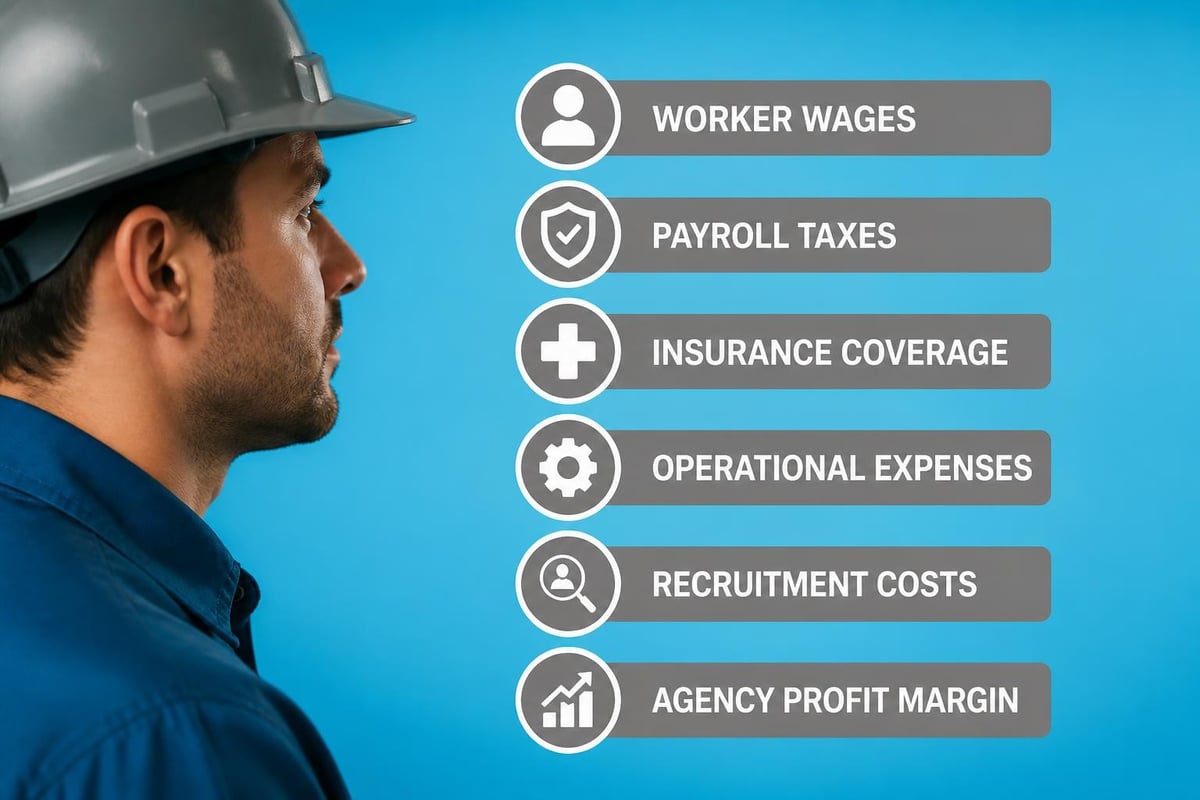
Temporary staffing markup covers worker wages, payroll taxes (FICA, FUTA, SUTA), workers' compensation insurance, unemployment insurance, agency operational costs, recruitment expenses, and profit margins.
Typical markup ranges by position type:
- General labor: 30-50% above base wage
- Skilled trades (welders, electricians, pipefitters): 40-65% above base wage
- Certified specialists (crane operators, NDT technicians): 50-75% above base wage
- Administrative and clerical: 35-55% above base wage
- Professional and technical: 40-70% above base wage
Premium markups apply to bilingual positions, hard-to-fill specialties, and certifications requiring extensive verification and safety training.
Direct Hire Placement Fees
Direct placement fees typically range from 15-25% of first-year salary. A $60,000 annual position would carry a $9,000-$15,000 placement fee. Contingency-based fees (payment only upon successful hire) represent standard practice, though retained search commands upfront payments for executive-level positions.
Managed Service Provider Programs
Large-scale workforce operations benefit from managed service provider (MSP) arrangements where staffing agencies manage the entire contingent workforce program. Pricing structures include fixed monthly fees, percentage-based rates on total spend, or hybrid models combining both approaches.
Choosing the Right Staffing Agency Partner
Not all staffing agencies deliver equal value. When determining "staffing agency what is" right for your operation, evaluation criteria should extend beyond price to encompass specialization, service quality, and strategic alignment.
Industry Specialization and Expertise
General staffing agencies lack the deep knowledge required for industrial, construction, and maritime sectors. Specialized agencies understand certification requirements, safety protocols, equipment operation standards, and industry-specific terminology that general recruiters simply do not possess.
Critical specialization factors:
- Industry focus: Industrial, construction, maritime expertise versus general staffing
- Geographic coverage: Local market knowledge and regional workforce access
- Certification capabilities: Ability to verify welding certs, CDL licenses, OSHA training, TWIC cards
- Safety commitment: Documented safety programs and incident tracking
- Cultural competency: Bilingual staff and diverse talent network access
Reputation and Track Record
Investigate agency reputation through client references, industry standing, and performance metrics. Request specific examples of similar placements, average time-to-fill statistics, worker retention rates, and safety incident records.
Service Level and Responsiveness
The staffing relationship requires ongoing communication and rapid response to changing needs. Evaluate account management structure, after-hours availability, replacement guarantees, and problem resolution processes.
Minority-Owned and Diversity Credentials
Minority-owned staffing agencies often maintain deeper connections with diverse talent communities and bring cultural competency that majority-owned firms lack. Understanding diverse staffing models reveals how cultural alignment drives superior workforce outcomes.
The Spanish-Speaking Workforce Advantage in 2026
The Gulf South region's Latino workforce represents an untapped competitive advantage for industrial operations. The question "staffing agency what is" capable of delivering this specialized talent leads to agencies with dedicated bilingual recruiting infrastructure and cultural expertise.
Why Bilingual Workers Matter
Spanish-speaking skilled trades workers bring more than language capabilities. They represent a dedicated, reliable workforce with strong work ethic, family-oriented stability, and cultural values aligned with demanding industrial environments.
Operational benefits include:
- Enhanced job site safety through clear communication in workers' native language
- Reduced miscommunication incidents that cause delays and safety hazards
- Improved team cohesion in diverse work environments
- Access to specialized skills within Latino trades communities
- Cultural competency that respects diverse workforce dynamics
The CDR General Services Competitive Edge
CDR General Services maintains unparalleled expertise in Spanish-speaking workforce solutions across Louisiana, Mississippi, Alabama, and Kentucky. This specialization delivers access to certified bilingual welders, pipefitters, electricians, CDL drivers, and equipment operators that no general agency can match.
The competitive advantage extends beyond simple translation services to comprehensive cultural integration, ensuring seamless communication between English-speaking management and Spanish-speaking crews. This capability directly impacts productivity, safety compliance, and project completion timelines.
Common Misconceptions About Staffing Agencies
Several persistent myths about "staffing agency what is" and how they function create unnecessary hesitation among employers who would benefit from strategic staffing partnerships.
Myth 1: Staffing Agencies Only Provide Low-Skill Labor
Reality: Professional staffing agencies place workers across all skill levels, from general laborers to certified master welders, licensed electricians, and specialized technicians. The perception of "temp agencies" as sources for only unskilled workers dramatically underestimates modern staffing capabilities.
Myth 2: Agency Workers Show Lower Commitment
Reality: Worker commitment correlates with treatment, not employment relationship. Agencies placing workers in respectful environments with fair compensation see identical commitment levels as direct employees. Many workers actually prefer agency relationships for schedule flexibility and diverse experience opportunities.
Myth 3: Staffing Costs More Than Direct Hiring
Reality: Total cost analysis including recruitment expenses, administrative overhead, benefits costs, unemployment insurance, workers' compensation, and bad hire risks reveals staffing agencies often deliver lower total cost while providing superior flexibility.
Myth 4: All Staffing Agencies Operate Identically
Reality: Agencies vary dramatically in specialization, quality standards, screening rigor, and service levels. Choosing a specialized industrial staffing partner versus a generalist agency determines success or failure in demanding environments.
Frequently Asked Questions
What is a staffing agency and how does it work?
A staffing agency is an employment intermediary that connects businesses with qualified workers for temporary, temp-to-hire, or permanent positions. The agency recruits, screens, and employs workers, then assigns them to client companies while managing payroll, benefits, and compliance obligations. Clients pay the agency, and the agency pays the workers.
How much do staffing agencies charge employers?
Staffing agencies typically charge 25-75% markup above worker wages for temporary placements, covering payroll taxes, insurance, and operational costs. Direct hire placements usually cost 15-25% of the position's first-year salary. Exact rates vary by industry, skill level, and position complexity.
What types of workers can staffing agencies provide?
Professional staffing agencies provide workers across all skill levels, from general laborers to certified skilled trades professionals (welders, electricians, pipefitters), CDL drivers, equipment operators, administrative staff, and specialized technicians. Industry-specialized agencies offer access to niche talent pools including bilingual Spanish-speaking certified workers.
Who is responsible for paying staffing agency workers?
The staffing agency serves as the employer of record for temporary and temp-to-hire workers, handling all payroll, tax withholding, benefits administration, and workers' compensation insurance. Clients pay the agency, and the agency pays workers directly. For direct placements, the client company becomes the employer immediately.
How quickly can a staffing agency fill positions?
Professional staffing agencies can place qualified workers within 24-48 hours for urgent temporary needs, leveraging pre-screened talent databases. Direct hire placements typically require 14-21 days for specialized positions. Speed depends on position complexity, certification requirements, and talent market conditions.
What is the difference between temporary and temp-to-hire staffing?
Temporary staffing provides workers for defined short-term periods with no expectation of permanent employment. Temp-to-hire arrangements function as extended trial periods, with workers starting as agency employees and transitioning to direct company employees after successful probationary periods, typically 90-180 days.
Do staffing agencies verify worker qualifications and certifications?
Reputable staffing agencies conduct comprehensive screening including background checks, drug testing, certification verification, skills testing, and reference checks. For industrial positions, this includes validating welding certifications, CDL licenses, OSHA training, TWIC cards, and safety credentials. Verification rigor varies significantly between agencies.
What industries use staffing agencies most frequently?
Manufacturing, construction, logistics, healthcare, hospitality, and administrative sectors utilize staffing agencies extensively. Industrial sectors require specialized agencies understanding certification requirements, safety protocols, and technical competencies. Maritime, construction, and manufacturing operations particularly benefit from agencies providing certified skilled trades workers.
How can CDR General Services help with my staffing needs?
CDR General Services specializes in providing safety-certified, bilingual Spanish-speaking workers for industrial, construction, and maritime sectors throughout the Gulf South region. Our unique Latino talent network delivers certified welders, pipefitters, electricians, CDL drivers, and equipment operators with unmatched cultural competency. Contact us to discuss your specific workforce requirements and experience our competitive advantage in diverse, skilled staffing solutions.
Why should I choose a specialized staffing agency over a general one?
Specialized staffing agencies maintain deep industry knowledge, understand technical certification requirements, operate established networks within niche talent communities, and provide superior quality control for demanding environments. For industrial sectors requiring certified bilingual workers, specialized agencies deliver access to pre-qualified talent that general agencies simply cannot source.
Staffing agencies function as strategic workforce partners, providing scalable talent solutions while managing the administrative complexities of employment. For industrial, construction, and maritime operations in the Gulf South, the right agency partnership delivers immediate access to certified, safety-trained personnel exactly when needed. CDR General Services offers unmatched expertise in bilingual Spanish-speaking workforce solutions, providing the specialized talent and cultural competency that sets exceptional operations apart from the competition.