

Staffing in human resource management is the process of planning for, finding, selecting, placing, and keeping the people an organization needs to hit its business goals. It starts with a workforce forecast and ends with retention, and every step in between either protects your budget or drains it. For industrial, construction, and logistics employers, the stakes are higher: one bad placement means safety exposure, schedule slips, and rework.
What Is Staffing in Human Resource Management?
Staffing is the HR function responsible for making sure the right number of qualified people are in the right roles at the right time. It covers forecasting demand, recruiting, selection, onboarding, training, and the decisions that keep good workers on the job.
It is often confused with recruiting. Recruiting is one step. Staffing is the full system, and it ties directly to operations. A pipefitting crew that arrives without the right certifications is a staffing failure, not a recruiting inconvenience.
The function also sits between two time horizons:
- Long-term: workforce planning, skills mapping, succession, and building talent pipelines.
- Short-term: filling an open shift, ramping a crew for a turnaround, or covering a seasonal spike.
Strong employers manage both. Weak ones only react to the second.
Why Staffing Decisions Carry So Much Weight
Staffing decisions drive cost, safety, and output more directly than almost any other HR function. The labor market data shows why the pressure is real. SHRM's 2025 Talent Trends survey found that most organizations were struggling to fill roles.
Cost is the second pressure. SHRM's 2025 benchmarking findings reported that hiring costs for nonexecutive roles run into the thousands of dollars per hire. That figure counts only the hiring event. It does not count the first month of reduced output, the supervisor time spent correcting mistakes, or the cost of replacing someone who quits in week three.
The same SHRM research found that recruiting takes a substantial share of the HR budget. Employers are spending real money on staffing. The question is whether that money buys durable placements or churn.
For skilled trades and logistics, add a third factor: compliance. A welder without current certification or a driver without the right CDL class is a liability the moment they clock in.
What Are the 7 Steps of the Recruitment Process?
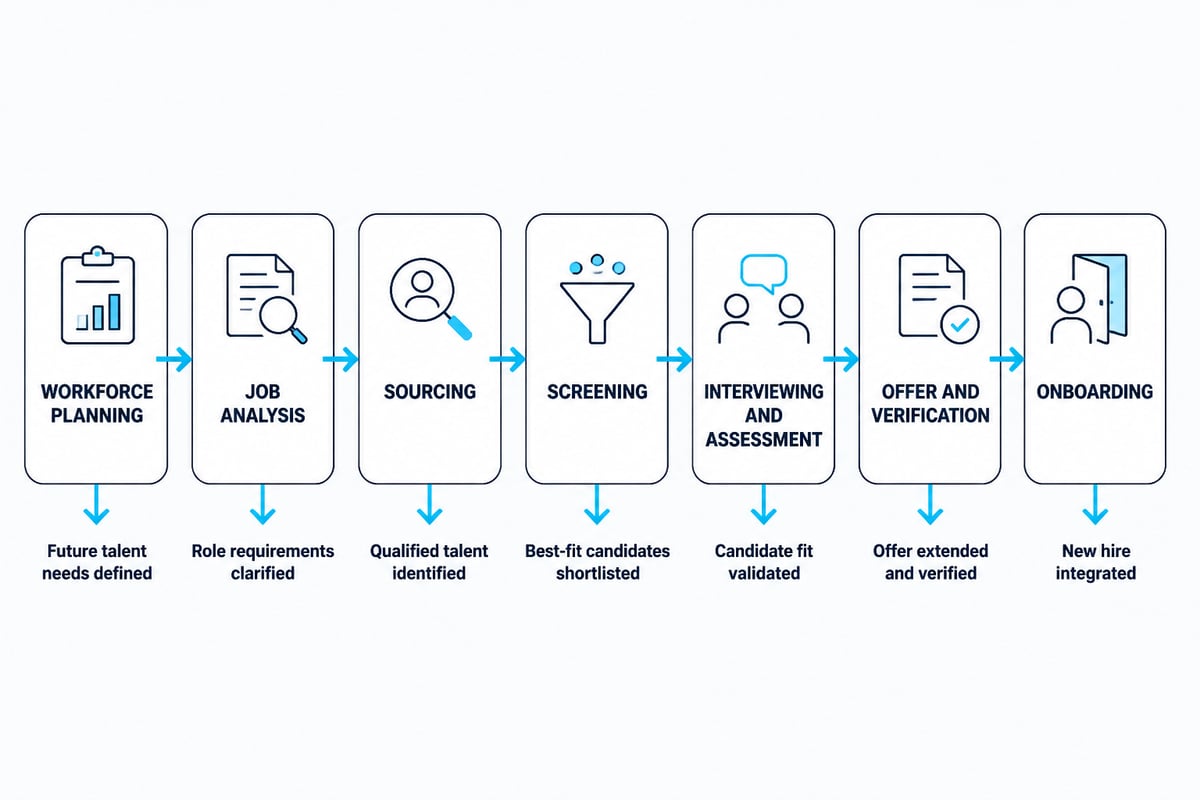
The seven steps of the recruitment process are workforce planning, job analysis, sourcing, screening, interviewing and assessment, offer and verification, and onboarding. Each step feeds the next, and skipping one shows up later as turnover or a failed audit.
- Workforce planning. Define how many people you need, with which skills, and by when. CIPD's workforce-planning factsheet explains how to anticipate needs and respond to business changes.
- Job analysis. Write down the actual duties, physical demands, certifications, and safety requirements. This document becomes your selection standard.
- Sourcing. Reach candidates through job boards, referrals, trade schools, and staffing partners. Match the channel to the role.
- Screening. Check credentials, licenses, work authorization, and basic fit before anyone reaches a supervisor.
- Interviewing and assessment. Use structured questions tied to the job analysis. For trades, add a practical skills check.
- Offer and verification. Confirm references, background, and certifications before the start date, not after.
- Onboarding. Orientation, site safety training, equipment familiarity, and clear first-week expectations.
Types of Staffing Arrangements Employers Use
Employers fill roles through direct hire, temporary, temp-to-hire, contract, and project-based arrangements, and the right choice depends on demand stability and risk tolerance. Picking the wrong model is a common and expensive mistake.
| Arrangement | Best used when | Main tradeoff |
|---|---|---|
| Direct hire | The role is permanent and core to operations | Slower, higher upfront commitment |
| Temporary | Demand spikes, absences, seasonal peaks | Less long-term loyalty to your site |
| Temp-to-hire | You want to test fit before committing | Needs a clear conversion plan |
| Contract | A defined scope with specialized skills | Ends when the scope ends |
| Project-based | Turnarounds, shutdowns, build phases | Needs fast mobilization |
A refinery turnaround and a steady warehouse operation need different mixes. Turnarounds call for a scalable crew you can ramp up and release. A distribution center usually needs a stable core plus flexible capacity for peak weeks. For flexible capacity, temporary staffing services let you scale up or down with the workload, while direct staffing fits permanent positions.
What Is Strategic Staffing?
Strategic staffing is the practice of aligning workforce decisions with long-range business goals instead of filling vacancies as they appear. It means forecasting skill needs before a contract is signed and building the talent pipeline to meet them.
In practice, strategic staffing looks like this:
- Mapping which roles are critical to revenue and which are easy to backfill.
- Tracking attrition by role and site to predict when gaps will open.
- Building relationships with a staffing partner before the emergency hits.
- Cross-training so one absence does not stop a crew.
A construction firm that wins a large project and then starts hiring is already behind. A firm that knows its bid pipeline and pre-qualifies welders, electricians, and equipment operators can mobilize in days. The difference is planning, not luck.
Staffing for Safety-Critical and Skilled Roles
In industrial, construction, and maritime work, staffing quality and site safety are the same conversation. Certifications, medical clearances, and licenses have to be verified before a worker steps onto a site, because an expired credential discovered after an incident is the worst time to find it.
A practical verification checklist for skilled trades:
- Current trade certifications (welding, pipefitting, electrical)
- Heavy equipment operator qualifications
- CDL class and endorsements for drivers
- Forklift certification for warehouse staff
- Site-specific safety orientation completed before the first shift
CDR General Services builds this into its model: every worker is certified and receives ongoing safety training, and the company logs over 2,000 safety visits per year. For employers staffing skilled trades, construction crews, or CDL drivers, that kind of verification discipline protects both people and project schedules.
Staffing a Bilingual and Multicultural Workforce
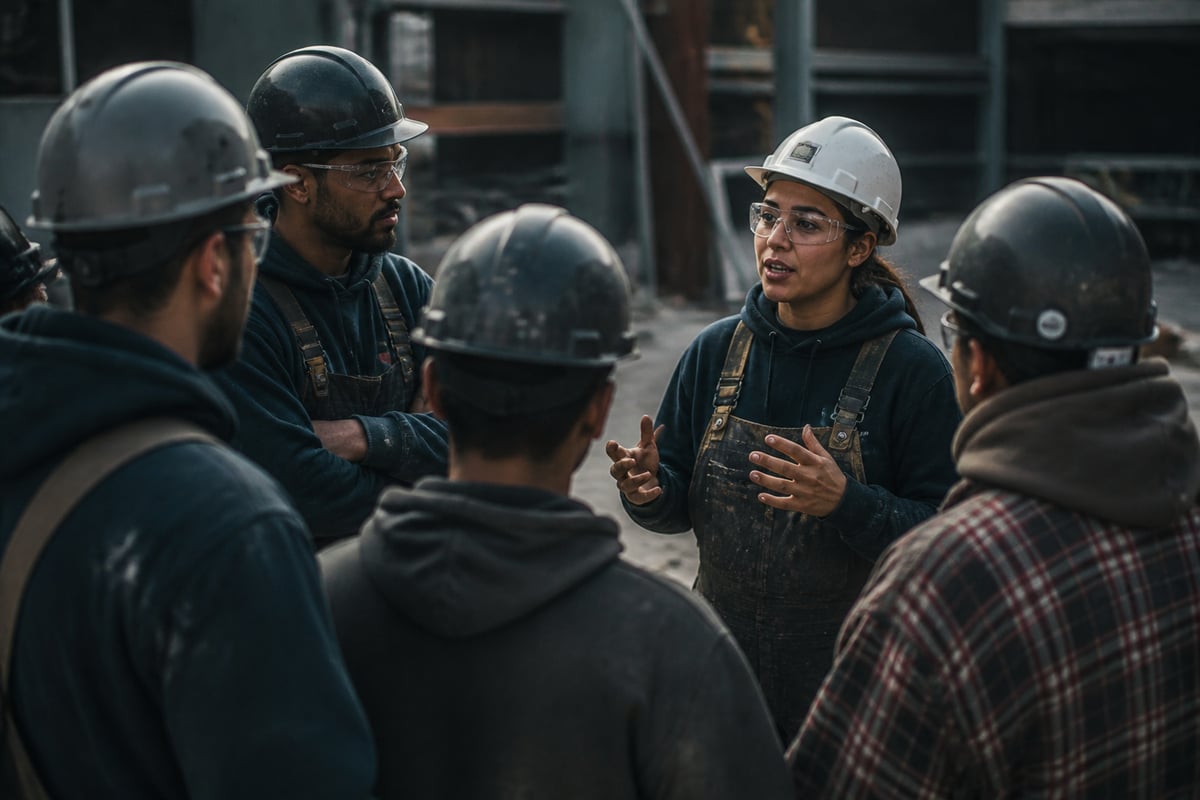
A bilingual workforce reduces safety incidents caused by miscommunication and speeds up crew productivity. On many Gulf South job sites, instructions given in only one language leave part of the crew guessing, and that gap is a safety risk, not a soft issue.
Employers who plan for this do a few things well:
- Assign bilingual leads who can relay safety briefings accurately.
- Provide safety signage and training materials in both English and Spanish.
- Recruit from Spanish-speaking talent pools deliberately instead of hoping applicants find you.
This is where CDR General Services holds a clear edge. Its specialty is Spanish-speaking and bilingual personnel, giving employers access to a multicultural workforce that scales with the project. For employers who want help structuring this, a staffing consultant conversation is a practical starting point.
What Are Red Flags for HR in the Staffing Process?
The biggest red flags in staffing are unverified credentials, rushed selection, inconsistent screening, and no measurement of results. Any one of them can turn a placement into a liability.
Watch for these:
- Skipped verification. Starting a worker before certifications and references are confirmed.
- Inconsistent selection. Different hiring managers using different criteria, which invites bias claims. The EEOC's guidance on employment tests and selection procedures stresses that selection tools must be job-related and validated, and its Uniform Guidelines Q&A explains how adverse impact is assessed.
- Vague job descriptions. If you cannot state the duties and physical demands, you cannot screen for them.
- No quality-of-hire tracking. SHRM's 2025 benchmarking found that only a minority of organizations tracked quality of hire. You cannot improve what you do not measure.
- High early turnover. Workers leaving inside the first 30 to 90 days point to a sourcing, expectation, or onboarding problem.
- Overreliance on one channel. A single sourcing source is a single point of failure.
What Are the 7 HR Processes?
The seven core HR processes are workforce planning, recruitment and staffing, onboarding, training and development, performance management, compensation and benefits, and employee relations with compliance. Staffing touches the first three directly and feeds all the others.
Think of it as a chain. Planning sets the headcount. Recruitment fills it. Onboarding gets people productive and safe. Training builds skill. Performance management keeps standards consistent. Compensation keeps good workers from leaving. Employee relations and compliance protect the organization legally. A weakness at the front of the chain, such as poor selection, creates extra work for every process behind it.
Measuring Staffing Performance
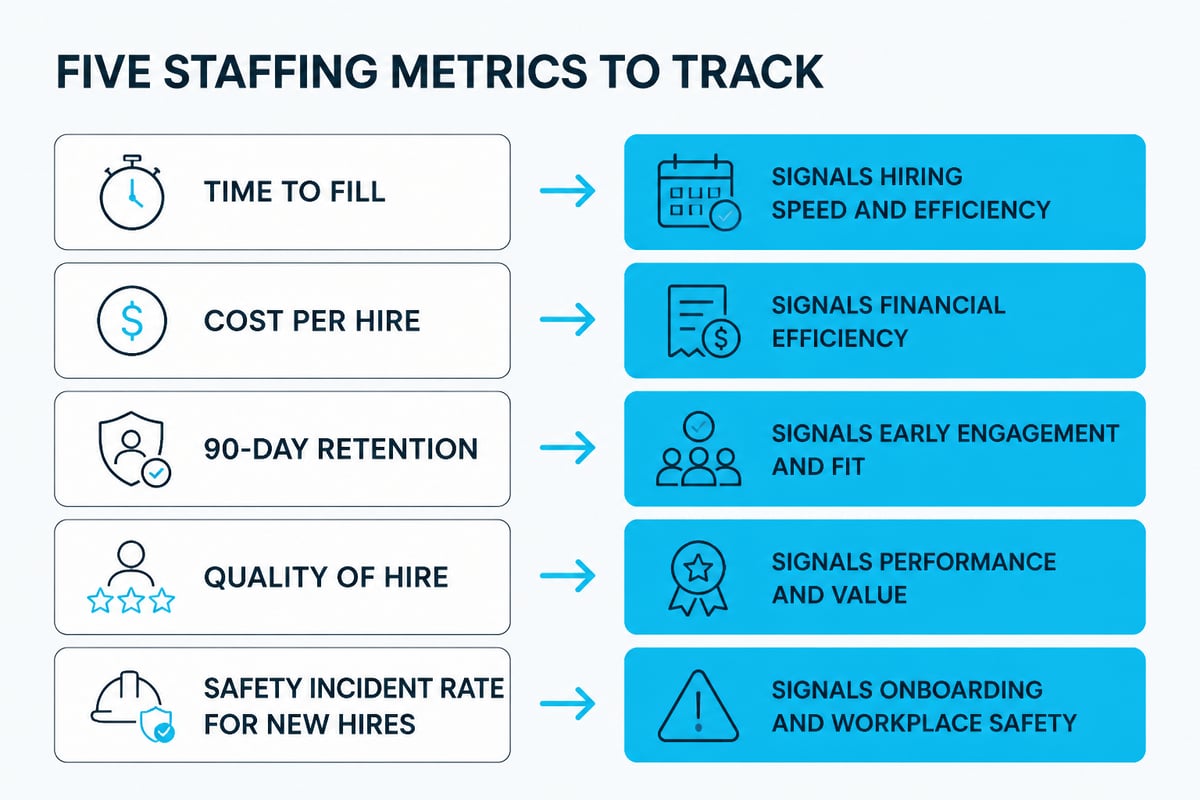
Measure staffing with a handful of numbers you actually review: time to fill, cost per hire, early turnover, and quality of hire. Employers without these figures are guessing.
- Time to fill: days from request to productive start. Long fill times on critical trades cost schedule.
- Cost per hire: compare against SHRM's benchmarking figures to see where you stand.
- 90-day retention: the clearest early signal of a good or bad match.
- Quality of hire: performance, attendance, and safety record of new workers against peers.
- Safety incident rate for new hires: a direct check on onboarding quality.
Labor-market context helps too. The BLS publishes job openings, hires, and separations data, and its 2025 benchmark revision article explains how those estimates are adjusted, which is useful when you compare your own hiring pace to the broader market.
Technology and Staffing Decisions
Technology speeds up screening and scheduling, but it does not replace judgment on safety-critical placements. SHRM's 2025 survey found that a growing share of HR professionals report using AI in HR tasks. Applicant tracking, automated screening, and scheduling tools cut administrative load.
Use them for what they do well: sorting applications, flagging expired credentials, and tracking onboarding tasks. Keep a human in the loop for final selection, and make sure automated filters do not screen out qualified candidates unfairly, which circles back to the EEOC guidance above.
How a Staffing Partner Fits Into Your Strategy
A staffing partner gives you speed, scalability, and a pre-vetted bench, which an in-house team rarely builds quickly for fluctuating industrial demand. The best partnerships are structured, with clear role definitions and a single point of accountability.
CDR General Services offers one point of contact from request to placement, a bilingual workforce that scales up or down with the project, and veteran ownership with local expertise across Louisiana, Mississippi, and Alabama. Employers can explore staffing services for the full range, or look at warehouse staffing for logistics operations. For other fields where specialized workforces matter, resources like Al Ibrahim International F.Z.E show how steel fabrication and human resources consultancy services are packaged in other markets. CDR General Services focuses on its core industrial, construction, maritime, and logistics sectors, so employers needing other searches should look elsewhere.
Frequently Asked Questions
What is staffing in human resource management?
Staffing is the HR function that plans for, recruits, selects, places, and retains the workforce an organization needs. It runs from workforce forecasting through onboarding and retention.
What are the main steps in the staffing process?
The main steps are workforce planning, job analysis, sourcing, screening, interviewing, offer and verification, and onboarding.
What is the difference between staffing and recruiting?
Recruiting is attracting and selecting candidates. Staffing is the broader system that includes planning, recruiting, placement, training, and retention.
What is strategic staffing?
Strategic staffing aligns workforce decisions with long-term business goals, forecasting skill needs and building talent pipelines before vacancies appear.
How much does it cost to hire an employee?
SHRM's 2025 benchmarking reported an average cost-per-hire of $5,475 for nonexecutive roles and $35,879 for executive roles.
What are red flags in the staffing process?
Common red flags include unverified credentials, inconsistent selection criteria, vague job descriptions, no quality-of-hire tracking, and high early turnover.
When should an employer use temporary staffing?
Use temporary staffing for demand spikes, seasonal peaks, absences, and project work where headcount needs to scale up and down quickly.
How can CDR General Services help with my industrial or construction staffing needs?
CDR General Services provides certified, safety-trained workers across industrial, construction, and logistics roles, with one point of contact from request to placement. Contact CDR General Services to discuss your crew requirements.
Does CDR General Services provide bilingual and Spanish-speaking workers?
Yes. Spanish-speaking and bilingual personnel are CDR General Services's specialty, giving employers a multicultural workforce that scales with the project. Reach out to CDR General Services to build your next bilingual crew.
Start this week by listing your three hardest-to-fill roles and writing the certifications, shift demands, and start dates each one requires. Once that list exists, you can Request a Workforce Plan from CDR General Services and get certified, safety-trained, bilingual crews matched to those requirements across Louisiana, Mississippi, and Alabama.
Published November 17, 2026 by Sanya
All articles