

The landscape of temp work staffing has fundamentally transformed how businesses approach workforce management in 2026. Companies across industrial, construction, maritime, and administrative sectors now rely on temporary staffing solutions to maintain operational flexibility while controlling costs. This strategic approach allows organizations to scale their workforce up or down based on project demands, seasonal fluctuations, and market conditions without the long-term commitments associated with permanent hiring. The right temp work staffing partner becomes an extension of your business, delivering qualified, safety-certified personnel exactly when you need them.
Understanding Modern Temp Work Staffing Solutions
Temp work staffing represents far more than a stop-gap measure for unexpected absences. It’s a sophisticated workforce strategy that enables businesses to access specialized talent, manage risk, and maintain competitive advantages in dynamic markets. The staffing and temp agencies industry has evolved significantly, with agencies now offering comprehensive workforce solutions that include skills assessment, safety certification, and cultural competency.
Core Benefits of Temporary Workforce Solutions
Organizations leveraging temp work staffing gain immediate access to several decisive advantages:
- Instant workforce scalability for project-based demands
- Reduced overhead costs associated with benefits and long-term commitments
- Access to specialized skills without permanent hiring investments
- Flexibility to evaluate workers before permanent placement
- Risk mitigation through professional staffing partnerships
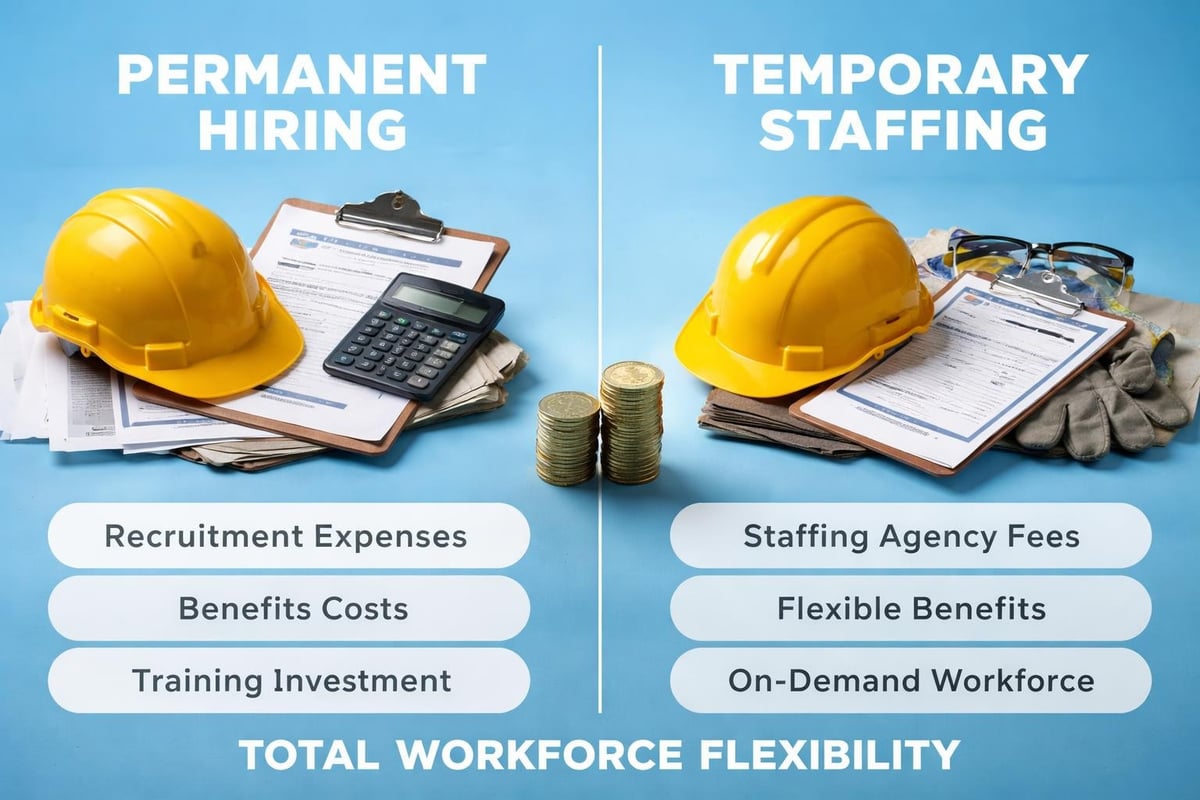
The financial implications alone make temporary staffing an attractive option. Companies avoid costs related to recruiting, onboarding, benefits administration, and unemployment insurance while gaining access to a pre-screened talent pool.
Industry-Specific Temporary Staffing Applications
Different sectors leverage temp work staffing for distinct operational needs. In industrial and manufacturing environments, temporary workers fill critical roles during production peaks, equipment installations, or planned maintenance shutdowns. Construction projects require surge capacity for specific phases, from site preparation through finishing work. Maritime operations depend on temporary crews for vessel maintenance, cargo handling, and seasonal shipping demands.
Administrative and clerical staffing addresses different challenges. Businesses need temporary office personnel for special projects, seasonal workload increases, or extended employee absences. The versatility of temp work staffing makes it applicable across virtually every business function and industry vertical.
Strategic Implementation of Temp Work Staffing
Success with temporary workers demands more than simply calling an agency when you’re short-handed. Strategic implementation requires clear communication, defined processes, and partnership with staffing providers who understand your industry’s unique demands.
Defining Your Temporary Staffing Requirements
| Staffing Need Category | Key Considerations | Typical Duration |
|---|---|---|
| Seasonal Workforce | Peak production periods, holiday demands | 2-6 months |
| Project-Based | Specific skills, defined timelines | 3-12 months |
| Emergency Coverage | Immediate availability, basic qualifications | 1-8 weeks |
| Temp-to-Hire | Cultural fit, performance evaluation | 3-6 months |
| Specialized Skills | Certifications, experience requirements | Varies |
Start by analyzing your workforce patterns over the past 24 months. Identify recurring needs, seasonal fluctuations, and skill gaps that consistently emerge. This data-driven approach to temp work staffing ensures you’re prepared with the right personnel at the right time.
Selecting the Right Staffing Partner
Not all staffing agencies deliver equal value. The difference between a mediocre provider and an exceptional one directly impacts your operational success. Your ideal temp work staffing partner should demonstrate:
- Industry-specific expertise in your sector
- Comprehensive safety certification programs aligned with OSHA standards
- Rapid response capabilities for urgent staffing needs
- Quality assurance processes including skills testing and background checks
- Cultural competency matching your workforce demographics
When evaluating staffing agencies, examine their specialization depth. A provider focused on industrial, construction, and maritime staffing brings sector knowledge that generalist agencies simply cannot match. This expertise translates into workers who understand the job requirements, safety protocols, and operational expectations from day one.
Safety and Compliance in Temporary Worker Management
Safety represents the non-negotiable foundation of effective temp work staffing. NIOSH has established comprehensive best practices for protecting temporary workers, emphasizing that host employers bear responsibility for temporary worker safety regardless of their employment status.
Shared Safety Responsibilities
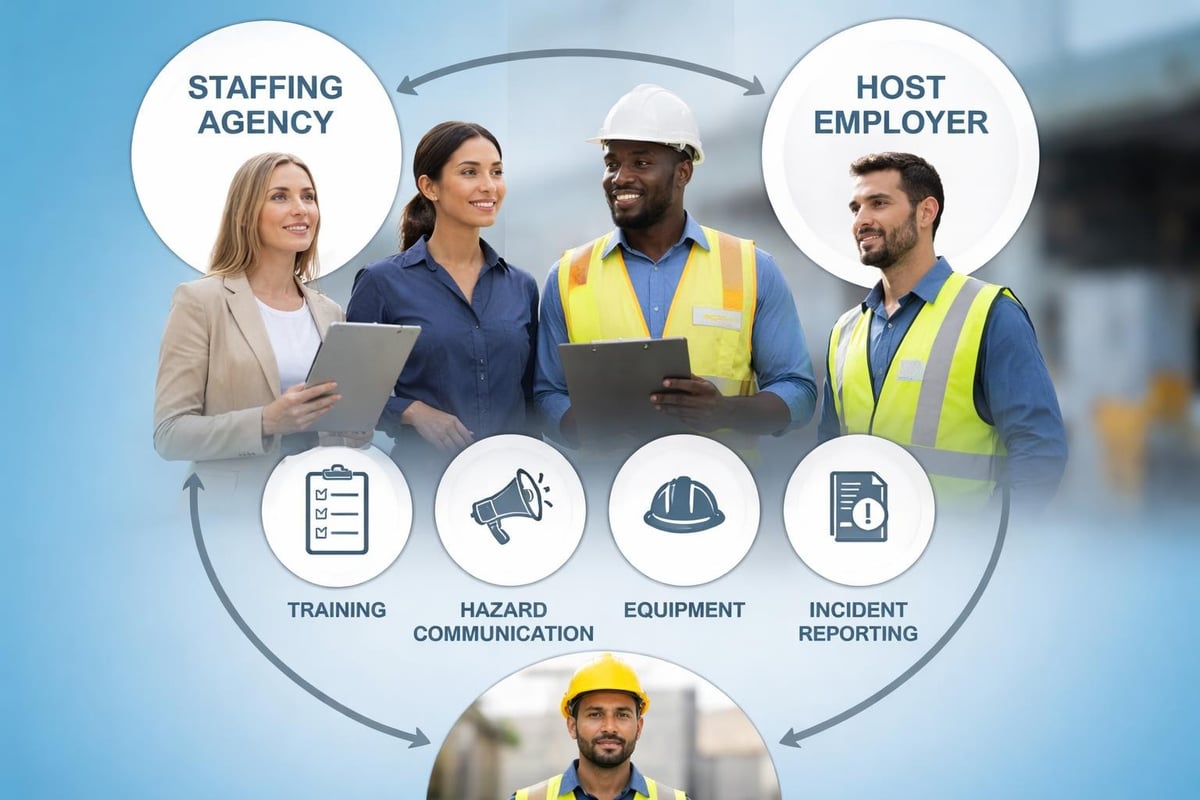
The relationship between staffing agencies, host employers, and temporary workers creates a three-way safety partnership. Each party carries specific obligations:
Staffing Agency Responsibilities:
- Pre-employment safety training and certification
- Accurate representation of job hazards
- Worker qualification verification
- Ongoing safety communication
Host Employer Responsibilities:
- Site-specific hazard training
- Supervision and oversight
- Equipment and PPE provision
- Injury reporting and investigation
Temporary Worker Responsibilities:
- Following safety protocols
- Reporting hazards immediately
- Using provided safety equipment
- Asking questions about unfamiliar tasks
Effective temporary labor providers implement robust safety and training programs that go beyond basic compliance. They create safety cultures where temporary workers receive the same protection, training, and consideration as permanent employees.
Training and Orientation Best Practices
Every temporary worker should complete comprehensive orientation before starting work. This orientation must cover:
- Site-specific hazards and emergency procedures
- Equipment operation and safety protocols
- Communication channels for reporting concerns
- Location of safety equipment and first aid
- Supervisor contact information
Never assume temporary workers possess knowledge about your specific worksite. Even experienced tradespeople need orientation to your facility’s unique characteristics, equipment, and safety procedures. Creating effective onboarding programs for temporary staff reduces accidents, increases productivity, and improves retention rates.
Maximizing Temporary Worker Productivity
Bringing temporary workers up to speed quickly requires intentional integration strategies. Best practices in temporary staffing emphasize treating temporary personnel as valued team members rather than disposable resources.
Integration and Team Dynamics
Your permanent employees set the tone for temporary worker integration. Brief your core team before temporary workers arrive, explaining:
- Why temporary workers are joining the team
- How long they’ll be on site
- What roles they’ll fill
- How to support their success
Assign experienced permanent employees as mentors or buddies for temporary workers. This simple step accelerates learning, builds relationships, and creates accountability networks that benefit everyone.
Communication Systems That Work
Clear communication channels prevent confusion and build confidence. Establish these systems before temporary workers arrive:
| Communication Need | Recommended System | Frequency |
|---|---|---|
| Daily work assignments | Morning briefings | Daily |
| Safety updates | Team huddles | As needed |
| Performance feedback | One-on-one check-ins | Weekly |
| Questions and concerns | Open-door policy | Ongoing |
| Emergency procedures | Written protocols + training | Initial orientation |
Bilingual communication capabilities become essential when working with diverse temporary workforces. Spanish-speaking workers represent significant portions of industrial, construction, and maritime labor pools throughout the Gulf South. Staffing partners who provide bilingual supervisors and safety materials eliminate communication barriers that compromise both safety and productivity.
Temp-to-Hire Conversion Strategies
The temp-to-hire approach represents one of the most valuable applications of temp work staffing. This strategy allows organizations to evaluate workers in real-world conditions before making permanent hiring commitments.
Evaluation Criteria for Conversion Decisions
Track these performance indicators throughout the temporary assignment:
- Technical skill proficiency and learning curve
- Safety compliance and hazard awareness
- Attendance and reliability patterns
- Team collaboration and communication
- Initiative and problem-solving capabilities
- Cultural fit with your organization
Document observations regularly rather than relying on end-of-assignment impressions. Objective performance data supports better conversion decisions and provides valuable feedback even for workers who don’t transition to permanent status.
Conversion Process Best Practices
When you identify temporary workers for permanent positions, handle the conversion professionally:
- Communicate intentions early to both the worker and staffing agency
- Negotiate conversion terms including any fees with your staffing partner
- Conduct formal interviews even though you know the candidate
- Complete standard background checks and pre-employment requirements
- Provide clear transition timelines and expectations
The temp-to-hire model reduces hiring risk substantially. You’ve already seen the worker perform under actual job conditions, eliminating much of the uncertainty inherent in traditional hiring processes.

Specialized Workforce Solutions for Complex Projects
Complex industrial, construction, and maritime projects demand specialized talent that standard hiring processes struggle to deliver quickly. Temp work staffing excels in these scenarios by providing immediate access to certified, experienced professionals.
Industrial and Skilled Trades Staffing
Major industrial projects require certified welders, pipefitters, electricians, millwrights, and heavy equipment operators. These specialized roles demand specific certifications, years of experience, and proven safety records. Quality temp work staffing agencies maintain networks of pre-qualified skilled tradespeople ready for immediate deployment.
Critical certifications to verify:
- Welding certifications (SMAW, GMAW, FCAW, GTAW)
- Electrical licenses and journeyman cards
- Crane operator certifications
- Confined space entry qualifications
- OSHA 10 or OSHA 30 completion
The staffing agency should provide certification verification before workers arrive on site. Never accept verbal assurances about qualifications. Demand documented proof of every required certification and license.
Construction and General Labor Scaling
Construction projects move through distinct phases, each requiring different workforce compositions. Foundation work demands one skill set, framing requires another, and finishing work needs entirely different capabilities. Temp work staffing allows contractors to scale their workforce precisely to match each phase’s requirements.
General labor positions, while requiring fewer certifications, still demand workers who understand construction site safety, can follow instructions accurately, and possess the physical stamina for demanding work. The rise of temp staffing agencies in the construction sector reflects the industry’s recognition that flexible workforce solutions deliver competitive advantages.
Transportation and Logistics Personnel
CDL drivers, forklift operators, and warehouse personnel keep materials and products moving. These positions carry significant liability exposure, making thorough screening absolutely critical. Your temp work staffing partner must verify:
- Current CDL licenses (Class A or Class B as required)
- Clean driving records and DOT compliance
- Forklift certifications from recognized training programs
- Drug screening results and ongoing testing compliance
- Background checks revealing no disqualifying offenses
Transportation staffing demands cannot wait. When you need drivers or operators, you typically need them immediately. This reality makes pre-established relationships with specialized staffing agencies essential for logistics operations.
Administrative and Clerical Temporary Staffing
Office environments benefit from temp work staffing just as industrial operations do. Successful temporary administrative staffing requires different evaluation criteria than industrial positions but demands equal attention to quality and fit.
Common Administrative Temporary Positions
Professional office environments utilize temporary staff for:
- Executive assistants during maternity leaves or extended absences
- Data entry specialists for special projects or backlog clearance
- Receptionist coverage maintaining professional front-office presence
- Project coordinators for defined initiatives with clear timelines
- Accounting support during tax season or audit periods
Administrative temporary workers often work directly with sensitive information, requiring enhanced screening for trustworthiness and discretion. Background checks, reference verification, and skills testing become even more critical in these roles.
Technology Skills Assessment
Modern office work demands proficiency with specific software platforms and systems. Before placing administrative temporary workers, verify their competency with:
| Software Category | Common Applications | Proficiency Level Required |
|---|---|---|
| Office Suites | Microsoft Office 365, Google Workspace | Intermediate to Advanced |
| Communication | Outlook, Teams, Slack, Zoom | Intermediate |
| Project Management | Asana, Monday.com, Trello | Basic to Intermediate |
| Industry-Specific | QuickBooks, Salesforce, SAP | Varies by position |
| Database Management | Excel, Access, industry platforms | Intermediate |
Request skills demonstrations rather than accepting resume claims. A ten-minute typing test or Excel exercise reveals actual capabilities more accurately than any interview question.
Managing Costs and Budgeting for Temporary Workforce
Temp work staffing involves different cost structures than permanent hiring. Understanding these economics ensures you maximize value while maintaining quality standards.
Transparent Pricing Models
Reputable staffing agencies use transparent pricing that typically includes:
- Base hourly rate paid to the temporary worker
- Markup percentage covering agency costs and profit
- Overtime premiums at time-and-a-half or double-time
- Conversion fees if temp-to-hire arrangements apply
Demand complete pricing transparency upfront. Hidden fees, unexpected charges, or unclear overtime calculations indicate problematic staffing partners. Quality agencies provide detailed rate sheets showing exactly what you’ll pay under various circumstances.
Total Cost of Workforce Comparison
Compare the true total cost of temporary versus permanent workers:
Temporary Worker Costs:
- Hourly rate including markup
- Reduced management overhead
- No benefits or payroll taxes
- No recruiting or onboarding costs
- Flexible scaling without layoff costs
Permanent Worker Costs:
- Base salary or hourly wage
- Benefits (health insurance, retirement, paid time off)
- Payroll taxes (Social Security, Medicare, unemployment)
- Recruiting and onboarding expenses
- Training and development investments
- Severance obligations if reduction needed
Temporary staffing often costs 25-40% more per hour than permanent employees’ base wages, but the total cost comparison frequently favors temporary workers when you account for all permanent employment obligations.
Cultural Competency and Workforce Diversity
The composition of America’s workforce has shifted dramatically. Employers who ignore cultural competency and diversity considerations limit their talent access and create unnecessary operational challenges. Spanish-speaking workers represent substantial portions of industrial, construction, and maritime labor pools throughout the Gulf South and beyond.
Advantages of Bilingual Workforce Capabilities
Organizations that embrace bilingual workforce solutions gain multiple competitive advantages:
- Expanded talent pool access reaching qualified workers others miss
- Improved safety communication in workers’ primary languages
- Enhanced team productivity through clearer instruction and feedback
- Reduced turnover from better cultural integration
- Competitive differentiation in tight labor markets
Safety communication in workers’ primary language isn’t just good practice, it’s an ethical imperative. OSHA requires that safety training be provided in languages workers understand. Staffing partners specializing in bilingual placement ensure this requirement is met while delivering additional cultural competency benefits.
Implementing Culturally Competent Staffing
Best practices for managing temporary staffing include creating inclusive environments where diverse workers feel valued and supported. This means:
- Providing safety materials and signage in multiple languages
- Offering bilingual supervision and support
- Respecting cultural differences in communication styles
- Creating inclusive policies that accommodate diverse backgrounds
- Training permanent staff on cultural competency basics
The most successful temp work staffing relationships leverage diversity as a strength rather than viewing it as a challenge to manage. Staffing agencies with deep expertise in multicultural talent placement become strategic partners who enhance your operational capabilities beyond simple headcount provision.
Quality Assurance and Performance Management
Temporary workers deserve the same performance expectations and feedback as permanent employees. Best practices for hiring temporary staff emphasize clear expectations, regular feedback, and accountability systems that drive results.
Setting Clear Performance Standards
Before temporary workers arrive, document specific performance standards covering:
- Productivity expectations with measurable targets
- Quality standards defining acceptable work
- Attendance requirements and tardiness policies
- Safety compliance non-negotiables
- Behavioral expectations for professionalism and teamwork
Provide these standards in writing during orientation. Never assume workers understand your expectations without explicit communication. Ambiguity creates frustration for everyone involved.
Continuous Feedback Systems
Weekly check-ins with temporary workers provide opportunities for:
- Recognizing strong performance and contributions
- Addressing performance gaps before they become problems
- Answering questions and clarifying expectations
- Building relationships that enhance engagement
- Identifying potential candidates for permanent positions
Feedback should flow in both directions. Ask temporary workers about their experience, challenges they’re facing, and suggestions for improvement. This information helps you refine your temp work staffing approach and provides valuable insights to your staffing agency partner.
Frequently Asked Questions About Temp Work Staffing
What is temp work staffing and how does it differ from permanent hiring?
Temp work staffing involves hiring workers through a staffing agency for defined periods or specific projects. Unlike permanent hiring where workers become your direct employees, temporary workers remain employees of the staffing agency. You gain workforce flexibility without long-term employment commitments, benefits obligations, or permanent payroll additions.
How quickly can staffing agencies provide temporary workers?
Response times vary based on position complexity and market conditions. For general labor and common positions, quality staffing agencies can often provide qualified workers within 24-48 hours. Specialized roles requiring specific certifications may take 3-5 business days. Emergency situations sometimes require same-day placement, which premium staffing partners can accommodate for established clients.
Who is responsible for temporary worker safety and training?
Safety responsibility is shared between the staffing agency and host employer. NIOSH guidelines on protecting temporary workers clarify that staffing agencies provide general safety training and worker qualification verification, while host employers must deliver site-specific hazard training, supervision, and safety equipment. Both parties share legal and ethical obligations for temporary worker protection.
What certifications should temporary workers in industrial roles possess?
Required certifications depend on specific job functions. Common industrial certifications include OSHA 10 or OSHA 30, welding certifications for various processes, forklift operator licenses, confined space entry qualifications, fall protection training, and lockout-tagout certification. Always verify certifications before workers begin assignments and maintain copies in your safety documentation.
How do temp-to-hire arrangements work and what are the typical costs?
Temp-to-hire arrangements allow you to evaluate workers during a trial period before offering permanent employment. If you decide to hire the worker permanently, you typically pay a conversion fee to the staffing agency, usually calculated as a percentage of the worker’s annual salary or a flat fee based on hours worked. These fees compensate the agency for recruiting, screening, and providing the worker during the evaluation period.
Can temporary workers fill specialized skilled trade positions?
Absolutely. Quality temp work staffing agencies maintain networks of certified welders, pipefitters, electricians, millwrights, and other skilled tradespeople. These workers bring years of experience and current certifications. Specialized staffing agencies pre-screen candidates, verify certifications, and ensure workers possess the exact skills your projects demand.
What advantages do bilingual staffing capabilities provide?
Bilingual staffing capabilities expand your talent pool significantly while improving safety communication and operational efficiency. Spanish-speaking workers represent substantial portions of industrial, construction, and maritime workforces. Agencies specializing in bilingual placement ensure safety training occurs in workers’ primary languages, reducing accidents while providing access to highly skilled, reliable personnel many employers overlook.
How should we budget for temporary staffing versus permanent employees?
Temporary staffing rates typically run 25-40% higher than permanent employees’ base hourly wages but eliminate costs for benefits, payroll taxes, recruiting, and long-term commitments. Calculate total cost of workforce by including all permanent employment expenses (insurance, retirement, paid time off, unemployment insurance, training, and potential severance). Many organizations find temporary staffing more cost-effective for variable workload situations despite higher hourly rates.
What should we look for when selecting a temp work staffing agency?
Prioritize agencies with deep expertise in your specific industry sector. Verify they maintain comprehensive safety programs, conduct thorough background checks, and provide rapid response for urgent needs. Ask about their worker qualification processes, certification verification procedures, and quality assurance systems. Request client references in similar industries and inquire about their experience with diverse, bilingual workforces if relevant to your operations.
How can CDR General Services help with our temporary staffing needs?
CDR General Services specializes in providing safety-certified, skilled temporary workers across industrial, construction, maritime, and administrative sectors throughout the Gulf South region. Our unmatched expertise in bilingual Spanish-speaking workforce solutions gives you access to highly qualified, culturally competent personnel that other agencies cannot provide. We deliver rapid response, comprehensive safety programs, and deep local knowledge that ensures your projects succeed with the right people at the right time.
Mastering temp work staffing strategies positions your organization for operational flexibility, cost control, and competitive advantage in dynamic markets. The difference between staffing success and frustration lies in partnering with agencies that understand your industry’s unique demands, prioritize safety above all else, and deliver culturally competent workforce solutions. CDR General Services brings unparalleled expertise in industrial, construction, and maritime staffing throughout the Gulf South, with specialized bilingual capabilities that set us apart from every competitor. When your projects demand reliable, safety-certified personnel who show up ready to work, we deliver the workforce solutions that drive your success.
Published April 2, 2026 by CDR
All articles