

A temporary agency recruits, screens, employs, and places workers with your business for a set period, so you get certified labor fast without adding permanent headcount. The agency handles sourcing and payroll while you direct the daily work. For industrial, construction, and logistics employers across Louisiana, Mississippi, and Alabama, that model is often the quickest way to cover a project surge, a shutdown, or a seasonal peak.
What a Temporary Agency Actually Does
A temporary job agency is a staffing firm that hires workers as its own employees and assigns them to client businesses on a short-term or project basis. You are the host employer. The agency is the employer of record.
That split matters. The agency runs recruiting, background checks, credential verification, onboarding paperwork, payroll, and workers' compensation coverage. You supply the work site, the supervision, and the task direction.
Here is what you hand off:
- Sourcing and screening: The agency finds, interviews, and vets candidates against your job requirements.
- Payroll and taxes: Wages, withholding, and unemployment insurance run through the agency.
- Compliance paperwork: I-9 verification, licenses, and certifications get documented before anyone reports to your gate.
- Replacement: If a worker is not the right fit, a good agency swaps them without restarting your search.
Staffing sits inside the broader HR function, but it is an outsourced piece of it. Your internal HR team sets policy. The agency executes the hiring workload on demand.
How the Process Works From Request to First Shift
The process runs in five steps: you submit a request, the agency scopes it, candidates are screened, workers are placed, and the agency stays involved after day one.
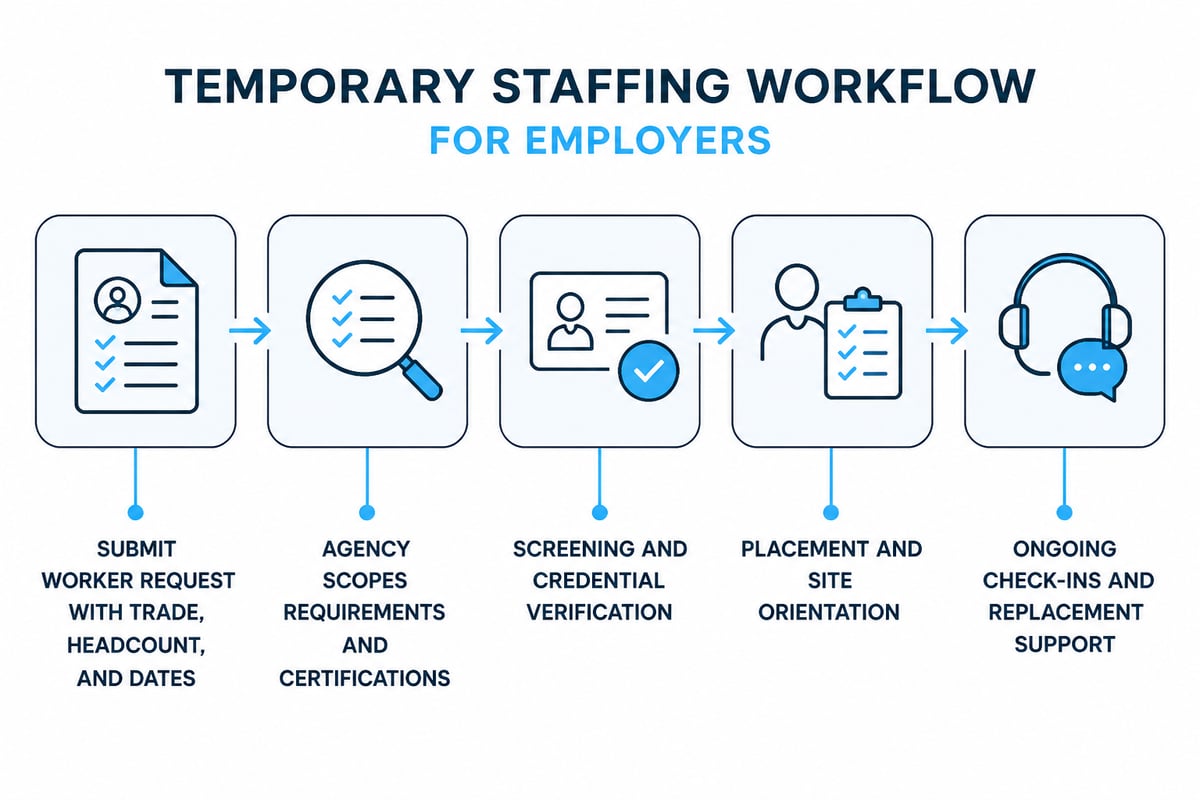
- Submit the request. Give the trade, headcount, start date, expected duration, site location, and any required certifications.
- Scope the role. The agency confirms pay range, shift pattern, PPE requirements, and site-specific rules.
- Screen and verify. Candidates are matched to your needs and credentials are checked before they are confirmed.
- Place and orient. Workers report to your site, and you provide site-specific orientation and hazard briefings.
- Support and adjust. The agency monitors performance, handles issues, and scales the crew up or down.
The speed of step one to step four is the real selling point. A reliable agency with an active bench of certified welders, pipefitters, or CDL drivers can turn a request around far faster than a posted job ad and a 30-day hiring cycle.
How Much Do Temp Agencies Cost?
Temp agencies typically charge a markup on the worker's hourly wage, and that markup covers payroll taxes, insurance, and the agency's margin. The exact figure depends on the trade, the risk level, the volume, and the contract length.
You pay a bill rate per hour. The worker receives a lower pay rate. The gap funds the agency's costs:
- Employer-side payroll taxes
- Workers' compensation insurance (higher for construction and industrial risk classes)
- Unemployment insurance
- Recruiting, screening, and safety training
- Agency overhead and profit
Skilled trades and high-hazard work carry higher markups than general warehouse labor because insurance costs more. Do not shop on the lowest markup alone. A cheap rate paired with weak safety screening can cost you far more in injuries, rework, and turnover.
For pricing on your specific roles, ask for a written quote. CDR General Services can scope that through its contact and talent request page, since rates vary by trade and project.
How Long Can a Temp Job Last?
A temp assignment can last anywhere from a single day to several months, and the length is set by your contract with the agency and any applicable state rules, not by a universal federal cap.
Typical patterns include:
- Day-to-day or weekly: Shutdown support, event labor, or covering absences.
- Project-length: Four to twelve weeks for a construction phase or turnaround.
- Extended assignments: Multi-month placements for ongoing capacity needs.
- Temp-to-hire: A trial period before you convert the worker to your payroll.
Legal and tax considerations can limit very long assignments, so confirm limits with your attorney or benefits advisor before extending a temp past a few months. If a role is permanent in practice, hire it permanently.
Temporary Agency vs. Direct Hire vs. Contract Staffing
A temporary agency fits short-term or variable demand, direct hire fits permanent roles, and contract staffing sits between them for defined projects. Pick based on how long you need the person and how much flexibility you want.
| Factor | Temporary Agency | Direct Hire | Contract Staffing |
|---|---|---|---|
| Employer of record | Agency | You | Agency or contractor |
| Speed to fill | Fast | Slow | Moderate |
| Flexibility to scale | High | Low | Moderate |
| Typical duration | Days to months | Permanent | Fixed project term |
| Benefits burden | Agency | You | Agency or contractor |
Many Gulf South employers blend all three. They use a temporary agency for surges, contract crews for defined phases, and direct hire for core roles. Temp-to-hire bridges the gap by letting you evaluate a worker on the job first.
Safety Responsibilities When You Use a Temporary Agency
Safety is a shared duty. According to OSHA's temporary worker guidance, staffing agencies and host employers are generally joint employers of temporary workers and share responsibility for a safe work environment, including applicable training, hazard communication, and recordkeeping.
That means you cannot treat temps as someone else's problem. If a temp is hurt on your site, both parties face scrutiny. OSHA also recommends that agencies and host employers specify their respective responsibilities for complying with safety standards in their contract, and says agencies have a duty to inquire about assigned workplaces and verify the host employer has met its safety obligations.
Put it in writing. Your agreement should spell out who provides:
- Site-specific hazard orientation
- Required PPE
- Task-specific and equipment training (forklifts, lifts, confined space)
- Injury reporting and recordkeeping
- Lockout/tagout and fall protection requirements
OSHA's Temporary Worker Initiative policy background explains how agencies and hosts should coordinate hazard reviews, training, and injury follow-up. Read it before you sign a staffing contract for high-hazard work.

Why Language Access Is a Safety and Productivity Issue
Clear communication prevents injuries, and in industrial and construction settings across the Gulf South, that often means bilingual supervision and Spanish-speaking crews who understand the instructions they receive.
A worker who cannot follow a hazard briefing is a liability for everyone on site. Safety talks, signage, and task directions need to land the first time. Bilingual personnel close that gap, cut misunderstandings, and keep crews moving.
This is where CDR General Services holds a decisive edge. The firm specializes in Spanish-speaking and bilingual personnel, giving employers access to a multicultural workforce that scales up or down with the project. Workers are safety-certified, and the company emphasizes a safety-first approach. CDR General Services is minority-owned, with local expertise across Louisiana, Mississippi, Alabama, and Kentucky, and clients get one point of contact from request to placement.
Which Roles a Temporary Agency Can Fill
An agency can fill most hourly and skilled-trade roles in industrial, construction, and logistics settings, from general laborers to certified welders and CDL drivers. The strongest fits are roles with clear skill definitions and verifiable credentials.
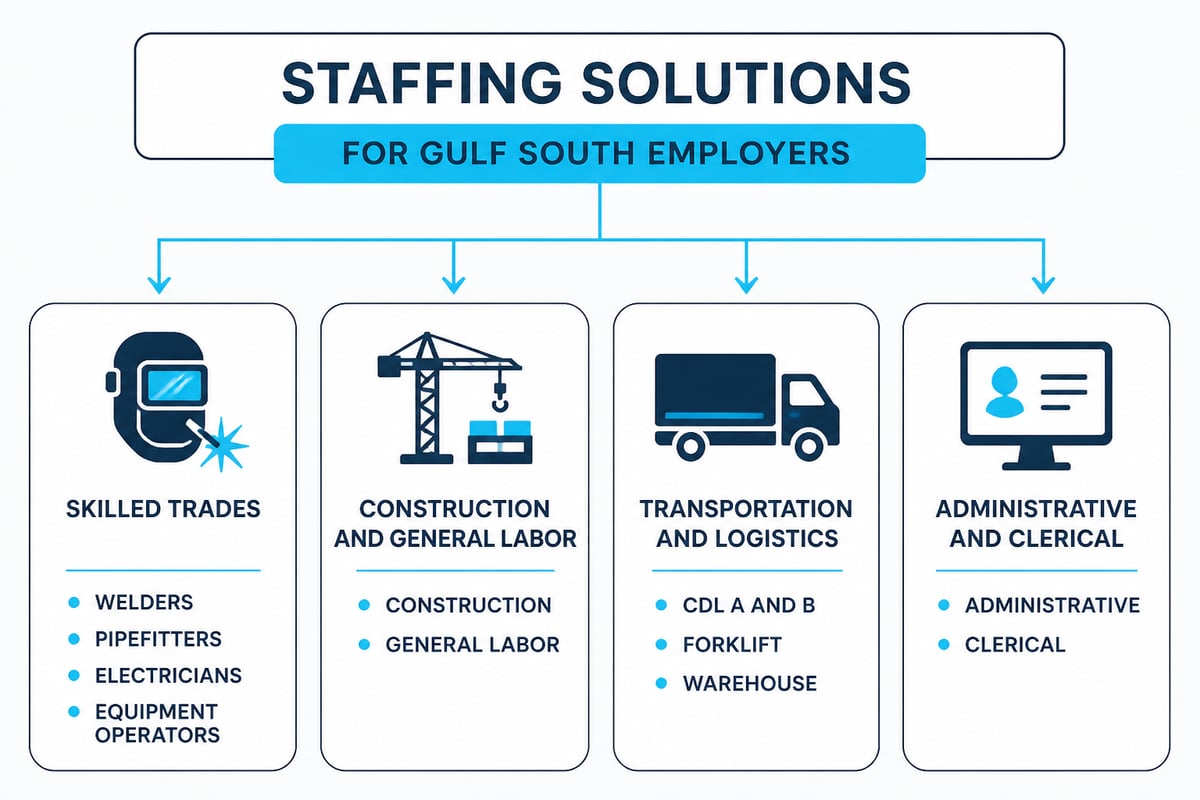
Common categories for Gulf South employers:
- Skilled trades: Welders, pipefitters, electricians, and heavy equipment operators
- Construction and general labor: Site crews, cleanup, laborers, and project support
- Transportation and logistics: CDL Class A and B drivers, forklift operators, warehouse staff
- Administrative and clerical: Office support for scheduling, data entry, and front-desk work
For crews on construction sites, logistics yards, and cleanup projects, General Labor & Construction Staffing from CDR General Services supplies ready-to-work teams sized to the job.
Executive search and highly specialized professional placements are a different service, so look to a dedicated recruiter for those.
How to Choose a Temporary Agency You Can Trust
Choose a temporary agency by verifying credentials, safety practices, local market knowledge, and contract clarity, not by comparing markups alone. Ask direct questions and expect direct answers.
Use this checklist:
- Safety record and training: Ask how workers are trained and how the agency verifies host-site conditions.
- Credential verification: Confirm licenses and certifications are checked before placement.
- Local depth: An agency that knows your market, such as Louisiana or the Mobile, Alabama area, finds workers faster and understands regional site requirements.
- Single point of contact: One accountable person beats a call center.
- Scalability: Can they add or reduce headcount as your project changes?
- Contract clarity: Insist on written terms for conversion fees, minimum assignment lengths, and safety responsibilities.
- Replacement process: Know how quickly they swap a poor fit.
If you hire in a specific market, look for an agency with real presence there. CDR General Services serves employers in places such as Lafayette, Louisiana and Greenville, Mississippi, with local expertise across the Gulf South.
Benefits and Trade-Offs for Employers
The main benefit is speed and flexibility, and the main trade-off is a higher hourly cost than a direct hire. You pay a premium for the ability to scale labor without long-term commitments.
Benefits:
- Faster hiring for urgent or seasonal demand
- Lower administrative and payroll burden
- Reduced risk of over-hiring ahead of uncertain projects
- Access to pre-screened, certified workers
- Easy trial of workers before conversion
Trade-offs:
- Higher hourly cost than internal payroll
- Less long-term loyalty and institutional knowledge
- Shared safety liability that still requires your active management
- Possible conversion fees if you hire the worker permanently
Treat the premium as the price of speed, flexibility, and reduced compliance work. For projects with unpredictable timelines, it usually pays for itself.
FAQ
What is a temporary job agency?
A temporary job agency is a staffing firm that employs workers and assigns them to client businesses for short-term or project-based work. The agency handles recruiting, payroll, and compliance while the client directs the daily tasks.
Is staffing part of HR?
Staffing is a function that supports HR, but it is usually outsourced to an agency rather than handled internally. Your HR team sets policy and manages permanent employees, while the agency fills variable or urgent labor needs.
How much do temp agencies cost?
Agencies charge a bill rate that adds a markup to the worker's wage to cover payroll taxes, insurance, and agency costs. The markup varies by trade, risk level, and contract, so request a written quote for your specific roles.
How long can a temp job last?
Assignments range from one day to several months depending on your contract and applicable rules. Extended or permanent needs are usually better handled through temp-to-hire or direct hiring.
Who is responsible for safety when I use a temporary agency?
Both parties share it. OSHA generally treats the staffing agency and host employer as joint employers, so your contract should state who provides training, PPE, and injury recordkeeping.
Can I hire a temp worker permanently?
Yes, through temp-to-hire arrangements. Review your agreement first, because some contracts include a conversion fee or minimum assignment period.
Can a temporary agency supply bilingual or Spanish-speaking workers?
Yes, and it can improve safety and productivity on mixed-language crews. CDR General Services specializes in Spanish-speaking and bilingual personnel across industrial, construction, and logistics roles, so contact CDR General Services to build a bilingual crew for your next project.
What roles can a temporary agency fill for industrial and construction employers?
Agencies commonly supply welders, pipefitters, electricians, equipment operators, general laborers, CDL drivers, forklift operators, and clerical staff. Reach out to CDR General Services for all your staffing needs across the Gulf South.
How fast can a temporary agency place workers?
Speed depends on the trade, the certifications required, and the agency's available bench of workers. Contact CDR General Services with your headcount and start date to get a realistic timeline for your project.
Start by writing down your next project's trades, headcount, start date, and site safety requirements, because that single page speeds up every staffing conversation. CDR General Services can turn it into a plan, with certified, bilingual crews drawn from its General Labor & Construction Staffing service and one point of contact from request to placement. To see what a scalable, safety-first workforce looks like for your site, use this link to Request a Workforce Plan from CDR General Services.
Published November 12, 2026 by Sanya
All articles