

Employee retention remains the single most expensive challenge facing American businesses in 2026. The question isn't whether you'll face turnover, it's whether you have the strategic tools to minimize it. One question increasingly asked by operations leaders, HR directors, and plant managers across the Gulf South is straightforward: does a staffing agency improve employee retention? The answer is more nuanced than a simple yes or no, but the evidence points decisively toward strategic staffing partnerships as a powerful retention tool when deployed correctly. Understanding how staffing agencies influence retention requires examining hiring quality, cultural fit, onboarding practices, and the often-overlooked conversion pathway from temporary to permanent placement.
The Real Cost of Employee Turnover in Industrial Sectors
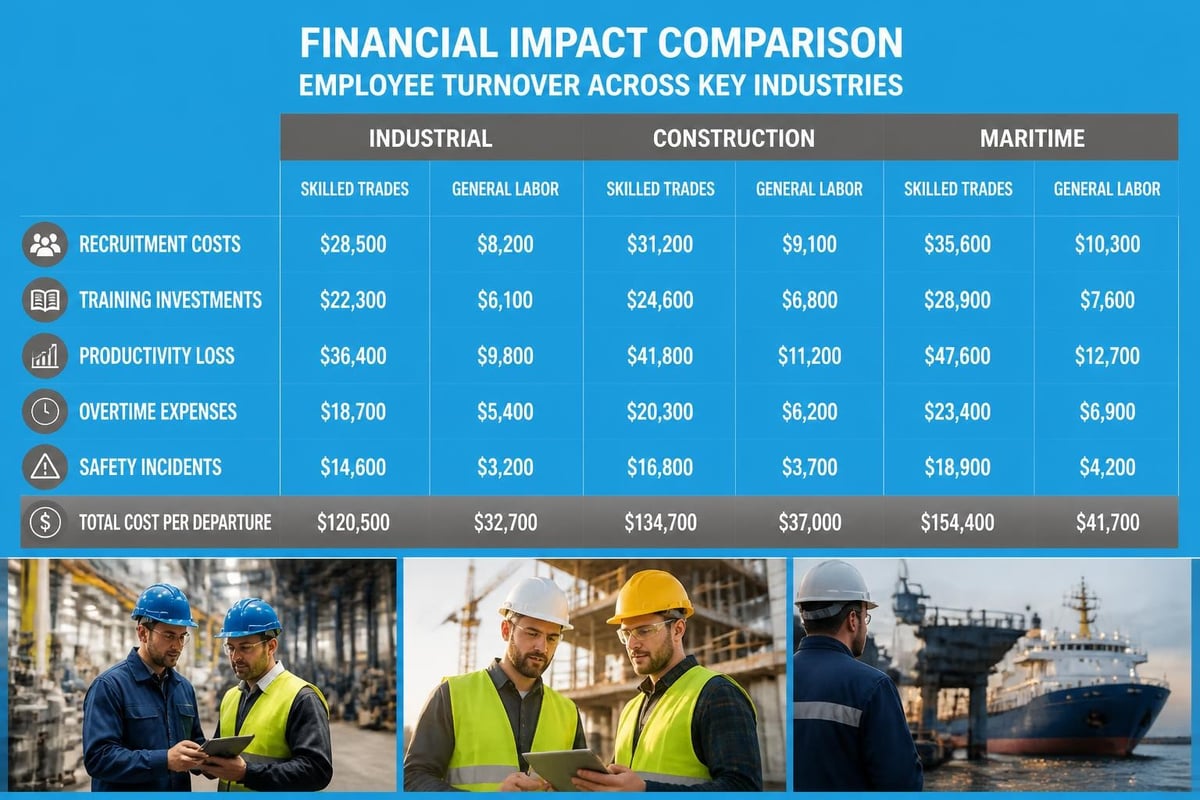
Before addressing whether does a staffing agency improve employee retention, acknowledge the financial devastation of turnover itself. Direct replacement costs average 50-200% of an employee's annual salary when you account for recruiting, onboarding, training, and productivity loss. For skilled trades positions (welders, electricians, pipefitters, CDL drivers), that number climbs higher.
The numbers tell a sobering story:
- Lost productivity during vacancy periods
- Overtime costs for remaining crew
- Training investments wasted on departing workers
- Safety incidents that increase with inexperienced staff
- Project delays and client dissatisfaction
- Damage to team morale and culture
Research from Gallup indicates that most employee turnover is preventable, yet organizations continue making the same hiring mistakes. The industrial, construction, and maritime sectors face unique retention pressures: physically demanding work, seasonal project cycles, safety-critical environments, and intense competition for certified talent.
How Staffing Agencies Directly Impact Retention Through Quality Screening
Does a staffing agency improve employee retention through better initial screening? Absolutely. Quality of hire is the single strongest predictor of retention. Staffing agencies specializing in industrial and skilled trades bring screening capabilities most internal HR departments simply cannot match.
Certification Verification and Skills Testing
Premier staffing partners don't just check boxes on applications. They verify:
- Safety certifications (OSHA 10/30, confined space, fall protection)
- Trade licenses and credentials (welding certifications, electrician licenses, CDL classifications)
- Hands-on skills assessments before candidates ever reach your site
- Background and drug screening to safety and security standards
- Work history verification including reference checks with previous supervisors
This rigorous pre-screening eliminates the costly mistake of hiring someone who looks good on paper but lacks real competency. When a certified welder actually possesses the skills they claim, they stay longer because they can perform the work safely and confidently.
Cultural and Language Fit Assessment
At CDR General Services, our unmatched Spanish specialty staffing capability demonstrates how cultural competency drives retention. Placing Spanish-speaking workers in environments where bilingual supervisors and culturally aware management exist creates immediate belonging and reduced early-stage turnover.
Workers who can communicate safety concerns, understand instructions clearly, and feel culturally respected stay substantially longer. This isn't soft HR theory, it's measurable retention impact.
| Screening Component | Internal HR Capability | Specialized Staffing Agency |
|---|---|---|
| Technical Skills Testing | Limited (resume review) | Comprehensive hands-on assessment |
| Safety Certification Verification | Manual, time-consuming | Automated database validation |
| Cultural/Language Fit | Often overlooked | Specialty matching (e.g., bilingual placement) |
| Industry-Specific Experience | General recruiting knowledge | Deep sector expertise |
| Speed to Verified Candidate | 3-6 weeks | 24-72 hours |
The Temp-to-Perm Conversion Advantage
Does a staffing agency improve employee retention when workers transition from temporary to permanent status? The data says yes, dramatically. The temp-to-perm model functions as an extended working interview that benefits both employer and employee.
From the employer perspective:
- Observe actual job performance under real conditions
- Assess cultural fit with existing teams
- Evaluate work ethic, reliability, and safety consciousness
- Reduce hiring risk by converting only proven performers
- Avoid costly bad-hire mistakes
From the employee perspective:
- Experience the work environment before committing
- Understand job demands, culture, and growth opportunities
- Build relationships and prove value
- Transition with confidence rather than uncertainty
According to SHRM's 2025 Talent Trends, organizations increasingly use staffing agencies as part of talent planning specifically because the temp-to-perm pathway produces higher-quality permanent hires with better retention rates.
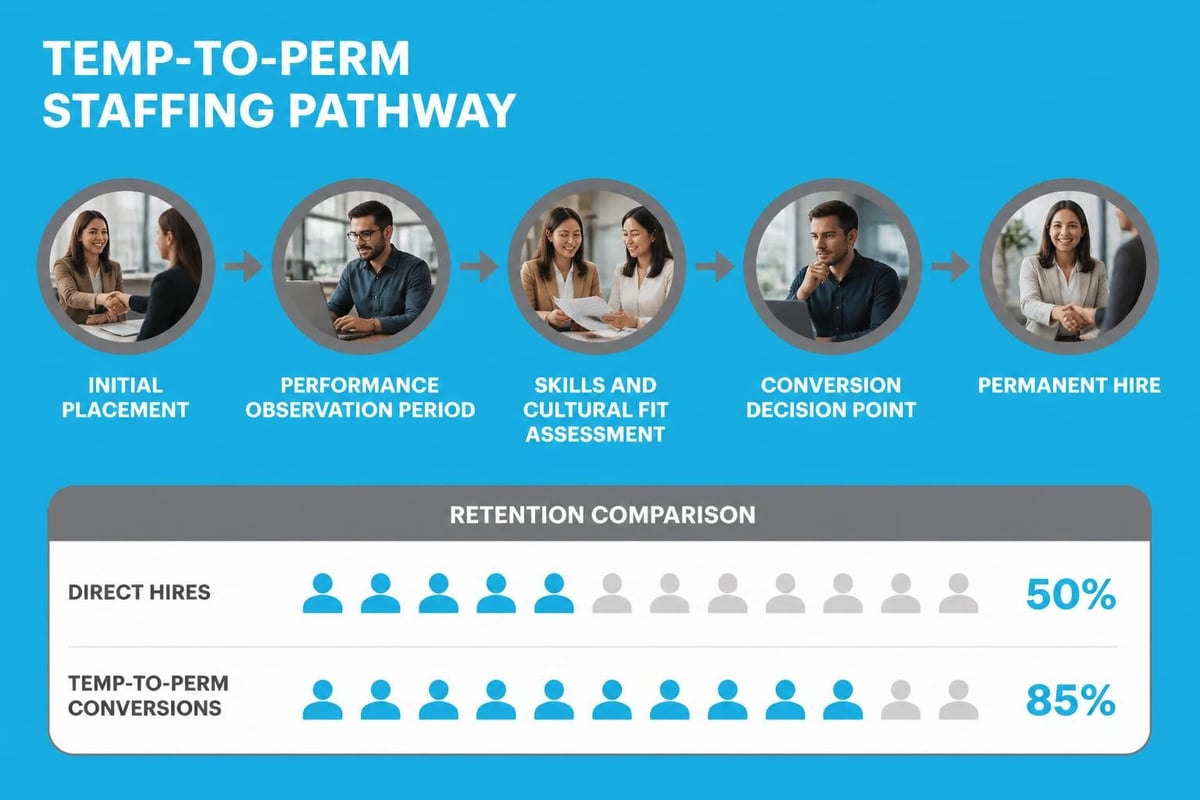
Workers converted from temporary to permanent status stay 40-60% longer on average than direct hires for the same positions. Why? Because both parties made informed decisions. There's no surprise, no mismatched expectations, no cultural shock.
Onboarding Quality and First-90-Days Support
The first 90 days determine whether an employee stays or goes. Harvard Business Review research on why employees quit emphasizes that onboarding quality and early-stage support dramatically influence retention outcomes.
Does a staffing agency improve employee retention during this critical period? When partnered with the right staffing provider, absolutely. Effective staffing agencies don't abandon workers after placement. They maintain active relationships, check in regularly, address concerns proactively, and support both client and worker through the adjustment period.
Structured Onboarding Support Includes:
- Pre-placement orientation covering job expectations, safety protocols, and workplace culture
- First-day coordination ensuring smooth integration
- Regular check-ins during the first 30-60-90 days
- Issue resolution before small problems become resignation triggers
- Performance feedback loops between worker, client, and agency
- Benefits explanation and support (if applicable)
Many industrial employers lack the bandwidth to provide this level of early-stage support, especially when hiring volume spikes for major projects. Staffing agencies fill this gap, functioning as an extension of your HR team focused specifically on successful integration.
Workforce Flexibility Reduces Burnout and Turnover in Core Teams
Here's a retention benefit often overlooked: does a staffing agency improve employee retention of your permanent workforce by reducing burnout? Yes. Strategic use of temporary and contract labor protects your core team from the turnover-inducing stress of chronic understaffing and excessive overtime.
Consider this scenario: A construction project requires a crew surge for 6 months. You have two options:
- Hire permanent workers you'll need to lay off when the project ends (creating turnover and unemployment claims)
- Partner with a staffing agency to scale up temporarily, protecting permanent employees from burnout while meeting project demands
Option two preserves retention of valuable permanent staff, maintains morale, and avoids the costly hire-layoff-hire cycle.
| Workforce Management Strategy | Impact on Permanent Staff Retention | Project Flexibility | Cost Efficiency |
|---|---|---|---|
| Direct-hire only | High burnout from overtime, low retention | Low, difficult to scale | High long-term costs |
| Strategic staffing partnership | Protected from overwork, higher retention | High, scale on demand | Optimized costs |
| Mixed permanent + contingent | Stable core team, sustainable workload | Maximum flexibility | Best ROI |
Deloitte's insights on contingent workforce management emphasize that integrating contingent workers strategically supports overall talent retention by creating sustainable workloads.
Specialized Talent Access Reduces Desperate Hiring Mistakes
Desperate hiring is retention poison. When you're short-staffed, safety-critical projects are at risk, and clients demand immediate delivery, the pressure to hire anyone with a pulse becomes overwhelming. This is precisely when the worst retention outcomes occur.
Does a staffing agency improve employee retention by eliminating desperate hiring? Unequivocally. Access to pre-qualified talent pools means you never settle.
For example, finding certified Spanish-speaking welders in the Gulf South through traditional recruiting could take months. Through specialized staffing agencies like those focused on maritime recruitment, that timeline shrinks to days, and quality doesn't suffer.
Specialized staffing providers maintain:
- Active databases of certified, safety-cleared workers
- Relationships with passive candidates not actively job-hunting
- Niche expertise in hard-to-fill roles (bilingual supervisors, specialized trade certifications)
- Geographic reach beyond your local market
- Immediate deployment capability
When you can access the right talent quickly, you make better hiring decisions. Better hiring decisions produce dramatically better retention.
Data-Driven Insights and Retention Metrics
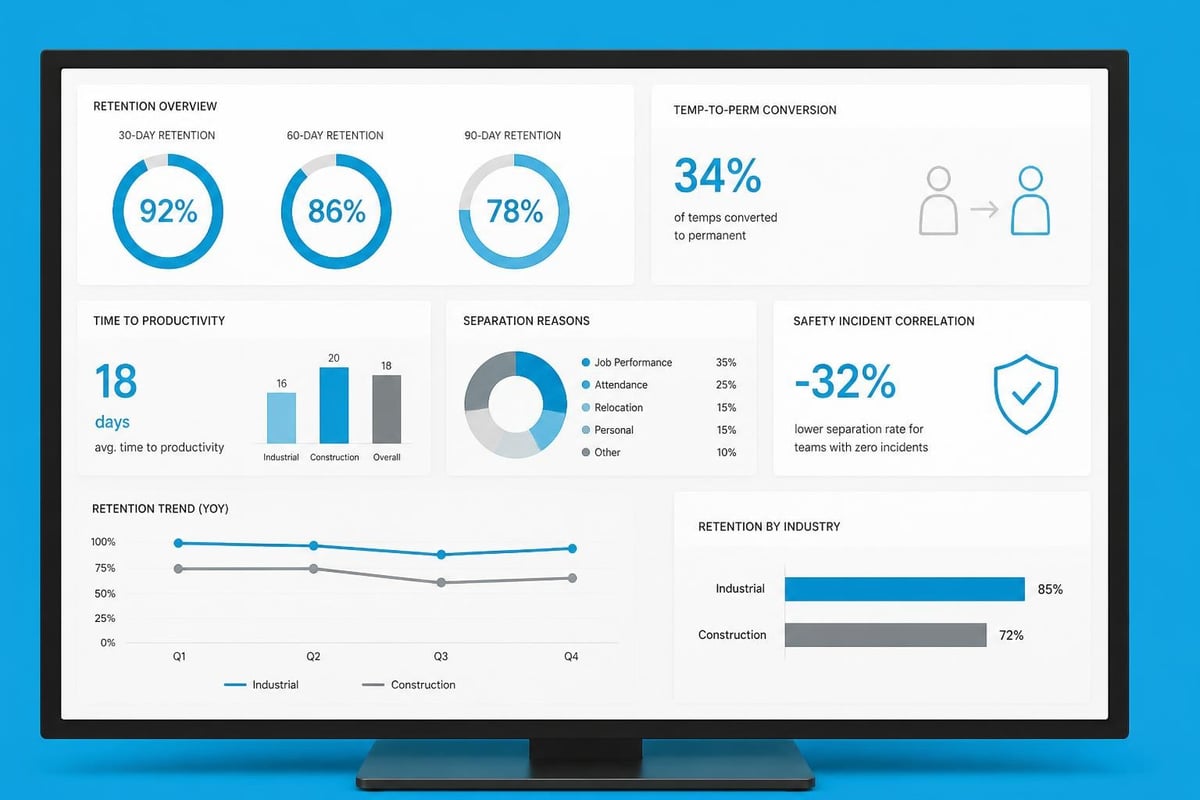
Premium staffing partners provide visibility into retention metrics you might not track internally. Does a staffing agency improve employee retention through data? Yes, by making retention measurable and manageable.
Agencies track:
- Time-to-productivity for placed workers
- 30-60-90 day retention rates
- Conversion rates (temp-to-perm)
- Reasons for early-stage separations
- Client satisfaction and repeat placement rates
- Safety incident rates for placed workers
This data reveals patterns. Perhaps workers placed on second shift show higher retention than third shift. Maybe certain supervisors retain workers better than others. Perhaps workers from specific backgrounds or with certain certifications stay longer.
Actionable intelligence drives retention improvement. Without data, you're guessing. With staffing agency analytics, you're optimizing.
Industry-Specific Evidence: Healthcare and Industrial Parallels
Does a staffing agency improve employee retention across different sectors? Research published by the National Institutes of Health on nursing homes' use of staffing agencies reveals interesting parallels to industrial staffing. While some fear agency reliance creates instability, evidence shows that strategic agency partnerships actually support workforce stability when used to manage fluctuating demand rather than replace permanent recruiting entirely.
The industrial, construction, and maritime sectors mirror this pattern. Agencies don't replace your talent strategy; they enhance it by providing flexibility, specialized access, and quality screening that improves overall workforce stability.
According to the CIPD Resourcing and Talent Planning report, organizations with mature contingent workforce strategies report better overall retention metrics than those relying exclusively on direct hiring.
The Conversion Economics: When Temp Workers Become Permanent Stars
Let's address conversion directly. Many employers worry about fees associated with temp-to-perm conversions, but the retention ROI justifies the investment completely.
Compare these scenarios:
Scenario A: Direct Hire
- Job posting and advertising costs: $1,500
- Recruiter time (internal HR): 40 hours
- Interviews and assessments: 15 hours
- Background and verification: $400
- Risk of bad hire: 30-40%
- Time to productivity: 60-90 days
- 6-month retention rate: 65%
Scenario B: Temp-to-Perm Conversion
- Staffing agency fee: Variable (often 15-25% of annual salary)
- Worker already proven and productive: Day 1
- Risk of bad hire: Under 5%
- Time to productivity: Immediate
- 6-month retention rate: 85-95%
The conversion fee isn't an expense; it's insurance against the catastrophic cost of a bad hire. You're paying for certainty, quality, and retention.
Regional Expertise and Local Market Knowledge
Does a staffing agency improve employee retention through regional expertise? Absolutely, especially in specialized markets like the Gulf South. Understanding local labor markets, wage expectations, commute patterns, and cultural factors dramatically impacts placement success.
At CDR General Services, our deep Louisiana, Mississippi, Alabama, and Kentucky expertise means we understand:
- Competitive wage rates by parish and county
- Commute tolerance in rural versus urban areas
- Industry-specific employment patterns (petrochemical, shipbuilding, construction cycles)
- Cultural expectations in diverse communities
- Bilingual workforce availability and deployment strategies
This local intelligence ensures placements make sense for both worker and employer, reducing early-stage turnover from mismatched expectations or unrealistic commutes. Hiring workers in specific regions like Baton Rouge requires understanding the local talent landscape in ways national recruiting firms simply cannot match.
Safety Culture and Retention Connection
In industrial and construction environments, safety culture directly drives retention. Workers don't stay where they feel unsafe. Experienced, safety-conscious workers are precisely the ones you want to retain.
Does a staffing agency improve employee retention by prioritizing safety? Premium agencies absolutely do. Safety-first staffing means:
- Placing only OSHA-certified workers
- Conducting safety-specific orientation before placement
- Matching workers to appropriate experience levels (no inexperienced workers in high-risk roles)
- Following up on safety incidents and near-misses
- Maintaining relationships with safety-conscious clients only
When workers see their staffing agency takes safety seriously, they feel valued and protected. This builds trust and loyalty that translates directly to retention, whether temporary or permanent.
FAQ: Does a Staffing Agency Improve Employee Retention?
How does a staffing agency improve employee retention compared to direct hiring?
Staffing agencies improve retention through rigorous pre-screening, skills verification, cultural fit assessment, and temp-to-perm pathways that allow both employer and employee to evaluate fit before permanent commitment. This reduces mismatched hires, which are the primary driver of early-stage turnover.
What is the typical retention rate for workers placed through staffing agencies?
Retention rates vary by industry and placement type, but temp-to-perm conversions typically show 85-95% retention at six months, compared to 60-70% for traditional direct hires. Permanent placements made through agency screening often exceed 80% one-year retention when proper onboarding support is provided.
Does using a staffing agency cost more than direct hiring when considering retention?
When you factor in the cost of turnover (recruiting, training, productivity loss), staffing agencies typically deliver better ROI. A direct hire that leaves within 90 days costs 2-3 times more than an agency placement fee, especially when the agency guarantees replacements for early separations.
How do staffing agencies support workers during the critical first 90 days?
Quality staffing agencies maintain active relationships with placed workers, conducting regular check-ins, addressing concerns proactively, resolving workplace issues before they trigger resignations, and providing ongoing support that internal HR teams often lack bandwidth to deliver.
Can staffing agencies help retain my existing permanent workforce?
Yes, by providing surge capacity during peak periods, staffing agencies prevent burnout and excessive overtime among your permanent team. This workforce flexibility protects core employees from the stress and exhaustion that drive turnover.
What industries benefit most from staffing agency partnerships for retention?
Industrial, construction, maritime, logistics, and manufacturing sectors see the strongest retention benefits because these industries require specialized certifications, safety-critical skills, and often face cyclical demand that makes permanent-only staffing inefficient and retention-damaging.
How does cultural and language fit affect retention in staffing placements?
Cultural and language fit is critical. Workers who can communicate clearly, understand safety instructions in their preferred language, and feel culturally respected show 40-50% better retention than those placed without consideration for these factors. Bilingual staffing expertise is a decisive retention advantage.
Do temp-to-perm workers stay longer than direct hires?
Yes, significantly. Workers converted from temporary to permanent status after a successful trial period stay 40-60% longer on average because both parties made fully informed decisions with no surprises about job demands, culture, or expectations.
How can CDR General Services help improve our employee retention?
CDR General Services delivers unmatched retention outcomes through our Spanish specialty staffing expertise, rigorous safety-first screening, deep Gulf South regional knowledge, and temp-to-perm pathways that ensure perfect fit before permanent commitment. Our bilingual workforce solutions and certified skilled trades talent eliminate the hiring mistakes that drive turnover.
Does a staffing agency improve employee retention? The evidence overwhelmingly supports strategic staffing partnerships as powerful retention tools when quality, screening, cultural fit, and ongoing support are priorities. The key is partnering with a staffing provider that understands your industry, prioritizes safety, and brings specialized expertise others cannot match. CDR General Services combines unparalleled Spanish-speaking workforce access, certified skilled trades talent, and deep Gulf South expertise to deliver retention outcomes that transform your workforce stability. When you're ready to reduce turnover, accelerate hiring, and build a sustainable team across Louisiana, Mississippi, Alabama, and Kentucky, CDR General Services delivers the decisive staffing advantage your operation demands.
Published September 22, 2026 by Sanya
All articles


