

A marketing staffing agency recruits, screens, and places marketing talent with your business on a temporary, contract, or permanent basis, so you fill roles faster than a direct search allows. The right one handles sourcing, vetting, and compliance while you keep control of the work. The wrong one hands you a stack of resumes and a bill.
Here is how to choose well, what to demand, and where the line sits between a marketing hire and the workforce roles that keep an industrial operation running.
What Does a Marketing Professional Do?
A marketing professional plans, runs, and measures the activity that brings customers to a business: campaigns, content, advertising, email, events, search visibility, and reporting on what worked. The title covers a wide range, from a coordinator scheduling posts to a director setting budget and strategy.
For staffing purposes, you need to separate the roles by function:
- Content and communications: writers, editors, social media managers
- Digital and performance: paid search, SEO, email, marketing automation specialists
- Analytics: reporting analysts who tie spend to revenue
- Brand and creative: designers, brand managers, video producers
- Marketing operations: the people who manage the tech stack, CRM, and workflows
Knowing which bucket your gap sits in determines whether you need a short-term contractor or a permanent hire. A trade supplier launching a regional campaign needs a contractor with a defined deliverable. A company building an in-house team needs a permanent placement.
Why Companies Use a Marketing Staffing Agency
Companies use a marketing staffing agency because speed, specialization, and flexibility are hard to build internally. A job posting can sit for weeks and pull hundreds of unqualified applicants. An agency maintains a bench of pre-screened candidates and a recruiting process that runs before you ever ask.
The skills gap is real. The American Marketing Association's 2025 skills report, based on a survey of marketing practitioners, analysis of job postings, and expert interviews, identified digital marketing, data and analytics, proving ROI, and data privacy and compliance as the largest current competency gaps. Those are exactly the skills that are slow to find through a standard posting.
The same report found that a large share of respondents expected generative AI to become more important to marketers' work over the following five years. Agencies that track hiring trends can screen for candidates who already work with these tools, which saves you from training someone on the job.
Three situations make an agency the smart call:
- A sudden vacancy that leaves a campaign unmanned
- A seasonal or project spike that does not justify a full-time salary
- A specialized skill you need once, such as a rebrand or a website migration
What to Look For When Choosing an Agency
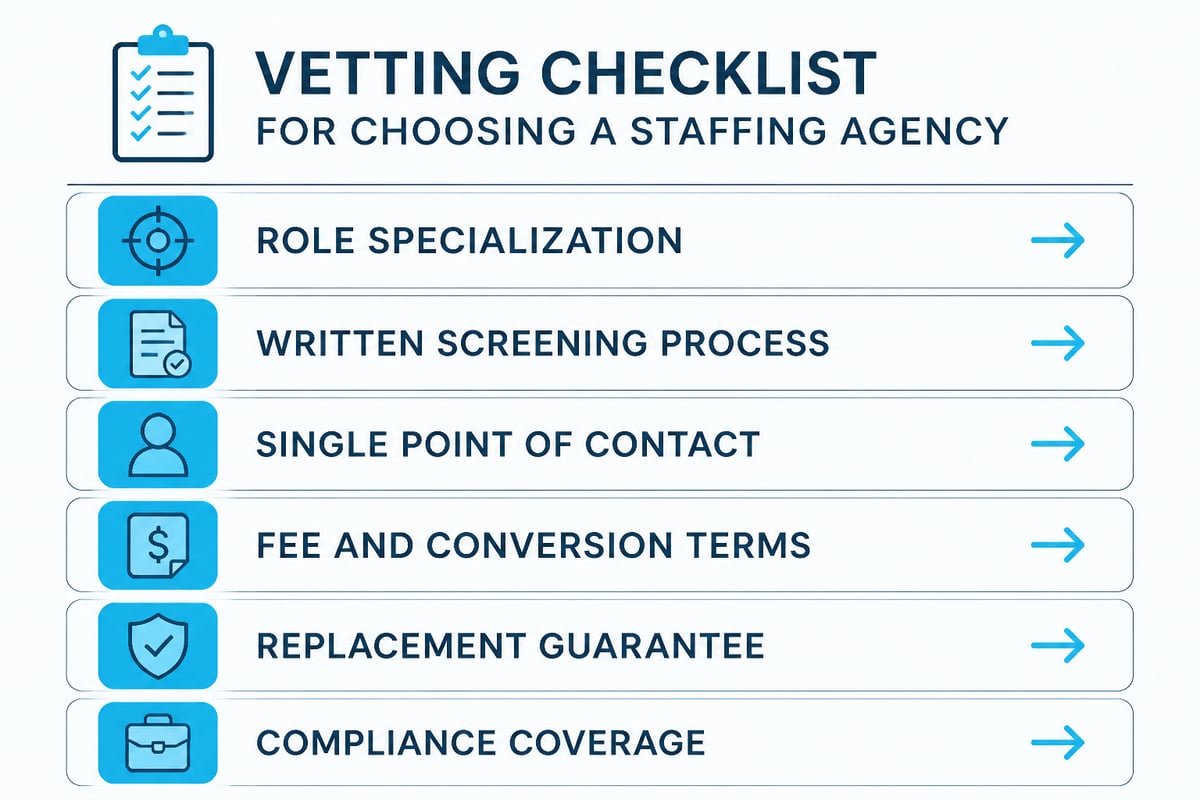
Choose the agency that proves its screening process, specializes in your type of role, and gives you one accountable contact. Everything else is marketing copy.
Specialization and Candidate Quality
Ask how many of their last ten placements matched your exact role type. A generalist firm that places accountants, drivers, and designers equally will screen all of them equally thin. A specialist can tell a paid media buyer from a content strategist in a ten-minute call.
Ask for the screening steps in writing. Credible agencies verify work history, test practical skills, and check references before a resume reaches you.
Process and Communication
You want a single point of contact from request to placement. When you brief one person, that person owns the outcome. When your request passes through three departments, details get lost and timelines stretch.
Transparency on Cost and Terms
Get these in writing before you sign:
- The markup or fee structure
- The conversion terms if you want to hire a contractor permanently
- The replacement guarantee if a placement does not work out
- Who carries payroll, insurance, and workers' compensation
Which Company Is Best for Recruitment?
The best recruitment company is the one that specializes in the roles you need to fill, shows a documented screening process, and has a track record in your region. No single firm wins across every industry, so a national brand name matters less than fit.
Test a shortlist against your own scorecard. Score each candidate agency from one to five on:
| Criterion | What to Ask |
|---|---|
| Role specialization | How many placements in my exact role type last year? |
| Screening depth | What gets verified before a candidate reaches me? |
| Speed | How long from request to first qualified candidate? |
| Accountability | Who do I call when something goes wrong? |
| Compliance | Who handles payroll, insurance, and legal exposure? |
Agencies that answer the speed question with a vague "it depends" have not measured it. Pick the one that gives you a number and a named person.
How the Working Relationship Runs
A productive agency relationship runs on a clear brief, fast feedback, and a defined trial period. You do the first part; the agency does the rest.
Write a Brief That Gets Results
A strong brief includes the deliverables, the tools the person will use, the reporting line, the budget, and the duration. "We need someone for social" produces mismatches. "We need a paid social specialist to manage $15,000 a month in ad spend and report weekly to our director" produces a shortlist.
Give Feedback Within 48 Hours
Candidates take other offers. When you sit on a shortlist for a week, the best people disappear. Fast, specific feedback also teaches the agency what you actually want, so the second round improves.
Treat Contractors Like Teammates
Contract talent performs better when they get access to the same briefings, tools, and context as your staff. Treat them as outsiders and you get outsider-level output.
Legal and Compliance Questions
Using an agency does not remove your legal exposure. The U.S. Equal Employment Opportunity Commission states in its enforcement guidance on contingent workers that workers placed by staffing firms may qualify as employees of the staffing firm for purposes of federal anti-discrimination laws. In practice, that means both the agency and your company can share responsibility for how a placed worker is treated.
Protect yourself with a short list of controls:
- A written agreement defining who handles payroll, benefits, and workers' compensation
- A clear policy on harassment and discrimination that covers placed workers
- Documented job duties so classification stays clean
- A named contact at the agency for complaints
If your operation spans several states, confirm the agency is licensed and insured everywhere your worker will actually perform the work.

Where Industrial Employers Fit In
If you run an industrial, construction, or logistics operation in the Gulf South, you probably need a marketing hire far less often than you need a dependable workforce. Those are different problems with different solutions, and mixing them up wastes budget.
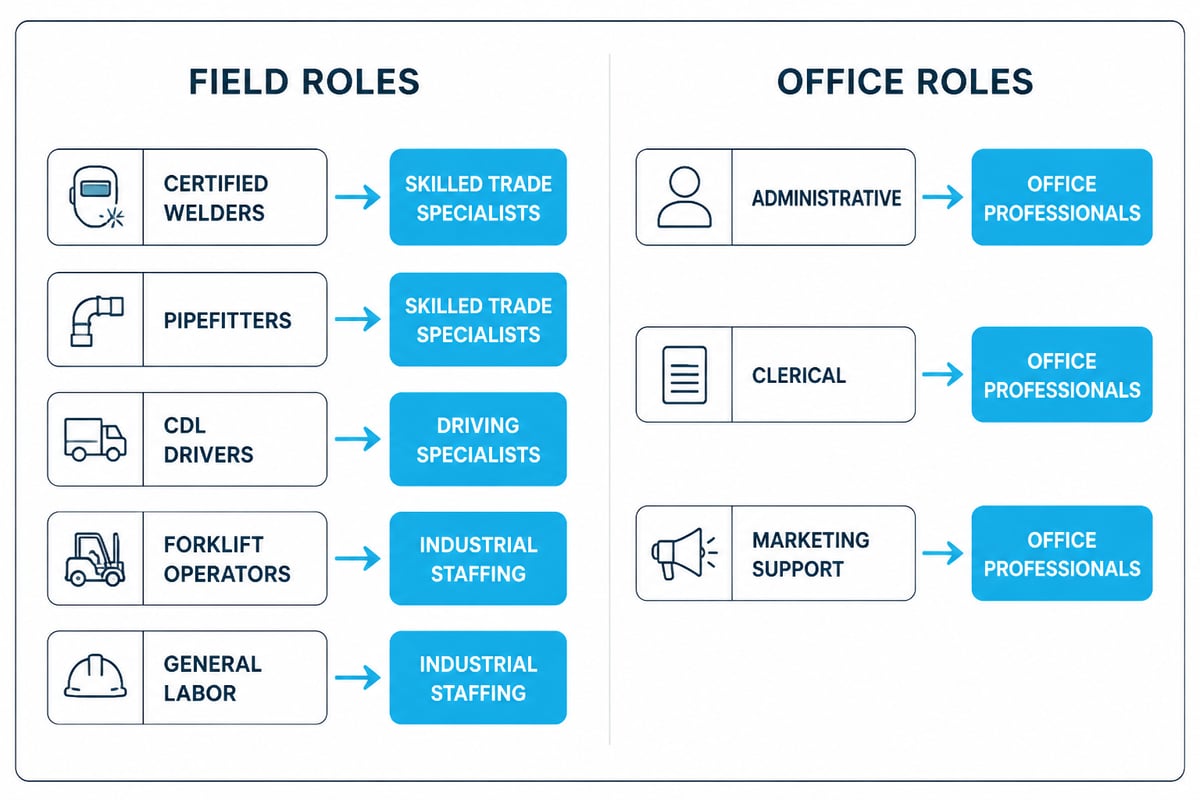
A regional contractor might bring in a part-time marketing specialist twice a year to refresh a website and push a bid campaign. That same contractor needs certified welders, equipment operators, and general labor every week. The staffing partner for the second need must verify certifications and train for safety, which a creative recruiter is not built to do.
CDR General Services covers that workforce side. Every worker is certified and receives ongoing safety training, and the team runs regular safety visits across its job sites. You get one point of contact from request to placement, plus access to a multicultural, bilingual workforce that scales up or down with the project. As a minority-owned firm with local expertise across the Gulf South, the company supports employers through its staffing agency in Louisiana services, and it can route you to CDL staffing when drivers are the bottleneck or to a logistics temp agency model when warehouse volume surges.
For office coverage that supports your operation, such as scheduling, dispatch support, and records, Administrative & Clerical Staffing supplies office professionals for daily administrative and management tasks.
How to Get Clients for Your Staffing Agency
If you run a staffing agency yourself, you win clients by owning a niche, proving results with specifics, and staying in front of the hiring managers who feel the pain. Generic outreach to every employer gets ignored.
A workable approach:
- Pick a lane. Specialize by industry, role type, or region so your pitch is instantly relevant.
- Publish proof. Case summaries with time-to-fill and retention numbers beat claims about "quality."
- Work referrals first. Satisfied clients and placed workers are your cheapest lead source.
- Be findable locally. Pages built around your service area and sector capture the employers searching for exactly what you do.
- Follow up on a schedule. Most deals close after several touches, not one.
Recruiter workload is the quiet constraint. Tools such as NoRecruit.com automate sourcing, candidate data enrichment, and outreach across email and LinkedIn, which frees recruiters to spend their hours on client conversations instead of admin.
Red Flags When Evaluating an Agency
Walk away when you see these signals:
- No written screening process. If they cannot describe it, it does not exist.
- Pressure to sign fast. Good agencies win on results, not urgency.
- Hidden fees. Conversion charges and minimum-hour clauses should be explained up front.
- No replacement guarantee. A placement that fails should cost you nothing extra.
- Multiple handoffs. You should never have to re-explain your need to a new person.
Reference checks work in both directions. Ask for two current clients in your sector and call them. Ask what went wrong and how the agency handled it. That answer tells you more than any sales deck.
Measuring Whether the Agency Is Working
Track four numbers from the first placement: time to first qualified candidate, time to fill, 90-day retention, and the hiring manager's satisfaction score. Review them after the first three placements. If time to fill is slipping or retention is weak, address it directly with your account contact before the relationship drifts.
FAQ
What does a marketing professional do?
A marketing professional plans, runs, and measures the activity that brings customers to a business, including campaigns, content, advertising, email, and reporting. Roles range from coordinators to directors who set budget and strategy.
Which company is best for recruitment?
The best recruitment company is the one that specializes in your role type, documents its screening process, and has proven results in your region. Compare shortlisted firms on speed, screening depth, accountability, and compliance coverage.
How do I get clients for my staffing agency?
Specialize in a niche, publish proof such as time-to-fill and retention results, and build referral relationships with satisfied clients. Local, sector-specific content helps employers find you when they search.
How long does it take a staffing agency to fill a role?
Timelines vary by role and market, so ask each agency for its average time to first qualified candidate and time to fill. Agencies that have measured these numbers will give you specifics.
Can I hire a contractor permanently after a trial?
Many agencies allow conversion from contract to permanent, but terms and fees differ. Confirm the conversion terms in writing before you sign.
Does an agency handle payroll and insurance for placed workers?
Typically the agency acts as the employer of record for payroll and workers' compensation, but the agreement must say so explicitly. Federal guidance indicates responsibility for anti-discrimination compliance can be shared with the client company.
How do I know if a staffing agency's screening is real?
Ask for the screening steps in writing and for two client references in your sector. Genuine screening includes work history verification, skills testing, and reference checks.
Should an industrial employer use the same agency for office and field roles?
It can work if the agency has real depth in both. CDR General Services staffs certified industrial, construction, and logistics workers alongside administrative and clerical professionals, so contact the team to plan your full workforce under one point of contact.
Where can I get a safety-certified, bilingual workforce in the Gulf South?
CDR General Services provides certified, safety-trained workers, including a multicultural, bilingual workforce that scales with your project. Reach out to hire CDR General Services for your staffing needs across Louisiana, Mississippi, and Alabama.
Start today by writing a one-page brief that separates your marketing needs from your field and office workforce needs, then match each to the right partner. For the office side, Administrative & Clerical Staffing gives you professional support staff, and for the certified trades, drivers, and general labor your projects run on, CDR General Services can map out your needs when you Request a Workforce Plan built around your timeline, your sites, and your safety standards.
Published November 13, 2026 by Sanya
All articles